

Joseph Mikhael, MD:
Beth, come on up. My wife calls Beth "sparkly" because she is a sparkly person. And Beth, take it away, my friend. Take it away.
Beth Faiman, CNP:
Thank you so much, Dr. Mikhael. Hello, everyone.
One of the first times I interacted with Dr. Mikhael was in 2013. He wrote these Mayo consensus guidelines. He was the lead author. And then I met him in person. I thought he would be larger than life, and he's just so down to earth, extremely knowledgeable and giving of his time. So we really appreciate him being with us.
And I'm Beth Faiman. I'm a nurse practitioner, one of the founding members of the Nurse Leadership Board in 2006. I keep wanting to say, "2005." It was just a meeting to get together and put all the heads, 20 of us, in one room to think about what's the best way to help patients and help educate nurses to give good care to patients? And I'm just so honored and blessed to have had all these years of experience with Diane Moran, who you might know here, and she supported us.
We're going to talk about patient empowerment, participating in shared decision-making. This is a topic that I'm very passionate about. I feel like there's this paternalistic model. Doctors say, "I know what's best for you. I think you should take this treatment." And sometimes they're right, but not always are they right.
Who here made a decision today? No one. You got up, you decided to come here, where to sit, what to wear. These are all parts of decision-making. Those are your decision-making. But it gets a little bit more complicated when myeloma is concerned.
This is what we're going to talk about today. We're going to review what is shared decision-making, a very practical guide to how you can take part in your own care, identify influencing track factors to treatment decision-making. You might sometimes think you don't have all the information. Maybe you think you have all the information, I don't know, but there's some strategies we'll discuss for you and you can share with your support group members or friends or family. Because even like in internal medicine, in primary care, there's discussions about, "Do I take this cholesterol medicine, this antibiotic, this medication?" And so that's really important. We'd like you to be on Dr. Joe's favorite drug, nada, because you'll have great compliance, but we have to get through it.
So one of the things that we try to achieve, most of us, in the myeloma space is patient-centric care. I've worked for Cleveland Clinic for 30 years, and for those 30 years, that's really been one of our mantras and that's what I try to portray for my patients. And the aim of shared decision-making is to ensure that the patients understand their options. You mutually share goals. We want to do best by you as healthcare providers, but we also need to make sure that you have all the information.
This is a share model and this is by the Agency for Healthcare Quality and Research. And actually, in many different areas in internal medicine, primary care and other specialties, insurance requires that you have documented these shared decision-making discussions in the medical chart for reimbursement purposes. For example, one of the recommendations is that we should be seeking your participation, ask if you want to be involved in the discussion of decision-making. Then we need to help you explore your different options. Do you want to take a bispecific antibody or CAR T-cell therapy? And there's just so many options. We need to break it down for you and give you reasonable options that you might have that you can discuss with your care partners, friends, family, or whoever your support system is.
We need to then, as healthcare providers, assess your values and preferences. Do you want pills at home? Do you want shots in the infusion area? What are the costs associated with these therapies? We need to be discussing that.
And then we reach a decision, and we don't just stop there at reaching a decision, "We're going to take treatment A, B, or C," or, "we're going to do test A, B, or C." We're then going to evaluate and reevaluate those decisions. And so this is a very agreed-upon model of care that we enact in my institution, and Dr. Joe does this. Dr. Hillengass is in the audience too, and I'm sure he does this at Roswell Park, and we want to involve everybody.
What are some of the steps in the decision-making process? I shared with you a model of what healthcare providers should be considering, but we have to identify that a decision is needed. Looking at your myeloma labs regularly, every month or every two months, whatever trajectory you're on, wherever you are in your treatment, maybe you're just smoldering or MGUS, and we're watching your labs before you need treatment. We need to identify that a decision is needed. And it can be a lab test, a PET scan, a bone marrow biopsy. It doesn't have to be treatment-related, but it could be around the whole myeloma care.
I like this menu that was on there. Teresa Maselli helped share some of these slides with me and she put this menu. I don't know where she got it, but when I look at the decision of what to order on this menu, I take into account a lot of different factors. And I don't know how I would arrive at a decision without consulting with somebody else.
Understanding the treatment options. We want to make sure that the healthcare provider is sharing the evidence-based options. Dr. Joe is going to share some more information, but he also shared some updates of new drugs, and that was because people enrolled in clinical trials, and clinical trials haven't gotten us to where we are in 2025 with the explosion of new therapies in the last 20 years without giving patients the risks, the benefits, and alternatives to the standard treatments that are available and the experimental treatments. And again, we can talk all day about clinical trials, I think that'll come up later on as well, but it's a wonderful way to get access to medications that you otherwise wouldn't have access to. We'll talk about that again another time.
And then come to a decision and follow up. As I mentioned in that share model, we always want to reevaluate the decision. Once you arrive at a decision, it's not written in stone. You can change your mind at any time. You can ask questions at any time and you shouldn't feel bad. Sometimes people don't want to offend their provider. Go talk to a nurse then, the nurse will guide you through it, or talk to a different healthcare provider, maybe your primary care provider you have a better rapport with than a new oncologist that you just started seeing. Find somebody in the practice that you work with that you feel comfortable with.
What are the benefits of shared decision-making? Many, many years of research have gone into this concept. It started in Europe and the UK. They do a lot of shared decision-making over there as well as coming over to the United States. But regardless of cancer, neurology, other domains, there have been a lot of research that says patients really, in most cases, want to have a say in their treatment. And for many reasons they might not have a say in their treatment, and it could be as easy as asking for a second opinion. So hopefully you have a myeloma specialist, hopefully you have a local oncologist to save you from driving back and forth, but making sure that you can find people that you feel comfortable with in discussing your concerns is really important.
Shared decision-making reduces uncertainty. It enhances adherence. Drugs don't work if people don't take them, right? If you don't believe you need a drug, it's not going to work. Simple things like acyclovir, we give that as an antiviral. For many of those of you in the audience who are on certain therapies have to be on acyclovir, for example. I have patients that say, "I just don't know if I need it." It's not that they didn't care or they didn't want to take it, they just didn't understand why we were recommending it. So it's just as easy as asking questions and discussing it with your healthcare team to make you feel more comfortable.
Shared decision-making requires staying informed. So coming to patient family seminars, logging into Living Well Series from home, the International Myeloma Foundation has so many resources, as you can see and you'll hear over the next two days. Think about how some of these resources you hear might help you after you leave this room, after you leave the conference this weekend.
And it can have a positive impact on quality of life. Feeling like you have a say in what goes on in your healthcare, I feel like that's so valuable. I want you to feel like if I'm your provider, or whoever your provider is, that you feel like you have a good rapport and can discuss anything.
Now, there's many factors that can influence what you may or may not be able to do or what you might say. There may be a point in your treatment where Dr. Joe or your oncologist might say, "You know what? I think this is the best thing for you. I'm not sure that there's any better options right now, but let's talk about something later on. But right now, I really think we need to do this." And that's okay. You can still ask questions, you can still consult with other people, and make sure that you feel comfortable and that decision sits well.
But there can be disease-derived, that would be an example of maybe your disease diseases progressing rapidly and we need to make a decision and this is what they think is the best drug for you. It can be patient-derived, and then it can be provider-derived. So again, all of these, without going into great detail, are factors that will go into those decision-making.
What are some more strategies? The International Myeloma Foundation works so hard to make these beautiful resources and they are available online. You can request them to be sent to you, but it's really cute. I don't know if you've ever gone to the website and they have this thing where you click on it and it looks like a book that's turning. If you have a Kindle or an iPad, you can actually feel like you're reading the book without having the paper book in front of you.
But you can seek the information, reach out to the info line, and most of you walking around, I saw some people trying it early on, Milo. There's an iPad station out there. You can ask Milo anything. And Milo is the chatbot that has valid information that's fed to it so it doesn't hallucinate. You heard about those hallucinations that the AI has some from time to time. It doesn't hallucinate as much as some of the other AI from like ChatGPT and non-reputable websites. It gives you some really good information.
Be involved in your care. When I see a new patient with myeloma, and oftentimes, hopefully I'll be able to see them with MGUS and then follow them if they smolder, offer them clinical trials, build up a relationship, but I encourage everybody to get a notebook. I even have notebooks in my office I can just hand to them, but I ask them to keep a journal of their symptoms, keep a list of the appointments that you go to for the kidney doctor, heart doctor, blood pressure doctor, internal medicine doctor.
Stay up to date on health maintenance because survivorship starts at diagnosis. And as you heard from Dr. Joe, we had a recent study that showed that a third of patients that were very, very sick that got a single dose of an infusion called cilta-cel CAR T are still in an excellent remission many years later.
That's just one therapy. We have bispecific antibodies, we have standard treatments. Many of these have really revolutionized the myeloma space, and you'll hear about those today, but it gets overwhelming. And if you can't remember what happened when you took this drug, but you have your journal, you can go back to volume one or two or three, then we can go back together and see what happened.
There's no I in team. If you spell it the word team, T-E-A-M, there's no I in team. And so that's what I tell my son who's on a hockey team, "It's about a group effort," and that's what I tell my patients. "I'm not the only person you're going to see. I'm a nurse practitioner and I have a physician or two or three that might work with you. And then I have nurses, social workers, financial counselors." How many of you here know who's on your team or how to get a hold of them? I have a couple people. Okay, more hands. Thank you. Phew, you know how to get a hold of your team.
So there's different roles, but sometimes the roles overlap and that's okay. The myeloma specialist and the general hematology oncology doctor, that's one of the questions I get from my patients. If they come to see me for a consult, sometimes they feel bad, they don't want to offend the doctor because they got a second opinion. And I say to them, "No, I'm glad you came because that way we can collaborate in your care." Now they have these electronic medical records in many areas of the country and actually in some parts of the world that talk to each other. We have these portals called MyChart or MyCare or whatever your system shows. We can communicate electronically, we can communicate with your other local doctors electronically. There may be some overlap. And if there's ever a difference in opinion, we're going to talk about it.
So if I am recommending or my team's recommending treatment A for you and you feel comfortable with treatment A, then I would call the local doctor. I say, "You know what? We discussed this case at our board meeting. We discussed this case with our patient, and we're recommending this." And nine times out of 10, they are very comfortable with that. It's that discussion and that communication that's really important.
Primary care, people are living longer than ever. We don't want to get your myeloma in a good remission or have a functional or good cure... I use the word cure these days because if you don't have any evidence of disease for 10 years and you're still in a remission, that's a functional cure. That is just as good as we can get for diabetes. You get controlled hypertension, and that's okay. We have good control of the disease, but we don't want to work so hard to get you in that good remission and then have a high blood pressure crisis or coronary artery disease that goes untreated or a new colon cancer.
So making sure that you involve your primary care provider and their team is really important to make sure that we're not missing because sometimes they think I'm checking vitamin D levels or vitamin B levels and all that other regular stuff. I'm really focused on the myeloma. And while I do that for some of my patients, I'm still very much encouraging that they participate in regular discussions with their primary care.
And then subspecialists, it takes a village to keep people healthy. There are some concurrent conditions that can occur. For example, if you take steroids, who's been on steroids here? Lots of people probably. It can cause mood swings, high blood sugar, bone loss. We're going to hear from Michaela about the importance of bone health later on and functional movements and such. And so there's all these things we have to think about from an endocrinology perspective, from a psychiatric perspective. So making sure that you identify people that can help you through any of these things is really valuable. And then staying connected, keep a list of your providers, names, dates, et cetera, for sure.
Preparing for medical visits, as I mentioned, I encourage everybody to get a journal. And now some of these people are walking in with an iPad and they take notes on their iPad. That's more than I do, but I think that that's really wonderful because it's a written electronic account of all their symptoms, all their concerns, all of their labs, and they come prepared because we only have a limited time. I get a half hour per person, which I think is great. Some providers only get 15 minutes, but I'm fortunate to have the time, but I still want to be good with that time. I want to get to know what they did this weekend, where they're traveling to next, how their grandkids are doing, and then I also want to talk about their healthcare as well.
So prepare a list of your medications, if you had any hospitalizations, surgeries, or anything in between, make sure that you have your questions. Prioritize your questions for the top list of the most important ones, and then we try to make sure that I know that you have a list of 20 questions. Before I chit-chat and talk about their weekend or their cruise, I'm going to go through your questions and make sure to address all your most important things.
The paperwork, if you have any medical signatures that are required, make sure that we get that to the right people in the office. We want to inform any of the updates, as I mentioned, any of the new symptoms. I now have this AI tool. So when I go in the office, they're recording everything, and I thought, "Gosh, people aren't going to want to be recorded," but when I'm done with the visit, it spits out this wonderful after-visit summary. Does anybody get an after-visit summary? And I am so... I want to focus on our visit, so I don't type that fast. And what's so nice about it is I forgot that I talked about their left toe was hurting, and then it's in the after-visit summary, "Make sure you keep an eye on it," or, "see a podiatrist if it gets worse." And so it's really nice.
So if you have a provider that you see, see if they have options to give you an after-visit summary so you can remember what was discussed. And I'm going to continue using my AI technology for whoever. Nobody said that I couldn't record them, by the way. I mean, I feel like I wouldn't mind either, but definitely see if you can get a written summary after your visit, and then follow up next steps. When you're in to see the doctor or the team, "What's my next step? When is my lab work due? When's my next treatment? How do I schedule it? Who schedules it for me? Do I have to do it myself?" Making sure those answers are taken care of for you.
I'm very passionate about telehealth. Telehealth is something that's been around for many years. My husband actually is director of telehealth for a company that's based in the Southwest, but we live in Ohio, but he helped to develop a portal at Cleveland Clinic. And so early on, I saw the benefits of people not having to drive four hours to see me because I was then able to start offering them telehealth services. And what a nice way to follow up after you've had CAR T or bispecific antibody, or if you're in a nice, long remission, you can live a half hour down the street or a half a mile down the street and not want to get out of your house, pay for parking, go through the stress of actually going into a cancer center.
So if that's something that might be right for you, see if your provider gives virtual health visits. I have some people now that never want to see me in person because we have so much fun just doing the face-to-face telehealth. I get a half hour, I see the cat sitting on their shoulder, and I get to see the kids will pop in and say, "Hi," and it's just really nice to be able to discuss it with them in their environment where they tend to be a little bit more relaxed and more willing to open up about their concerns.
But again, check with your healthcare team. See if telehealth or telemedicine is an option. Most payers are still reimbursing because it's considered a face-to-face visit. See what the technology is that's required. Most of the time it's a Zoom platform for most of the platforms across the United States right now. "What's the process? What's the technology needed?" And there are some test calls that you can do. There's always some information that can be provided from that institution that you're going to do the telehealth on, but try to get into a quiet location. Don't be driving down the street when you're trying to do your telehealth visit.
And if it's a time that's not right for you, reschedule it. We want you to be feeling comfortable. And I know some healthcare providers are not as flexible with their schedules in person, but they tend to be a lot more flexible with the telehealth because they can be at home and do a telehealth visit while you're at home and doing a telehealth visit.
What's nice about it too is I can get you labs locally or imaging locally, and then we can, a week later, do that virtual visit. In a week, I probably see each day four or five patients out of my 15 patient-a-day schedule, I see four or five virtually and it's the best part of my day. No, I love people inpatient too. I love people in-person, but I really like to connect virtually too.
Creating a care network. We had discussion about not everybody has a care partner, and that's what we call somebody who's a partner in your care and somebody there to help out. In many cases with CAR T-cell therapies, bispecific antibody therapies, and some of the newer drug regimens, you need somebody that's able to support you a little bit more. We've identified some rotating caregivers. We also have a program, my institution, that identifies maybe some patients in the support group that say, "Okay, I'll come and I'll drive you to your appointment or pick you up from your appointment if you need a ride" sort of thing, but trying to create a care network the best you can.
And Robin had shared with you that there's a support group for people that are sole partners. And I've heard some really wonderful stories at the Support Group Leader Summit in Minneapolis a couple weeks ago. I heard some really great stories and success stories about being a single person and navigating the healthcare system by yourself, so it can be done. And don't forget to ask the IMF and maybe join in that support group if you want some more information.
But for those of you that have care partners, they can assist in many ways, but sometimes they don't know how to help. So if you are a support system to a loved one, there's some tips here that you can talk, such as just attending medical appointments. And I see some people say, "You know what? I'm going to give you space in the room. I'm just going to sit in the lobby and have a cup of coffee while you go and have the one-on-one discussion." And so giving people space might be necessary as well, but knowing that you're there is important. As I mentioned, it can be one person or a rotation of people, and so building partnerships is really important. Having that second set of ears is nice too.
I talked a little bit about telehealth visits before, but another benefit of telehealth visits is that I have a patient in my area, but then their son is in Atlanta, their daughter is in Texas. We can all Zoom in together. That's a way of having a support systems and family join in without actually having to all physically be in the same place so they can all be supporting the parent or the grandparent and part of the care.
Oh, I'm going backwards. Don't do that. We got to keep going forward. Don't you love this cute little emoji guy?
So what are some key takeaways and things to think about? You're going to be here for a couple of days, so over the next two days, evaluate where you are in the shared decision-making process. How do you feel about your relationship with your provider? What can be better? Maybe it's great. Is there somebody else in the office that you might have a better rapport with and want to see more often? Many offices have people like me, an advanced practice provider, and how I work is they'll see the doctor once or twice, then they'll see me a couple times, and we rotate and flip-flop. So they get my opinion, they get their opinion, but we all share the same information. Sometimes they talk to the other provider about different things than they talk to about me. And so I think making sure that you have a team that you feel comfortable with and who to call and how to get a hold of them is important.
If you do have a MyChart, telehealth way of communicating side effects, symptoms, concerns through the portal in between, absolutely try to reach out that way. I love those MyChart messages coming in, and then it can help alleviate concerns if they get labs ahead of time and they're like, "My light chains look like they're up. What does that mean?" I say, "Oh, don't worry. We'll talk about it next week. I think it's fine." And so just that short interaction can make you be put at rest, and then we can talk face-to-face more about it the next visit, or if there is a need for a change in treatment, say, "Well, maybe we need to do a bone marrow biopsy or a PET scan. We're going to talk more about that next week." So again, that two-way communication is really integral to your care.
And then create questions that might give you more understanding about what the treatments might be or what is your future and how to plan for your future. If you want to take a vacation or visit loved ones in another city, go to Europe, we can have planned holidays. Absolutely. In most cases, if you're in a good remission, we can set you up to enjoy life. We want you to take that option. And so if you're too afraid to say, "I want to go to Europe for 10 days, it might mean that I'm missing treatment," at least bring it up to your healthcare provider. I have somebody that's always wanted to go to Italy and she's finally, her kids want to take her. I'm like, "Why wouldn't I let you go?" So I give them antibiotics, antivirals phone numbers of who to call. She's going to be fine.
So anyhow, I think that's all I have and I have no idea about my time. I think I have five minutes left for questions if anybody has any. Thank you for listening.
Am I allowed to offer questions, Michael? Michael, you're running. Don't you usually have microphones?
Michael:
I'm going to get a mic.
Beth Faiman, CNP:
Oh, okay, good. Thanks. Crystal clear. Oh, there, we got one over there.
Speaker 1:
Just take one too.
Beth Faiman, CNP:
Yes? The lights are so bright.
Speaker 2:
I know [inaudible 00:24:48]
Beth Faiman, CNP:
Yeah.
Speaker 2:
Okay. So my question is you mentioned that you might have 15 minutes, you might have 30?
Beth Faiman, CNP:
Yes.
Speaker 2:
Okay. So what determines whether I get 15 minutes with my myeloma specialist or 30 minutes?
Beth Faiman, CNP:
That's an excellent question. So for those of you that didn't hear about it, I said, "You might get 15 minutes, you might get 30 minutes," and it's set by the practice, number one. Also, if they have extra patients they have to add on.
So ask your provider, "How much time do you get with each patient? And does that ever change?" Because for people that need more time, I tell them, "Make your appointment in advance so I can spend an hour with you to discuss this topic." For survivorship, so I'm working on a survivorship initiative, so after you've had CAR T or bispecifics or a transplant, I'm setting an hour aside so that I can spend an hour going over your health, going over your care, what you got and what you could get in the future.
So talk to your provider and say, "How much do you get with a patient?" And sometimes you might feel like you need more time, sometimes less time. So just communicate what your needs are, and I'm sure they're going to do the best they can to help you there.
Speaker 2:
I'm having some... I talk pretty loud, but-
Beth Faiman, CNP:
Yeah. Well, there's people all the way back. So I think your question was would it make you angry if you needed some more time?
Speaker 2:
And if I put in the MyChart to y'all, like the day or two before and said, "Hey, my appointment's blank and I'm having some problems, I really would like to have a little more, 30 minutes. I'm hoping that we have a 30-minute appointment because I'd really like to discuss these fully with you"?
Beth Faiman, CNP:
Absolutely. And that's where the care team comes in. You might want to just be in front of that myeloma specialist for a full half hour, and some people aren't set up that they can do that. But that's why I bring in the whole care team approach because I have nurses, pharmacists, physicians, and social workers. Lots of people can sometimes address your questions.
So no that would not make me... We get it all the time. I work at Cleveland Clinic in Ohio, and we, because I work with about 12 different specialists, physicians, and then I'm at one of the nurse practitioners, but we encourage people to use the electronic communication because it allows us to prepare for your visit. So I say if you have something that you want to talk about and it's two in the morning and you can't sleep because it's bothering you, send it to us, and then I'll see it and then we can talk about it. I have people that do that all the time.
The other thing is that a lot of these electronic records are saying, "Oh, if you take too much time on this, we might charge you." You might've seen that too at some institutions. And so also just ask your healthcare team because mine's set up like that. It's just a generic message because sometimes people write really long messages, but then I explain to them, "No, we're not going to charge you for it. It's really geared towards people that don't see the doctor regularly or the provider, and they just want care electronically. They don't want to ever come in. It's not for myeloma patients."
So no, it wouldn't bother me if you had a list of questions ahead of time because then I might be able to go through some of those questions, and then even if we only have 15 or 20 minutes, then we can achieve it very efficiently.
Speaker 2:
Thank you.
Beth Faiman, CNP:
Thank you. That's my two cents. Dr. Joe might say something else, but we'll see. And I think we're good.
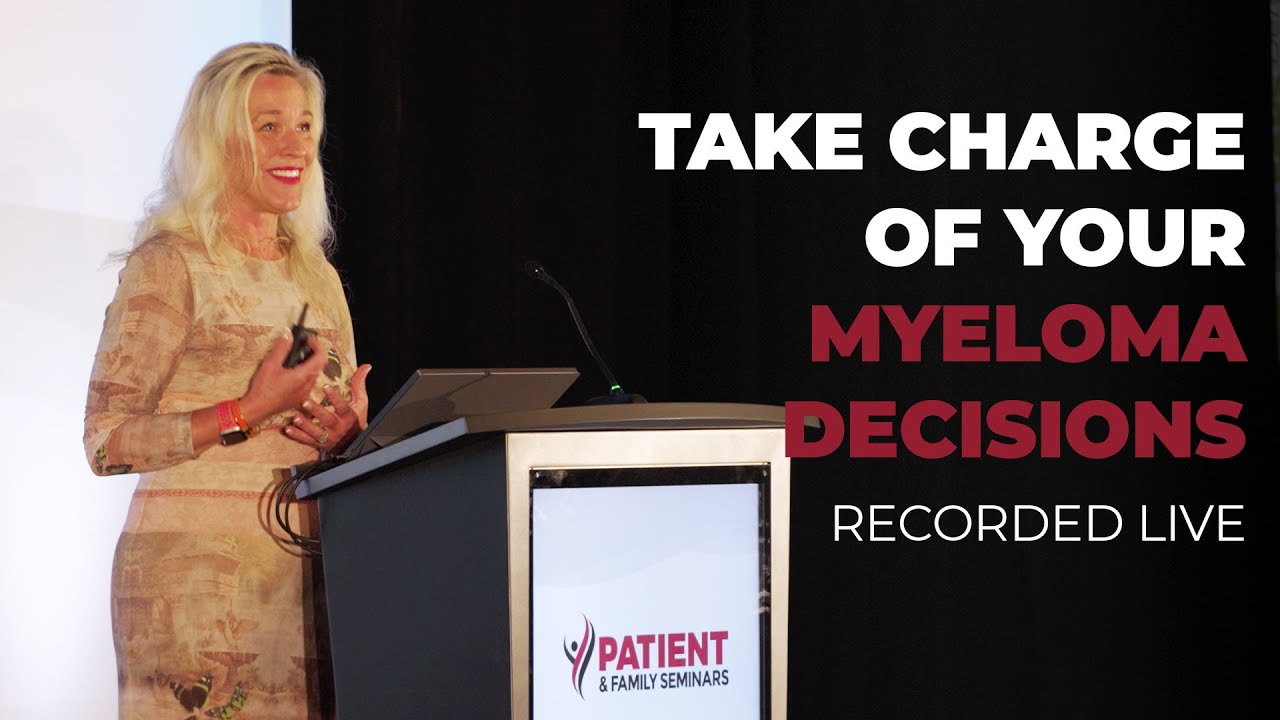
Patient Empowerment in Myeloma: How Shared Decision-Making Improves Care
Navigating multiple myeloma can feel overwhelming, but patients and families don’t have to face it alone. In this powerful Patient & Family Seminar session, Beth Faiman, PhD, MSN, APN-BC, AOCN®, BMTCN®, FAAN, FAPO, a founding member of the IMF Nurse Leadership Board, explains how shared decision-making transforms myeloma care. She outlines practical strategies to help patients take an active role in their treatment choices, understand all available options, and work with care partners and healthcare teams to make informed decisions.
From weighing new therapies like bispecific antibodies and CAR T-cell therapy, to understanding the role of clinical trials, managing side effects, and making use of telehealth, this discussion offers tools for patients and families to feel empowered. By fostering collaboration between patients, care partners, and providers, shared decision-making reduces uncertainty, improves adherence, and enhances quality of life.
Key Takeaways
- 0:00 - Introduction
- 1:20 - What Is Shared Decision-Making in Myeloma?
- 09:00 - How Patients Can Take an Active Role
- 19:30 - The Role of Care Partners and Support Networks
- 21:50 - Key Takeaways Summarized
Have a question that needs more personalized support? Call us! We’re here for you. The IMF’s InfoLine is available to answer your myeloma-related questions and concerns. Call us at 1-818-487-7455, email us at [email protected], or schedule your call at a time that works best for you at: https://www.myeloma.org/infoline
Beth Faiman, PhD, MSN, APN-BC, AOCN®, BMTCN®, FAAN, FAPO
Cleveland Clinic Taussig Cancer Institute
IMF Nurse Leadership Board Member
Beth Faiman, PhD, MSN, APN-BC, AOCN®, BMTCN®, FAAN, FAPO, has become an exemplary leader in bringing critical knowledge of cancer nursing to clinical providers — locally, nationally, and internationally. As a founding member of the International Myeloma Foundation Nurse Leadership Board (NLB) and practicing clinician, she demonstrates enthusiasm for continuous learning by conducting innovative research and demonstrates the importance of using and integrating new medical knowledge within nursing practices. In 2023, Faiman was given the NP/PA Educator of Distinction Award in Multiple Myeloma and in 2022, Faiman was named the Top NP in Hematology/Oncology and inducted as an inaugural Fellow of Advanced Practice in Oncology (FAPO) awarded by the Advanced Practitioner Society for Hematology and Oncology (APSHO). Faiman is a Distinguished Fellow in the American Academy of Nursing (FAAN). She is the current Editor-in-Chief of Journal of the Advanced Practitioner in Oncology. She remains an active author, presenter, mentor, and educator on the topics of hematology, oncology and supportive cancer care.
Faiman received her Bachelor of Science in Nursing degree from Ursuline Academy (1996), a Master of Science in Nursing at Kent State University (2002), and a PhD in clinical research from Case Western Reserve University (2014). Faiman is an adult nurse practitioner in the Department of Hematology/Oncology at the Cleveland Clinic in Ohio, and a clinical member of the Case Comprehensive Cancer Center under the Cancer Prevention, Control and Population Research Program. She has edited several books and authored many chapters and papers, including Editor of the 3rd Edition of the Multiple Myeloma Textbook for Nurses (2021), and both Editions of the Blood and Marrow Certification Manual for Nurses (2017, 2023), by ONS publishing. She previously held appointments on the American Board of Internal Medicine and American Society of Hematology.