



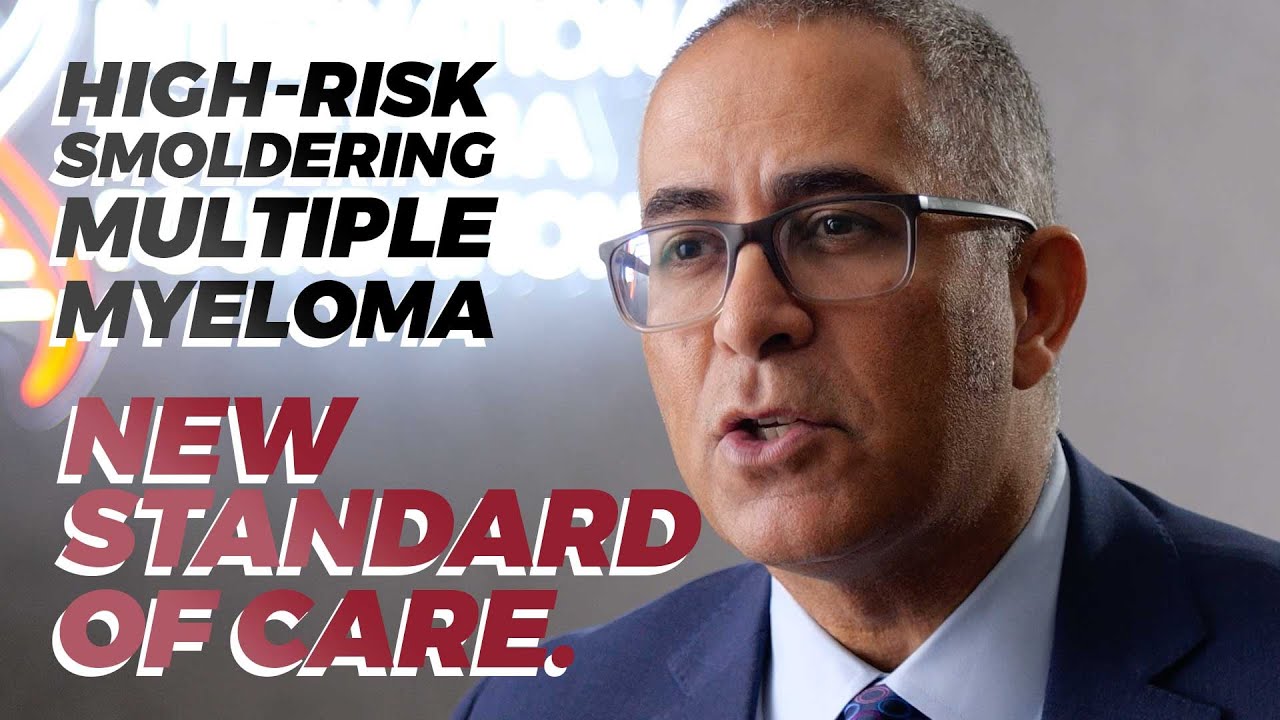
Dr. Joseph Mikhael -
In my overview video of the American Society of Hematology annual meeting, I identified five key areas of research in multiple myeloma. Let's dive into number one, smoldering multiple myeloma. To learn more about the other areas that we're exploring from ASH, please subscribe to our YouTube channel and you can learn about the other four areas that I highlight.
In the world of cancer, we want to find a way to intercept and intervene cancer earlier on so patients don't suffer all the consequences of cancer, and that maybe we can ultimately cure it. In multiple myeloma, this means intervening at the stage of smoldering multiple myeloma.
And a really important study was done that was presented at ASH, the AQUILA Clinical Trial, which looked at patients with high risk smoldering multiple myeloma. So they had features that we would expect their myeloma to progress to active myeloma within the next two years. And these patients were randomized to two important arms. Arm number one was what we would do now, the standard of care, active monitoring, careful watching of their blood work every three months, doing a PET scan, or CT scan, or MRI scan at least once per year, and doing a bone marrow test at least every two years. The second arm was the new intervention arm of giving patients single agent daratumumab, where it was given in the typical schedule, weekly for 8 weeks, every other week for 16 weeks, then just once every 28 days for three years in total. And that three year intervention was designed to see can we improve people's outcomes by reducing the time to myeloma becoming active, and possibly even keeping them alive longer.
And sure enough, that's what the study showed us. The progression-free survival was considerably improved in those patients that had single agent daratumumab, and even overall survival was affected in those patients that had daratumumab. So what does this mean for us? Well, it means that we really have to have a careful conversation with our patients when they have high risk smoldering multiple myeloma. We don't wanna wait too long until the disease become active, but we also don't want to treat too early. And I think this study is really helping us see that there may be a sweet spot that we can intervene, and intervene with something as simple as daratumumab, because thankfully in this study, there were really very expected and manageable side effects.
The vast majority of deaths, there were not very many deaths in the study, but those that occurred, occurred when patients had progressive myeloma, not from the intervention itself. And so that conversation becomes really important because patients may want to simply continue to monitor their disease, but others may want this new intervention with single agent daratumumab, assuming it is available to them.
And lastly, I'll close off by saying there were other studies looking at smoldering myeloma, and sometimes an even more intense treatment, be it with a two drug combination or even CAR T-cell therapy. These are exciting times in multiple myeloma, and we want to be able to catch the disease early enough to prevent our patients from suffering from this disease. And we now have a new standard of care in high-risk smoldering multiple myeloma.