

Dr. Joe Mikhael:
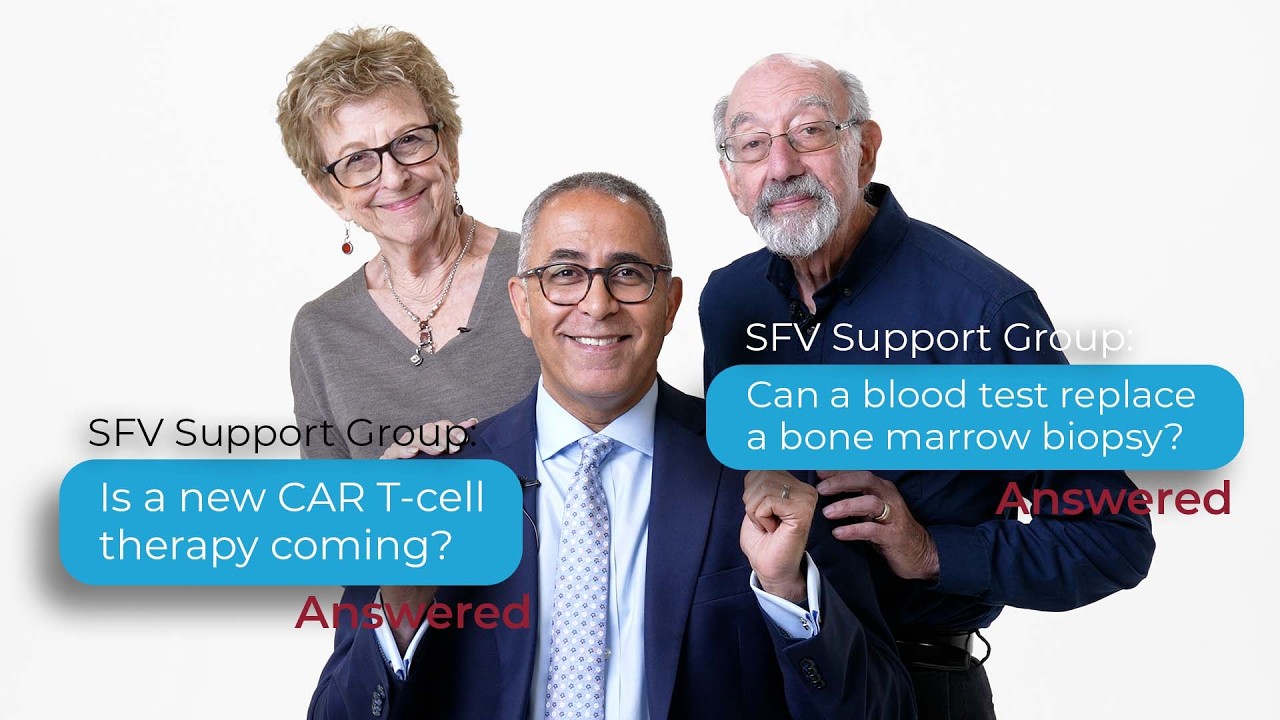
Hi, everybody. Dr. Joe here from the International Myeloma Foundation, and it's time for me to answer some questions. We love questions at the IMF. We have questions that come from all over the world.
Sally Weber:
Hi, Joe.
Dr. Joe Mikhael:
Well, hi, Sally. Hi, Malcolm.
Malcolm Katz:
Hello.
Sally Weber:
Our support group has some questions.
Dr. Joe Mikhael:
Really?
Malcolm Katz:
Yeah, we have questions for you.
Dr. Joe Mikhael:
Okay. Well, let's answer some questions from the San Fernando Valley Support Group led by my two friends here.
Question number one, do you have any updates on the anito-cel CAR T-cell therapy? Is the FDA approval still expected around December? Well, quickly, this is a reference to a new kind of CAR T-cell therapy that is not yet FDA approved called anito-cel, that it works a little bit differently than the CAR T-cells that we have now in that they bind to the myeloma cell a little bit differently, something called a D-domain binder.
We want CAR T-cells that bind to the myeloma cells and don't bind to anything else. So if they're designed more meticulously to bind to the myeloma cell, we know that they can be even more effective.
So this drug is going through the process of being approved. We don't know when. We know that the FDA has told us that we will likely have a response by the end of December 2026. Our fingers have crossed, of course, but we want to be able to have more options for our patients, options like anito-cel that seem to be very effective and actually have even fewer side effects.
Are there any developments in using a blood test for MRD, or minimal residual disease, or is a bone marrow biopsy still the only way to determine MRD status? Well, I wish I could say that we have moved away from doing all of our bone marrow tests and we do it all in the blood. We are testing this concept, the technology is getting better, but we know it's still most reliable for us to test for MRD, or minimal residual disease, tiny little bits of myeloma left by doing a bone marrow test and not just a blood test.
Sometimes now we can alternate them a little bit so that we can try and capture more information without having to do as many bone marrows. And I hope in the future, as the technology continues to improve, and we're very committed to this, we could do significantly fewer bone marrow tests.
Is it safe for a myeloma patient to have teeth extracted or dental implants? What should patients know about jaw healing and possible complications? This is an excellent question because we know that patients with multiple myeloma, specifically if they're on a bone-strengthener drug that we call a bisphosphonate, can have some unique complications if they have teeth extracted or dental implants.
So it's very important that when patients are started on one of these medications, that they have dental clearance in advance. And if you are going to have teeth extracted or have a planned dental implant, that this be discussed with your myeloma team as well as the dentist, because we want to minimize the risk of some healing complications that can come after. Thankfully, these are very rare, but it's important to take steps to make sure that we minimize that risk.
Let's take another question. One more question from our support group in the San Fernando Valley. I recently read about a lab value called beta-2 microglobulin. What does a high value indicate, and should this be checked routinely for myeloma patients? Great question. And the short answer is yes, this is a very important test. It's a test that is part of our initial classification of multiple myeloma to determine if someone has what we call high-risk myeloma versus standard-risk myeloma.
It's a chemical that's released in the blood when there's a lot of myeloma around. And so if someone has a very high level of diagnosis, it could indicate that there is rapidly growing multiple myeloma.
There is one caveat, is that if someone's kidneys are not working perfectly, the number has to be interpreted carefully. But yes, we would routinely test for a beta-2 microglobulin at diagnosis. It isn't a blood test, however, that we continue to follow or follow along the way when we assess response. It's really more so at time of diagnosis.
Well, I want to thank the amazing support group from the San Fernando Valley for these great questions and for the great work that they do in supporting each other.
If you're here in the Los Angeles area, we have a very special event in August. August 14th and 15th, we will have one of our Patient and Family Seminars. This is a two-day intense workshop where patients and their care partners and their families can learn about multiple myeloma, connect with other myeloma patients, and get a taste of the hope that we're experiencing now with all the new therapies that we have in multiple myeloma. We'd love to see you. Learn more at myeloma.org and look at that events tab, and it'll tell you more about the Patient and Family Seminar coming up. I'd love to see you there.