

Dr. Joseph Mikhael :
Should my children be tested for multiple myeloma? What is amyloidosis? Is there a link between myeloma and vitamin D deficiency? Hi everybody, Dr. Joseph Mikhael here, chief medical officer of the International Myeloma Foundation. I have the privilege of hosting several live Q&A sessions on Facebook, and these are the kinds of questions that come in all the time, and some of them didn't get answered because there are so many questions that come in. So today, I'm going to try to answer the questions that have been coming in from our patients and from their care partners across the world. If you do have a question, feel free to add it to the end of this video. You can use our social media channels, with Twitter or X, with Instagram, with LinkedIn, with Facebook, and use the hashtag #asktheimf and I'll do my very best to answer your question. All right, with that, let's dive into these questions, as they have been pouring in.
Question number one. "My brother was diagnosed with myeloma, and then I was diagnosed in 2011 and I'm currently being treated. How can siblings both be diagnosed with a rare cancer and it not be hereditary? Should our children be concerned about this rare cancer in the future and should they be tested?" Well, thank you for this great question. It is really challenging, because we tend to think of multiple myeloma as not being a so-called hereditary or familial condition. It is a disease that is relatively rare, but we do know that it does run sometimes in families. We've not developed concrete guidelines for screening of other family members, but most of us in the myeloma community feel that if there is more than one person within a close family that have multiple myeloma, it's very reasonable to at least consider testing those people in the rest of the family.
Now, of course, if there are signs and symptoms that may be consistent with myeloma, a low hemoglobin, fatigue, bone pain, all those usual things that point us in the direction, then absolutely, people should be tested. But we also have to remember that there are some implications of testing, it can affect things like insurance and other parts of our lives, and so that discussion should be had with the healthcare team. Lastly, I'll note that in the future, we hope to know a lot more about this, as we've engaged in the large iStopMM trial in Iceland, as we try to understand myeloma better and know in whom we should be testing, if not even screening.
All right, here's another question, very direct, but very important. "It's getting worse for people of color. Why?" We at the IMF have been committed to every single patient with multiple myeloma across the planet for 35 years. But we know, as I've often described, there are tremendous health disparities in multiple myeloma, where there are individuals and groups of individuals who have historically had inferior outcomes of myeloma, in particular the African American community and the Latino American community. Thankfully, there is evidence that things are starting to get better, of course not for everyone, but for many people. And the IMF has been working through our M-Power Program that you can learn more about at mpower.myeloma.org to try and improve the short and long-term outcomes of African Americans with multiple myeloma and others who have been historically underrepresented and undertreated with the disease.
It's very complicated for why this happens, of course, but we know there are things that are specific to myeloma, like delayed diagnosis and reduced access to care. The IMF is committed to this issue, and we seek health equity for all and will continue to work in this vein. But I would be encouraged that we are starting to see changes in the numbers of patients in terms of their survival, in terms of their access to therapies, because of initiatives like M-Power.
All right, let's move on to our next question. "I've had myeloma since 2005, and now have AML, or acute myeloid leukemia. Can you please do a video on patients dealing with two blood cancers?" Well, first of all, I'm very sorry to hear that this diagnosis has also been added to your diagnosis of multiple myeloma, and I am committing a full video to this. But in short answer to your question, sadly, we do know that about 5% to 6% of myeloma patients will have a second cancer diagnosed. We're not entirely sure of exactly why this happens, we think that it's partly due to someone's inherent genetics and their susceptibility to cancer. Secondly, because sometimes the treatments that we use may increase a risk to cancer.
And thirdly, what I sometimes call incidentaloma, and that just means that incidentally, other cancers get detected when you're being watched very carefully for the cancer that you do have. And so, there are very particular things that we have to be aware of, because unfortunately patients, with this may have to have treatments for both, they may not be eligible for certain clinical trials. And so, we do our very best to support patients through this duly difficult challenge of having two cancers at the same time. But you're not alone in this and we want to help you through your journey.
Here's another question that says, "I've been recently diagnosed with myeloma, and my question is if the treatments also help people who have high-risk multiple myeloma?" Well, again, as a quick recap, if you're not familiar with it, we typically divide myeloma into two buckets, what we call standard-risk myeloma, about 75% of patients, and high-risk myeloma, about 25% of patients. That definition changes now and then, but it really reflects the fact that about a quarter of patients have a biology, if you will, of myeloma, or a type of myeloma, that tends to be more aggressive, it tends to be a little bit more difficult to control and it tends to come back more quickly.
The myeloma community is very committed to trying to find ways to reduce that aggressiveness of the high-risk myeloma. And my quick answer to you is yes, these new treatments that we are working with, so many of the novel treatments that we have where we can engage a patient's immune system, like CAR T-cell therapy and bispecific antibodies, we are seeing that it is having a tremendous impact on high-risk myeloma. Yes, the prognosis of someone with high-risk myeloma in general is still not as good as patients with standard-risk myeloma, but we're working very hard to understand it better and to have even more tailored therapies for those individuals. It may mean right now for patients with high-risk myeloma that they may stay on treatment a little bit longer than someone with standard-risk, or they may have a few additional treatments, but we're doing our very best to continue to improve the quality and quantity of life of our patients with high-risk disease.
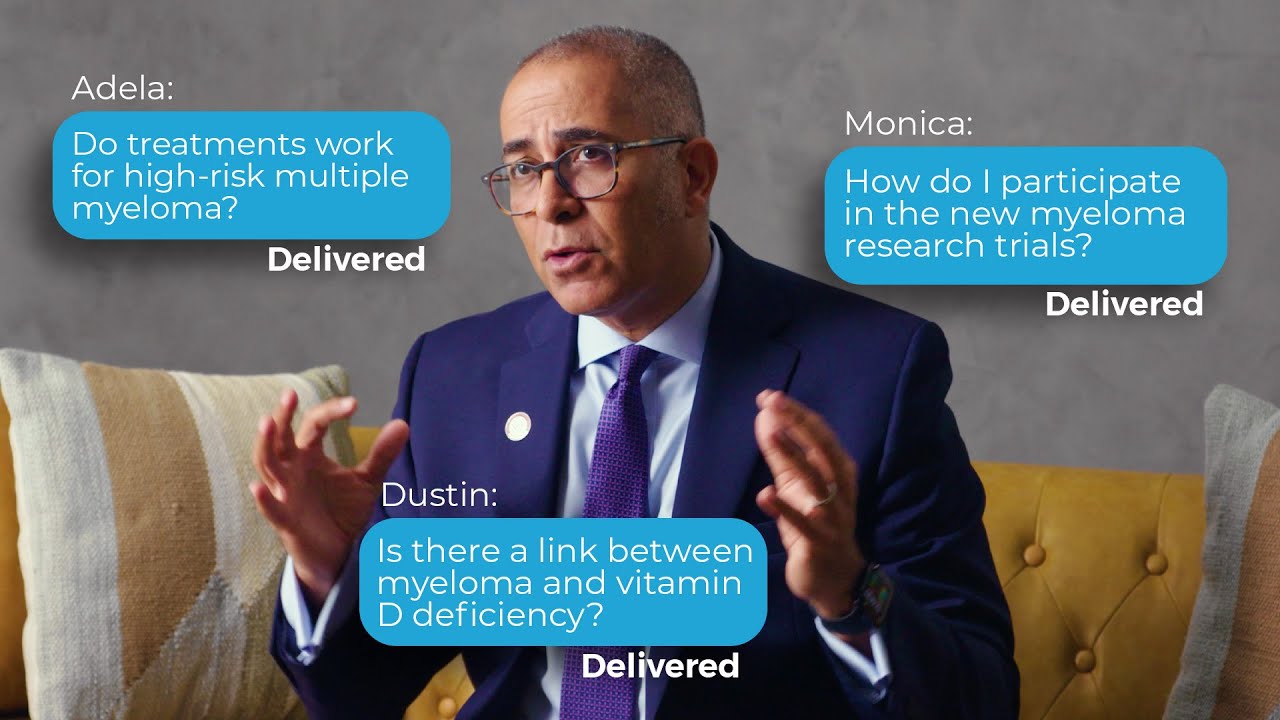
All right, let's move to our next question. Here's a great question from Monica. "I'm watching your videos of doctors sharing their findings from the research exposition," or from our big annual meeting that we had in December. "I want to be a part of these studies." Thank you, Monica. "How does a person get into these?" Well, this is a great question because Monica is really asking about inclusion in clinical trials, and clinical trials is something that we want to normalize in the myeloma community. What I mean by that is it's not that much different from the treatment that people normally have, meaning we want people to see that there are various options as they get treated, and clinical trials have improved the lives of patients with myeloma. Without clinical trials, we wouldn't have developed the new drugs that we know have so transformed this disease.
If you want to learn more about clinical trials, you can just go to our IMF website at myeloma.org and we've partnered with a wonderful organization, SparkCures, they can help find clinical trials that are available to you based on your myeloma, based on your geography or where you might be willing to travel. But this is absolutely important, because we want our patients to have the best option possible, and very often, the best option is a clinical trial.
All right, here's another great question. "How are MGUS and smoldering myeloma diagnosed? I didn't know I had myeloma until I was heavily symptomatic." What a fantastic question. We say this all the time, but myeloma is a relatively rare condition, but the precursor to myeloma, or the precancerous condition of MGUS, or monoclonal gammopathy of undetermined significance, and the intermediate area of smoldering myeloma, is actually much, much more common. And most patients with MGUS won't develop true myeloma, but very often, those are diagnosed before anyone has any symptoms. In fact, MGUS by definition really is asymptomatic, so it's typically picked up when someone has blood work done for something else and it's noticed that they have a high protein level or something that's not normal in their blood, and there we find the diagnosis of MGUS or smoldering myeloma.
Sadly, very often, by the time we make the diagnosis of myeloma, someone has had symptoms for a long time, and that's often why the diagnosis is delayed and people are diagnosed with a later stage disease. This is why we're trying to address this by examining through this huge clinical trial that we've done in Iceland to see, is it worth screening people for myeloma? Should people get regular blood tests, like you might get a regular mammogram or colonoscopy for colon cancer? We've not arrived at the conclusion yet, but we believe we're working in that way so that we can intercept, as it were, myeloma even earlier, so we can prevent all the damage that sadly myeloma can cause to the kidney, to the bones, and indeed to the rest of the body. Great question, thank you for that one.
Here comes another one. "I have been diagnosed with MGUS," on the subject of monoclonal gammopathy of undetermined significance. "My IgG and monoclonal protein increased from zero to 1.6 recently. My question is, what is my likelihood of developing multiple myeloma?" Well, of course, it's hard for me to answer that question very precisely because we use lots of different factors to determine if myeloma is present. Sometimes I say myeloma is like a crime scene. There isn't one piece of evidence that tells you the whole story, there are multiple pieces of evidence, the blood counts, the levels of the protein, X-rays, bone marrows, all of those things point us in the direction. But indeed, if your monoclonal protein has gone up over a period of time, it's very important that this be followed up with your healthcare practitioner and have a conversation with them, because more testing may be necessary to determine if myeloma has been developed or if we're getting very close to myeloma, as it may influence treatment.
Okay, let's move to another great question. "Do you have any information on being diagnosed with myeloma and amyloidosis?" Amyloidosis is a complicated topic, but I'm going to try and make it a little simple. Amyloidosis is a disease, and there are about 30 kinds of amyloid, where a protein gets stuck in an organ. In the case of myeloma, there's one kind of amyloidosis, called AL amyloidosis, and the A stands for amyloid, the L stands for the kind of protein that gets stuck in the organ, and that protein is called the light chain. The light chain is part of the protein that myeloma typically makes. We have these antibodies or immunoglobulins that have both heavy chains and light chains, and in some cases, these light chains, instead of just circulating like they do in myeloma patients, they change their conformation and deposit in organs. They particularly like to go to the kidney, to the heart, to the GI system, and almost every other organ in the body.
So it is quite possible to have amyloidosis by itself without myeloma, it's possible to have myeloma without amyloidosis, and then there are some patients in whom we actually see both conditions together. Typically, when we see them both together, one of them is more dominant than the other, meaning a patient is more classically like myeloma with the features of myeloma, oh, and by the way, we discovered a little bit of amyloid in the tissues. By contrast, there are some patients that have really amyloidosis with this protein stuck in the tissues causing that tissue to be damaged, but they also meet the criteria of myeloma. This is one of the reasons why we think it's very important that people see a myeloma specialist to help make that distinction, because it may have implications on treatment. But to reassure everyone, both conditions can indeed be treated. The treatments are often very similar, and we see a lot of patients do very well who have either amyloid or myeloma or even both together.
All right, the next question is by someone called Live Life Fully with Cancer. So first of all, I love your name and I think it's wonderful that you want to do that, because that's indeed our vision at the IMF, that every patient can live life to the fullest unburdened by the disease. "For clinical trials that use dexamethasone, will there be parallel trials using prednisone for those of us who are allergic to dexamethasone?" It's a great question. So dexamethasone is a steroid that we often use in myeloma because it boosts the effect of almost every other treatment we use in myeloma. But there are some patients that are either intolerant or potentially allergic to it, and so often we use a different kind of steroid called prednisone.
So typically, we wouldn't do a whole separate trial with just prednisone, although some are designed that way. But more often than not, clinical trials do allow for substituting the dexamethasone for the prednisone. So not being able to take dexamethasone, generally speaking, should not exclude people from trials or exclude people from treatment, but this has to be looked at by a case-by-case situation. Thank you so much for asking that question.
All right, Dustin asks this question, "Is there a link between multiple myeloma and vitamin D deficiency?" The short answer is yes, there is a link. We know that vitamin D is a pretty complicated vitamin, actually, and is involved in a lot of things in the body, in terms of our bone development, but also our bone marrow development. And some studies have noted, in particular in Caucasian populations, if someone has a very low level of vitamin D and is known to have myeloma, it may be a risk factor of their prognosis with myeloma. Now, it's not absolutely concrete, but we know that biologically, those two things are connected, so it's not particularly a surprise.
That being said, I don't want people to think of the opposite, meaning if we know they're a group of people that have vitamin D deficiency, which could be from other reasons, that doesn't necessarily mean they're going to develop myeloma. It's more of a function that if someone has myeloma, one of the things we tend to check is the vitamin D level, as it may influence what we do and often we replace that vitamin D. And interestingly, this is not just specific to myeloma, we do see it in some other blood cancers, like lymphoma.
All right, let me come now to my last question. These have been so great today. This question comes to me from Steven. "My Kappa levels rose nearly 50 milligrams in one year. Lambda rose then diminished. The ratio went from 3.65 to 6.9. Any thoughts?" So again, people may not be familiar with these numbers, but as I often say, myeloma is a little bit like a crime scene, there isn't one piece of evidence that tells you the whole story. One way we measure the proteins in the blood is what's called the M-spike, which is the whole of the myeloma protein together, heavy chains and light chains together. But actually, in the majority of myeloma patients, we can also measure light chains. In some patients, we can only measure light chains. And there are two kinds of light chains, Kappa and Lambda, as was noted here by Steven.
In most of us, all of us who do not have myeloma, should have relatively similar levels of Kappa and Lambda. But when someone has myeloma, which is a cancer, a cancer means identical growth, one of the two dominates, either the Kappa level or the Lambda level. That's why when we look at the levels, we also look at the ratio, which is just what the Kappa level is over what the Lambda level is. And that ratio tells us, when there's a big difference between those two numbers, it could mean that the myeloma is growing. Now, to give relative terms here, a ratio going from, as was said, three and a half to seven, that definitely is a rise, but it's not a very high ratio. In general, we worry when people are going to be first diagnosed with ratios that actually go over 100, let alone three and a half to seven. But that being said, we want to be able to watch it.
Now, what's interesting is that these light chains can actually vary quite a bit. Sometimes they can just vary by being a little bit dehydrated or kidney function, lots of other things going on in our immune system, so that's why we have to track it over time and not make big decisions based on a small jump. So my answer to you, Steven, is obviously I'm a little bit concerned that the number's gone up, but it really hasn't gone up by very much and it's still relatively low. That needs to be followed over time.
Well, that's all I can get to today for our questions, but I hope this has been helpful to you. We really want to help answer all your questions that come, so feel free to enter questions on any of our social media channels. But of course, if it's more of a private question, feel free to reach out to us directly through the info line or online, and we'll have a private and personal conversation with you about you or your loved one with multiple myeloma so that we can help you through your journey with myeloma. Thanks so much for joining us today.