



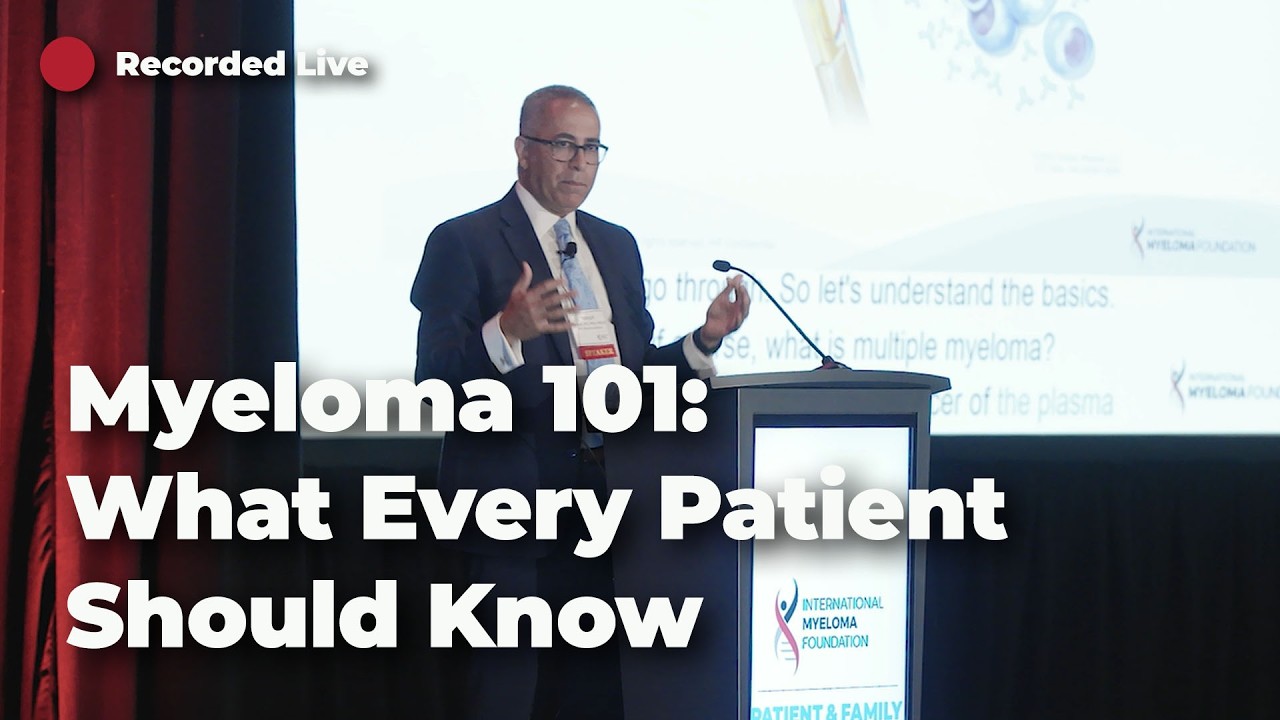
Dr. Joe:
Multiple myeloma is a cancer of the plasma cell, right? So our factory of blood exists within the bone marrow, which is what produces the cells that circulate in our blood, what I often call the red, the white, and the rosé. So you have three cells that circulate in your blood, your red cells that carry oxygen, your white cells that function as soldiers to fight infection, and your rosé cells or platelets that are small cells that help you clot. All this is made in the factory of your blood, which is a lot of it in your sternum, in your spine, and in your hips. Inside those larger bones, you've got this bone marrow or this factory that makes it all.
Within that factory, you've got a really small group of cells, typically only 1 to 2% of the whole factory. I've often said kind of like the steering wheel on a car, right? It's a very small part of your car, a pretty important part of your car, but it really is a small fraction of the car. But what happens in multiple myeloma, these plasma cells that are typically only 1 to 2% start to grow out of control. We'll come back to that in just a minute.
But what do plasma cells do? Plasma cells are the cells that make antibodies, those things that fight off infections for us. Every time you get a vaccination, and much more than that, every time you get exposed to something in the environment that your body says, "Hey, I'm not sure what this is. I need to protect you against it." And so it creates what we call an antibody. So like with a vaccination, if I get a tetanus shot, it's like sending a message to my plasma cell saying, "Hey, plasma cells, I want you to know what tetanus is like. In case Dr. Joe steps on a rusty nail, I want him to be protected." So it creates this antibody or anti-against body that is very specific to tetanus. And you just keep it in reserve your whole life so that if you do get exposed to tetanus and it comes to the body, the body say, "Hey, I know the antidote for that. I know what to do for that. I'm going to ship out some antibodies and those antibodies hook onto the tetanus and trigger the immune system to destroy it."
So we heart our plasma cells. These are very important cells. We would not be alive, most of us, if it were not for our plasma cells and the complexity, of course, of our immune system. Myeloma is a cancer of the plasma cell. So what is cancer? If someone asked you just really quickly, how would you define cancer? Some of you heard me say this before, three words, identical, uncontrolled growth. Identical, uncontrolled growth. It's just easier to conceive of a lump of lung tissue, for example, that's kind of growing out of control or kidney tissue that's kind of growing out of control. But it's the same thing. These plasma cells are supposed to be one to 2% of your factory, all of a sudden become 10%, 15%, 20%. We define myeloma by at least 10%, but sometimes it can be, I was just reviewing, actually on my way to the airport, I got a call from a community oncologist asking me about a patient who has 90% plasma cells in their bone marrow and the challenges of dealing with that.
And so myeloma then is a cancer of the plasma cell, this identical uncontrolled growth so that now these plasma cells, instead of making good antibodies that fight tetanus and measles and mumps and rubella and all the other things we get vaccinated for and should get vaccinated for, it's another discussion, that protect us, now all of a sudden they're making, if you will, bad antibodies that do the very opposite that now are going after your bone and your kidneys and going after other parts of your body.
So myeloma itself is a relatively rare disease. It accounts for about 2% of all cancers. When you look at the list here on the far side of the slide in terms of how high the incidence is, it's 2%, as I mentioned, of all cancers, which puts it 14th on the list, right? Breast is number one, prostate number two, lung number three, colorectal number four, melanoma number five. Myeloma's way down at 14, but a couple of interesting things about it. The average age of diagnosis is 69, but there are some very important things, and I get to get into this a little bit more when we talk to more about health disparities, but it affects people differently.
First of all, it's a bit more common in men than in women. For those of us who are of African descent, we have twice the risk of developing myeloma over those who are not of African descent. And so you can see the difference there in the width of those green bars of how it's distributed. And then in terms of age, as I mentioned, the average age is 69, it doesn't mean everybody's diagnosed at 69, just means that's the average. So it's not very common in patients under the age of 30. We do see cases and some of you know we've had some very rare pediatric cases. We've actually two eight year old boys in Latin America diagnosed with multiple myeloma, but the vast majority of patients are diagnosed over the age of 40, as you can see in the distribution there.
So what causes myeloma? I get asked, almost every patient who comes in asks me that. And I don't have a great answer to be honest, because for the vast majority of patients, we honestly don't really know. We know that there's an association with certain exposures. So for our veterans who've been exposed to Agent Orange, for firefighters who are exposed to repeated fires, it doesn't necessarily mean that they're going to get myeloma. It's still a relatively rare condition even amongst those individuals, but their incidence is a little bit higher. We also know that there's some kind of connection to obesity, as we know with many cancers. We don't fully understand it or can explain it. But of course, a lot of times I talk to patients like, "Well, Dr. Joe, I'm not a veteran. I'm not a firefighter. I'm not obese. I'm a 48-year-old white woman. How come I got myeloma?" We just don't have the answer, to be very honest.
We know that it's very complicated. We know that plasma cells by their nature are designed to respond. Remember we said, what do plasma cells do? They make antibodies. And so they're designed to respond to different triggers to be able to create antibodies against things we are vaccinated from or things that we get exposed to. And so it puts them a little bit at risk of going a bit off the rails and becoming cancerous. And interestingly, as I'll show you in just a moment, it is actually quite common that people have some plasma cells that have become a little bit cancerous as it were, and we'll come to that in a moment. But in terms of giving true known exposures or why someone had this, it's very difficult.
Lastly here, I often get asked, "Well, does it run in families?" The quick answer is typically it does not. So when someone is diagnosed, we don't typically start testing everybody in the family, but we do know there are clusters of families and we know that there is some risk. If you have a family member with myeloma, your risk is a little bit higher. Again, the baseline risk is still so low, it doesn't justify testing everybody, but we know that there are some familial links.
All right. Now I've talked a little bit about this before, but just as a reminder, this connection between myeloma and the bone marrow is that myeloma are made from the plasma cells and the bone marrow, but within that same bone marrow, you're making those three very important cells we talked about, the red cells, the white cells, and the platelets. And this is important because if the factory is so dedicated to making all of these plasma cells, you think of that poor patient that I got called about this morning who has 90% of their bone marrow making plasma cells, that means there's only 10% left to make the red, white, and a rosé, it's not going to be making those three cells that are there, which is why so often when someone is diagnosed with myeloma, more often than not, they will have lower blood counts. In particular, the one that is the most sensitive to this is the red cells, the anemia as we call it, or a low red blood cell count. About three quarters of patients who are diagnosed with multiple myeloma are typically diagnosed with a low red blood cell.
Well, let's understand these proteins or antibodies or immunoglobulins. We often use those same three words. In medicine, we love to use words that patients don't understand. We should just call it an antibody. I should call it the pinky and not the fifth digit. And so instead of calling an antibody, we call it an immunoglobulin, right? They're just two old words, immuno referring to immune, globulin referring to kind of a protein. So immunoglobulins are immune proteins.
Well, I don't want to cause any PTSD from science class or any time that you had to take health lessons, but let's look at the structure of these a little bit. I'm not going to try to make you all chemists or biochemists in the next two minutes, but just to get the essence of it, these proteins are typically shaped in a Y format. The most common one that we call the IgG is just a simple Y. There's some others because there are different kinds of immunoglobulins or proteins. There's IgG, which is by far the most common, but there's something called IgA, there's IgD, and then much more rare is IgM, IgD and IgE.
And basically what happens is when we test for this in the blood, we find them alongside of the good antibodies that you make. So if you have a patient who sadly develops multiple myeloma, they still have their other antibodies that they've made for measles, mumps, rubella, everything else, but all of a sudden they've got this big glut of this abnormal protein or this abnormal antibody that they've been making. When we test it in the lab, it's supposed to be relatively just to sort of low level hills like I have in Arizona, like nice rolling hills. All of a sudden you've got this big spike or this big chunk of abnormal protein and that's why we call it the M spike. So your doctor may be talking to you about the M spike. That's a way that we measure that abnormal protein in the blood.
Now to make it a little bit more confusing, sorry, I didn't make them, but for some patients, that whole Y stays intact and we measure that as the M spike. But for some patients, that Y, if you look at it carefully, it's not just a single Y, there's an extra little bit on the outside of the Y. We call those light chains. The longer ones in the middle, we call the heavy chains. The little ones we call the light chains. And about 20% of myeloma patients only have light chains when we go to test it in the blood. So they don't have that M spike to follow. They only have the light chains. Most patients have an M spike and in fact, most patients, we can measure both an M spike and a light chain.
So when your doctor is following you and your healthcare team is following you, as we think about how you're responding to myeloma, thankfully every month we don't have to do a bone marrow test and check what percent plasma cells have you had in your bone marrow. That would not be very comfortable, would it? We at least can follow it in the blood. So what you're typically following is either the M spike or the light chain level or perhaps both.
And this is where myeloma becomes complicated. Some of you have heard me say this before. I tell my patients that myeloma is a little bit like a crime scene, right? There isn't one piece of evidence that tells you the whole story. You need to look at the whole crime scene. We need to look at the bone marrow. We need to look at the light chain. We need to look at the heavy chain. We need to look at the chemistry of the blood. We need to look at the red, white and the rosé . Hopefully you'll be doing more than just looking at red, white and rosé later, if you know what I mean, at the reception. And sometimes we need to be looking at the imaging as well. So all of those things together give us the full picture of someone's multiple myeloma. And so that's why we say that most commonly 65% of patients have the IgG version, 20% have the IgA version, and about another 20% only have the light chain version of it.
Now, I mentioned earlier that all of that lands in what we call active multiple myeloma. So for someone to have myeloma, and my next slide will explain how we define myeloma, you have to have over 10% plasma cells and you have to unfortunately either have damage or about to have damage to your body because of it. But what makes myeloma a little bit unique in the whole cancer world is that even though myeloma is rare, the precondition to myeloma, as we call it, is actually quite common, which means that many of us, in fact, 1 in 20, 5% of people over the age of 40, if I look really carefully in their blood, I'm going to find some of that abnormal protein. We call it monoclonal. Monoclonal means identical. What was cancer? Anybody?
Group:
[inaudible 00:13:42].
Dr. Joe:
Identical, uncontrolled growth. Okay, keep your day jobs, right? So that's fine. But it's a protein that is identical. So we call it monoclonal as opposed to normal immunoglobulin or normal protein should be polyclonal, like the colors of the rainbow should be multiple colors. Here, it's one particular type.
And so it doesn't mean very much if someone has just this tiny little bit of it, but we call that MGUS, or Monoclonal Gammopathy of Undetermined Significance. It was coined by one of our earliest board members, Dr. Robert Kyle is retired now, but he's still with us in his late 90s. And he had tested a whole group of healthy individuals in Minnesota and determined that about 5% of people over the age of 40 have this little bit of protein. A small fraction of them will go on to develop myeloma, but most of them won't. So it's common for us as we get older, unfortunately, as you've all experienced, as we get older, some things don't function quite as well as they used to, right? I was playing pickleball earlier this week and my body's like, "There's no way you're getting that shot." My mind is like, "Oh yeah, I can get that." Next thing I know, I'm on the ground.
So some things with time unfortunately just deteriorate. And so the body's ability for the plasma cells to always respond properly deteriorates. And so we got to give our plasma cells, cut them a little bit of slack. As we get older, we make this little schmutz, this little bit of abnormal protein, and it typically doesn't mean very much. But if that continues to grow, then we get to this middle section, what we call smoldering myeloma, where there is some of this protein and enough of the protein to sort of raise the yellow flag of caution, but it's not quite at the level of multiple myeloma.
And I'm going to leave this topic for now because as you know, tomorrow when our amazing physician experts join us, you're going to meet Dr. Gregory, Dr. Lee, Dr. Vescio, who are going to join us tomorrow, we have a session called controversies. We're going to talk a bit about smoldering myeloma, when to treat, when not to treat. We're in this really challenging situation. As I said, myeloma is a complicated disease. For most cancers, breast cancer, colon cancer, lung cancer, we know you got it or you don't got it. You treat or you don't treat. Here sometimes in myeloma, we're in the middle going, "I'm not sure what to do." It's tricky because I don't want to over treat and treat too early. I definitely don't want to under treat and let someone's disease grow out of control. And sometimes making that distinction is very challenging, but that's how we divide the three groups of MGUS, smoldering myeloma and active myeloma.
But to have true myeloma, we used to say, show me the CRAB, right? What is CRAB? CRAB is an acronym that stands for Calcium elevation, the R is renal or kidney damage, the A is anemia or the low red blood cell count we talked about earlier and B refers to bone disease, either thinning of the bone or maybe even sadly, breaking of the bone. About 12 years ago, the chair of our board, Vincent Rajkumar, led some work to help us say, well, do we really have to wait until someone has developed CRAB to say that they have myeloma?
Some of you know I like to run. And so I always give this same analogy is if I'm running towards a cliff and Peter, who I'm sure can run a lot faster than me, sees me running towards a cliff, "Hey, Dr. Joe, we better pull you back, man. You're going to fall over into the Pacific here and get yourself into trouble." Let's not wait until someone falls off the cliff to say they have myeloma. The challenge is knowing where. If the cliff is miles away and I'm moving at my geriatric pace, then let me enjoy my run, right? But if I'm getting close to the cliff, you want to pull me back.
So we tried to define what's really close to the cliff, meaning what do we know that if people have, they're getting so close to that cliff that it's not worth waiting because they may end up breaking a bone, they may end up damaging their kidneys. So we added three things to this. One, the S standing for 60%. If we do a bone marrow test and 60% of the bone marrow is filled with myeloma, that's active myeloma. Even if there isn't CRAB criteria, it's coming soon, so we should trigger it.
Number two, what we call the light chain ratio. So when we look at those light chains, we all have some light chains in our blood and we have two types. One's called kappa and one's called lambda, in monoclonal disease or identical cancer, one of them goes way up compared to the other. If one goes a hundred times higher than the other, that tells us that that light chain burden is growing and light chains particularly like to go after the kidney. And so if someone's light chain ratio is that high, we're nervous that it's going to damage the kidney.
And then lastly, the M stands for MRI. We can do an MRI of the bone marrow, not of their bones to look for fractures and things like that. If we find fractures, they've already met the B of CRAB. The MRI bit is to look at the bone marrow that if the bone marrow has what we call focal areas or areas that look like are really active, that tells us the disease is active because normally it should look very bland. It should look very what we call homogenous under the microscope or under the imagery. But if we see focal areas, more than one focal area, it tells us the disease is active. So what we've said then is someone has to have 10% plasma cells in their bone marrow and one of these slim CRAB, one of these seven criteria to be defined as multiple myeloma.
So Heather mentioned that the slides are going to be available to you. I'm not going to go through every one of these, but this is now a summary of what I've just shared with you in terms of all the lab tests. The CBC, or Complete Blood Count, that looks for the white, red, and the rosé . There's various biochemical tests and then the tests that we do for that abnormal protein in the blood, the heavy chain and the light chain.
Interestingly, there are still some patients, it's a pretty small fraction, but there are still some patients where we can't find that protein in the blood at all, we only find it in the urine. And for those of you who have gone through this, you know that sometimes we ask you to collect your urine over 24 hours. It's not the most enjoyable thing in the world, keeping that little jug in the fridge, keep it far away from the apple juice. So that it's not really fun, but there are still some patients in whom we do that. We're about to revise our myeloma criteria, what we call our response criteria so that people, for those of you who may have been on a clinical trial or something where you had to collect that jug all the time, we're hopefully going to be doing a lot less of that.
There are some other blood tests that for time's sake, I won't get into a lot of detail, but I'll just mention two here. Something called the beta-2 microglobulin and something called the lactate dehydrogenase, or LDH. Some of you may have seen a recent video I did on beta-2 microglobulin because it came from a question from LA, from our movie stars here who did some videos with me and I was asked about beta-2 microglobulin. beta-2 microglobulin is just a blood test that tends to go up in multiple myeloma because it reflects some of the chemicals that those plasma cells release in the blood. Similarly, LDH is another chemical that gets released in the blood. We can see it in different cancers. We actually see it also in lymphoma. So when we see plasma cells or plasma-like cells, when they are increased in number, they release some of that into the blood and that can help us understand the disease a little bit better.
I also mentioned that we test imaging because it's not just enough to do the blood test, to do the bone marrow, to do the urine. We have to do imaging as well because we know myeloma can damage the bone. Historically, we used to do what we call the skeletal survey, just a plain x-ray of all of your bones. I'm sure some of you have had that done before, but we've come to learn that, I mean, if you do a plain x-ray and you see damage, okay, then we know there's a lot of damage, but it's not a very good sensitive test. It's not very precise. And so now we typically use either PET scanning or MRI scanning, something like that, that is much more specific to look because we don't want to wait until the damage is so severe that you see it on a regular x-ray. We like to pick it up on those earlier x-rays and we can detect things very, very carefully.
It is amazing to me how much imaging has improved our care in multiple myeloma. One of the reasons why I went into multiple myeloma, as some of you know, I wanted to take care of, sadly, the sickest of the sick. When I went into myeloma 30 years ago, most patients didn't live much more than a year and you knew which was the myeloma clinic because most patients were sitting in the waiting room hunched over. We didn't have bone strengtheners. We didn't even really understand how to use those braces yet to help people. And it was really tremendously damaging to the bone. But now with earlier and better detection, we can catch the disease earlier and I'll talk more about early detection tomorrow because I think that is one of the major steps towards curing this disease is not just treating it when it's devastating, but to catch it earlier.
I'm sure many of you in this room could share a story with me about how long it took to make the diagnosis. Some of you, thankfully it was caught a little bit earlier, maybe it was an insurance blood test or something of that nature. Our founders had discovered that. Brian Novis had discovered that he had an abnormal protein in his blood when he went to get some insurance blood work. But for many patients, it's after the bone is already broken. It's after the kidney has already been damaged, and so we want to catch that a little bit earlier.
And then of course, there's everybody's favorite, awkward party of one when we do a bone marrow test. And I know this is not fun, but this is where we go for the headquarters, right? This is where we go to find those plasma cells that live in the bone marrow. And when we go in there, we don't just go to look at the sheer number of them, although I did mention earlier when there's over 60% of them that tells you that something is severe, but we've also learned over time that there's a big difference between plasma cells. Some are really quite aggressive.
This is where we talk about what we call high risk and standard risk myeloma. About 25% of patients have so-called high risk myeloma and 75% have standard risk multiple myeloma. And that's mostly based on not just the number of plasma cells, but of the genes of those plasma cells. Let's be clear, these aren't your genes that you're passing on to your children. These are the genes of the cancer cells.
What defines cancer in many ways, I work at a genomics institute, so I'm a little bit biased to thinking this way, but it's all in the genes, right? Is that something happens in those plasma cells that their genes start to go off track and all of a sudden they start multiplying. This is one of the reasons why it's so exciting as I'll share with you in a few minutes how we try to treat multiple myeloma by reversing that trend or using someone's own immune system because that immune system's gone off the rails. Those genes have multiplied and mutated and gone in ways that have made them abnormal.
And so we've learned over time to look for key mutations, key, what we call cytogenetic abnormalities. Sometimes it's what we call a mutation. Sometimes it's called what we call a translocation. So translocation just means that one piece of chromosome from here and one piece of chromosome from there, they're supposed to live separately. Now all of a sudden they've come together and they give that cell the ability to be immortal because that's what cancer cells are, right? They're identical, uncontrolled growth. They keep growing when they shouldn't be growing.
And so when we do someone's bone marrow test, it's not just about what is the number, it's what are these cytogenetics? And we have all these different complicated cytogenetic features. And sometimes I put up this slide and people say, Dr. Joe, can you speak in English please? But the reality is we've recently redefined what we call high risk myeloma. And I don't want to spend a lot of time on this, but some of you I know are particularly interested in the area.
And basically we've said, someone has to have one of these five boxes that you see on the screen. And I know some of this looks really weird and this is just the wording and the terminology that we use, but it means, for example, if we take that very first one, it was called del 17p, that just refers to a deletion of the P arm of chromosome 17, because we know that a really important gene lives there. It's actually called the p53 gene. It's a gene that keeps everybody in order. It's like a supervisor gene. When that gene is deleted, or actually the second box also refers to this, when that gene is mutated, when the cats are away, the mice can play, right? When the supervisor is deleted or mutated, then all of a sudden the cells go out of control. And so those are the kinds of things that help us understand. And for time's sake, I won't go through all of these weird letters and numbers, but to give you an appreciation of what we see here.
If we can go to the next slide, I think someone might be moving the slides around there. If we can go to the next one, please. Thank you. We jumped ahead.
So lastly, in my last couple of minutes, because as I say, I'm going to get into immunotherapy a little bit more later, the treatment of multiple myeloma has radically changed even just in the last few years. Interestingly, in some ways, it's become more common to treat people very similarly. We used to make this big difference, are you transplant eligible or transplant ineligible? And that is still an important phenomenon because transplant basically refers to treating someone where we do what's called an autologous stem cell transplant or basically give them one big whopping dose of chemotherapy. That's really what transplant is all about. It's not so much about the transplant bit, it's about the chemo bit.
It's called transplant because before I give someone this big whopping dose of chemo that's going to get rid of any of myeloma that's left after I've initially treated them. So if you think of cleaning your kitchen floor, you sweep up everything in your kitchen and now the floor is almost perfectly clean, but then there's that little bit here and there and someone drops some peanut butter and someone drops some jam, whatever's on the floor, you need the mop to scrub it. Transplant is kind of like the mop. It's that big dose of chemotherapy to scrub the floor.
The problem is if I just give someone this big dose of chemotherapy, it's not only going to get rid of the bad stuff in your bone marrow, it's actually going to wipe out their whole bone marrow, even the good cells in it. So what we do before we give the big dose of chemotherapy is we collect from them stem cells or cells that can grow a new bone marrow, pull them out, then give them the chemo, then give them their cells back. Kind of like, sorry to mix analogies, but kind of like saying, "I want to get rid of the weeds in my lawn. Let me just burn the lawn." Okay, good. Gets rid of the weeds, but gets rid of the grass too. But if I have seeds to grow a new lawn, I can.
And so we used to always say, "Are you transplant eligible or ineligible," because transplant did save lives and keep people alive for longer. Well, now we've come to learn that not everybody needs transplant and that'll be one of our controversies tomorrow. Transplant is still a viable treatment. I don't want to dismiss it, but I'm going to be a prophet for a moment and predict that we'll be doing less transplants in the future. That's another discussion for tomorrow. But whether someone's transplant eligible or not, more often than not, we're giving them four drugs off the start because what we've learned is myeloma is so complicated, it's hard to just get one drug to initially control it. It's better to use a combination of drugs. This is how we overcame HIV, not because we had one magic pill, but the right combination.
And so we typically give people a four drug combination, sometimes higher doses, lower doses. We adjust it to the individual. And then they may or may not go to a stem cell transplant. And then we can start, as I was describing earlier, tapering back the doses and maybe even stopping so that patients can get off therapy once they've achieved a response.
Thankfully, the vast majority of our patients, over 90% of them, if not 95% of them, will have a response to treatment. The sad reality is most patients' disease will still come back. And that's what we call relapse. And that's why we need more treatments all the time for relapse therapy. And this is why we've put for your slides, I'm not going to go through them all because you're going to hear about them all weekend, but I love the fact that I have to keep adding to this list. And because iberdomide got approved yesterday, it didn't quite make its own category, but it'll get there in the next slide set.
But you can see that we have all these different categories of drugs, both the ones that we've been using now for several years. And now on the next slide, some of these new ones, things like CAR T-cell therapy, bispecific antibodies, and antibody-drug conjugate that you're here to hear about, and what I just shared with you in terms of the new pipeline of iberdomide and so much more to come.
We did talk already a little bit about measuring treatment that when we see those numbers come down, the M spike, the light chain, we have different sort of gradations of that response. If someone's at least cut in half, we call that a PR or a partial response. If it's 90%, it's very good partial response. Ultimately, the goal is to get to a complete response or 100% response. And even as I shared earlier, MRD negativity. MRD negativity means we can't find myeloma after looking at a million cells. So we have to look at a million cells. If we find one, they're still MRD positive. So MRD means that we're pretty much eliminating the disease, although we know we haven't entirely eliminated it.
And then lastly, and I say I'm going to cover this more on the next slide set, so I'm going to stop here, but we have learned to attack myeloma differently. We used to use the sort of, if I can call it older school bald and barf kind of chemo. Let's just throw everything we have at this disease and see if it can be taken down to now much more strategically and carefully attacking the myeloma. And a lot of what we do in myeloma is we found these things that stick out, remember in the hot topics I talked about CD38? Well, we found all these other things that stick out of myeloma.
I'm sorry that they all have weird acronyms and look a bit like license plates, GPRC5D, BCMA, FCRH5, these funny things. But what they are, are ways in which we can target the multiple myeloma. And I'll describe, I'm just going to move ahead here because I get to review these in more detail later of how we do it.
I will truly conclude with this though, that I want to leave you with a sense of hope. We were talking with Jennifer, our new chief program officer that when we were chatting with some folks here at the start that one of the hopes of a weekend like this is what? One, I like to educate. My greatest joy at these meetings is when I look out at a crowd like this and I'm trying to explain something and all of a sudden I see these little light bulbs go on over people's heads like, "That's what that means." Oh, I love that. That's like my nirvana when I see that happening. So yes, we want to educate. But we don't want to just educate you. We also want to give you hope and we want to give you a sense of community that there are people around you who are supporting you through this and helping you through every step of the way as you saw in that beautiful video a few minutes ago.
When it comes to hope, I don't want to give you false hope. I don't want to over or understate the case. I am not saying that we have cured myeloma, but what I'm seeing is we are for the first time as a myeloma community coming together to have the conversation about how do we define cure? I know that sounds a bit weird because my favorite definition of cure is what someone would tell me if I walked up to Universal Studios and asked somebody, "Hey, what does cure mean?" They're probably going to say something like, "Well, you get treated and then you don't have to think about it anymore." I would love to reach that level, but for purposes of our clinical trials or work, we need a common definition.
We've come up with this definition. It's not perfect. It's still being worked on. What it says is that someone gets treated to the point that they reach MRD negativity and they stay there for five years and here's the clicker, and they're not on treatment. So they have to be five years on nada, on nothing before we can start thinking about calling them cure.
Now, does it mean that if you're here today and you haven't had any treatment for five years and you're MRD negative that you're cured? No, it doesn't mean that, but it means that you have a much greater chance of staying in that remission that much longer. And that fraction of patients, when I started that 30 years ago, maybe 1% of patients met that definition. Now we're starting to see 10, 15, maybe even 25% of our patients starting to reach this kind of level. So there is tremendous hope as we seek to, as Heather shared earlier, accelerate the prevention and cure of multiple myeloma, why we of course pay attention to people's quality of life.
And that's because we have this ridonkulous number of drugs that just continues to grow. And thanks to our sponsors that are here and to the scientists and to the patients who participate in clinical trials, we'll talk more about that. That's what's brought us to this level. It's been the understanding of the disease, the application of that understanding and developing new drugs and of bringing them to the community. And in myeloma right now, I have never seen a time where... It's getting harder and harder for me to choose the hot topics because we keep getting all these drug approvals and that's a great problem to have, isn't it? Because all of these drugs are coming and more.
And we close always by saying that we do think it's really important that you take ownership of your disease. One of the things that we encourage you is to make sure that you understand the disease better, but that you also have the opportunity to speak to experts. There'll be experts here this weekend that can chat with you. And of course, in your own personal care with your team that's taking care of you, that you have the opportunity to work with someone who understands the disease with all the great resources that are available to you here. So with that, I will stop and thank you so much for listening.

