

Dr. Joe:
Hi everybody. Dr. Joe here from the International Myeloma Foundation, and it's such a pleasure today to have with me my dear friend and colleague, Beth Faiman, to help answer all the great questions that you send to us on a regular basis.
Beth Faiman:
And as you heard, I'm Beth Faiman. I am a member of the Nurse Leadership Board of the International Myeloma Foundation, and I'm so excited to be here to answer all of your questions. But before we dive into today's questions, I want to remind you that the International Myeloma Foundation hosts many in person and online educational seminars. We are here for you to answer all your clinical questions so you have all the knowledge you need to help with your care.
Dr. Joe:
And if you have more specific questions that you want to speak to someone about, please reach out to our info line and one of our coordinators will work with you. Or if you have that question in the middle of the night and you want to ask an AI chatbot, please come meet [email protected] and Myelo will also answer your questions. While on the subject of questions, Beth, I think it's time to dive in.
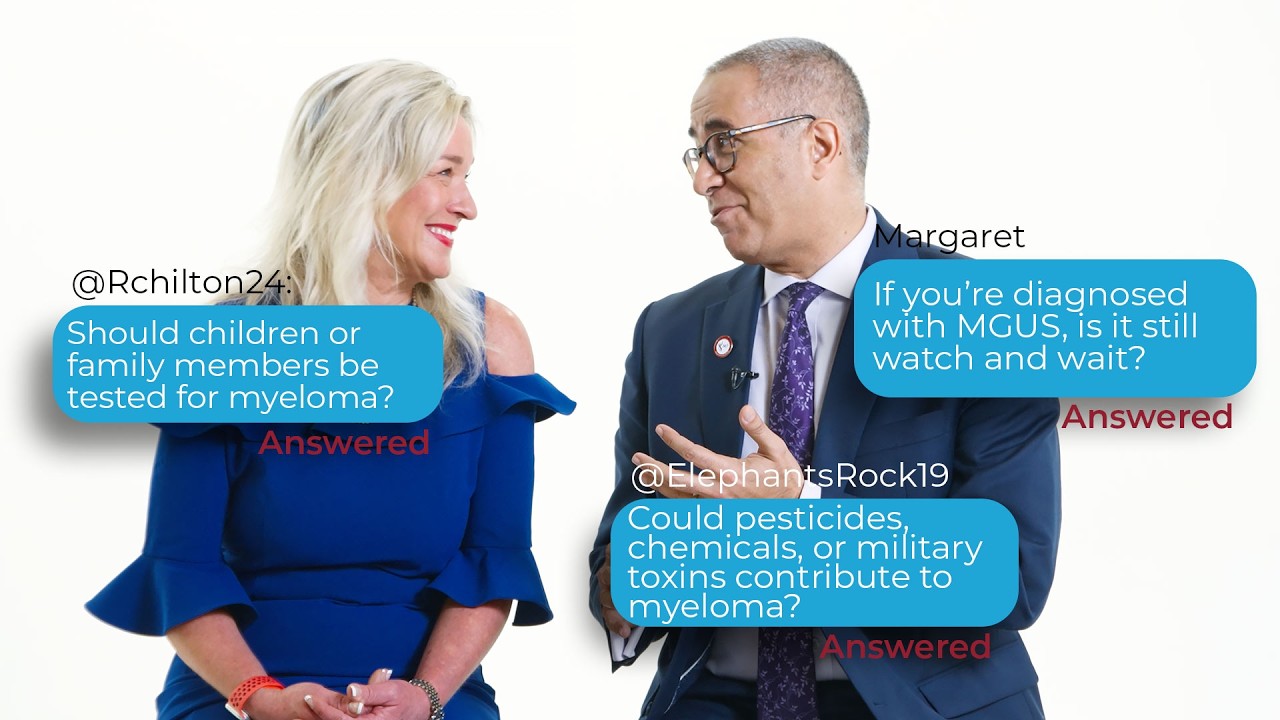
I was diagnosed with myeloma in 2023 at the age of 63. My sister was diagnosed two years later. Should our children be tested? If so, at what age should that begin?
Beth Faiman:
Well, that's a very interesting question, one that I get all the time. We know that there may be a familial link, but we're not quite sure. And so what I recommend for patients is to educate their family members on their diagnosis and have the discussion with their primary care providers about the recommended screening. Maybe it would be recommended in high risk patients, but not for everybody.
My family has multiple cancers, could pesticides, DDT, pharm chemicals, or military toxins contribute to myeloma?
Dr. Joe:
Well, first of all, I'm sorry to hear that there are multiple cancers within your family. The cause of multiple myeloma has still been challenging for us to really understand. We know that there have been some exposures that put people at higher risk of developing multiple myeloma. Things like Agent Orange, firefighters who've been exposed to repeated fires, and potentially some of those chemicals that were listed in the question. But of course, it's always hard to make that a definitive answer.
When we see those toxins, where we see that previous exposure, we have learned, however, that myeloma is myeloma, and we treat it pretty much the same way, whether someone has had that exposure or not. And if you have more concerns, of course, discuss this with your healthcare team so they can look more carefully into the history.
If you're diagnosed with MGUS, is it still watch and wait?
Beth Faiman:
It's not necessarily watch and wait. I think of it as watchful waiting because what happens is there's different levels of MGUS. Some people have MGUS is just MGUS where they have a little extra protein and it's not harming their body at all. Other individuals have a higher risk of needing treatment for multiple myeloma. So it's really important to finally understand, discuss with your healthcare team, what is my risk?
And there are risk calculators available now that will calculate our risk, but do you have just a little bit of MGUS where you're monitored every three or six months or every year? Or are you more in a smoldering category? So discuss your concerns with your healthcare team and hopefully you'll feel comfortable and confident with the answers.
Does bone destruction begin silently during MGUS and can we interrupt that pathway early?
Dr. Joe:
That's a fascinating question because it speaks to the fact that myeloma is always preceded by what we call precursor conditions, MGUS or monoclonal gammopathy of undetermined significance and smoldering myeloma. But the question asks it very brilliantly, could it silently be happening? And that's a reminder to us that when we do have patients with MGUS or smoldering myeloma, we should be evaluating their bones to ensure that that destruction is not starting because if it is, it may unfortunately mean that they have progressed to multiple myeloma. Let me pause here for a moment to remind you that the IMF makes getting updates in multiple myeloma, both easy and accessible.
Beth Faiman:
So to make sure you never miss any future events and stay in with the latest and greatest information, please go to subscribe.myeloma.org and make sure you're on that newsletter list.
Dr. Joe:
Great. Well, let's get back to our questions here, Beth. How does someone know that they're high-risk myeloma?
Beth Faiman:
So high-risk multiple myeloma is defined by a variety of clinical and laboratory features. So basically we're looking at your bone marrow biopsy results, your blood results, how high is your protein? Where's it located? And then we look at the chromosomes under the microscope to determine one's risk status. The International Myeloma Working Group has great guidelines which you can find online to see where you are classified as high risk or standard risk myeloma. And as Dr. Joe has said before, we treat all myelomas the same, but we might treat those with high risk myeloma a little bit more aggressively to get rid of those clones, to keep one in remission and to get the best deepest and durable remission possible.
Catherine asked an interesting question. What breakthroughs are coming for high risk patients, Dr. Joe?
Dr. Joe:
Well, as we know, we divide multiple myeloma into standard risk and high risk categories. About 25% of patients have that designation of high risk myeloma, which just typically means that the myeloma is likely to grow a little bit more quickly. But thankfully, we have a lot of breakthroughs that are demonstrating to us that when we take a more aggressive tact in treatment, which typically means using more combinations of therapy, treating patients for longer, and seeking that deepest response, MRD or minimal residual disease negativity, when we do those three things together, we've learned that we can significantly reduce that, if you will, high risk status so that patients can do better with this disease.
I'm also excited looking into the future that we're now designing clinical trials specifically for patients with high-risk multiple myeloma so that we can bridge that gap and continue to improve the prognosis of our myeloma patients, even those with high-risk disease.
So here's another great question that I have for you from Dora. Are there any updates for non-secretory multiple myeloma?
Beth Faiman:
So non-secretory myeloma happens when we're not able to detect the abnormal protein in the blood or the urine like we usually could. Sometimes the protein is hiding in the bone marrow environment, sometimes it's attacking the bones. What's nice to know is we have better imaging techniques. Sometimes you might have to go through more bone marrow biopsies, but it remains that the myeloma might be growing and we need better ways to detect it so we can get you in the deepest and most durable remission possible.
Stephanie asks, "Is it true that myeloma comes back more aggressively each time?"
Dr. Joe:
Unfortunately, in general, the answer to that question is yes. When we think of how the biology of myeloma works, when it is first diagnosed, it hasn't been exposed to any treatment. It's relatively naive, if you will, which reminds us of how important it is to treat it effectively the first time. But we also know, unfortunately, we don't really cure myeloma with that first treatment, at least in the vast majority of patients. So when it comes back, it does tend to come back a little bit more aggressively. Typically, it has overcome the drugs that it's been exposed to before, so it becomes what we call resistant to those therapies.
Now, thankfully in multiple myeloma now, we have new mechanisms of action and multiple drugs, now over 20 drugs approved in myeloma to overcome it, but yes, typically it comes back a little bit stronger. Now, lastly, I would say that we are with our brand new therapies, with CAR T-cell therapy and bispecific antibodies, we're seeing patients even who have had multiple relapses have the deepest and most durable remissions they've ever had. So I hope in the future, we'll be able to counteract any aggressive myeloma with a more effective treatment that can give patients a better quality and quantity of life.
Pua asks us, what is considered a low dose of dexamethasone?
Beth Faiman:
This is such a great question, Pua, and so thank you for asking it. So back when Dr. Joe and I started practicing, we gave patients dexamethasone 360 milligrams a month, four days on, four days off. That was considered high dose dexamethasone. Subsequent clinical trials showed 40 milligrams weekly is the recommended dose. Now, a low dose of dexamethasone is no dose of dexamethasone, in my opinion, but some people need it.
Drugs like daratumumab, carfilzomib, and some of our other treatments need maybe a four milligram dose of dexamethasone to offset side effects. So it's really subjective what a low dose of dexamethasone is, but it's typically a much lower dose than we used to use historically. And I have another question for Dr. Joe to follow along that vein. Is dexamethasone responsible for my abdominal changes?
Dr. Joe:
I'm sorry to hear that you're experiencing some of the side effects of dexamethasone. Now, dexamethasone is the drug that we love and that we hate. We love it because it really does boost the effect of almost every therapy we have in myeloma. It can reduce the risk of having an infusional or administration reaction, and sometimes it can even reduce nausea and indeed reduce pain. But at the same time, it comes with lots of side effects. It can increase blood sugar. It can increase blood pressure. It can make people a bit anxious and sometimes have difficulty sleeping, and of course, it can cause some abdominal issues.
I would absolutely speak to your provider about those abdominal issues because it may be related to dexamethasone or it may be related to something else. In general, to reduce the side effects of dexamethasone, we're taking a strategy now where we reduce the dose of dexamethasone as someone is being treated so we can maximize its benefits, but definitely reduce that risk of those side effects that we see so commonly. Thanks so much for watching today.
Beth Faiman:
And if you liked these videos, there's more of you to enjoy. I like the one that you're discussing, the newly diagnosed myeloma patients, Dr. Joe.
Dr. Joe:
Well, I'm glad you like that one, Beth. And if you want to see other videos, subscribe to our YouTube channel and you'll find many of them, including the ones in our upcoming live events where we will be discussing the latest and greatest in multiple myeloma.