


Dr. Brian G.M. Durie:
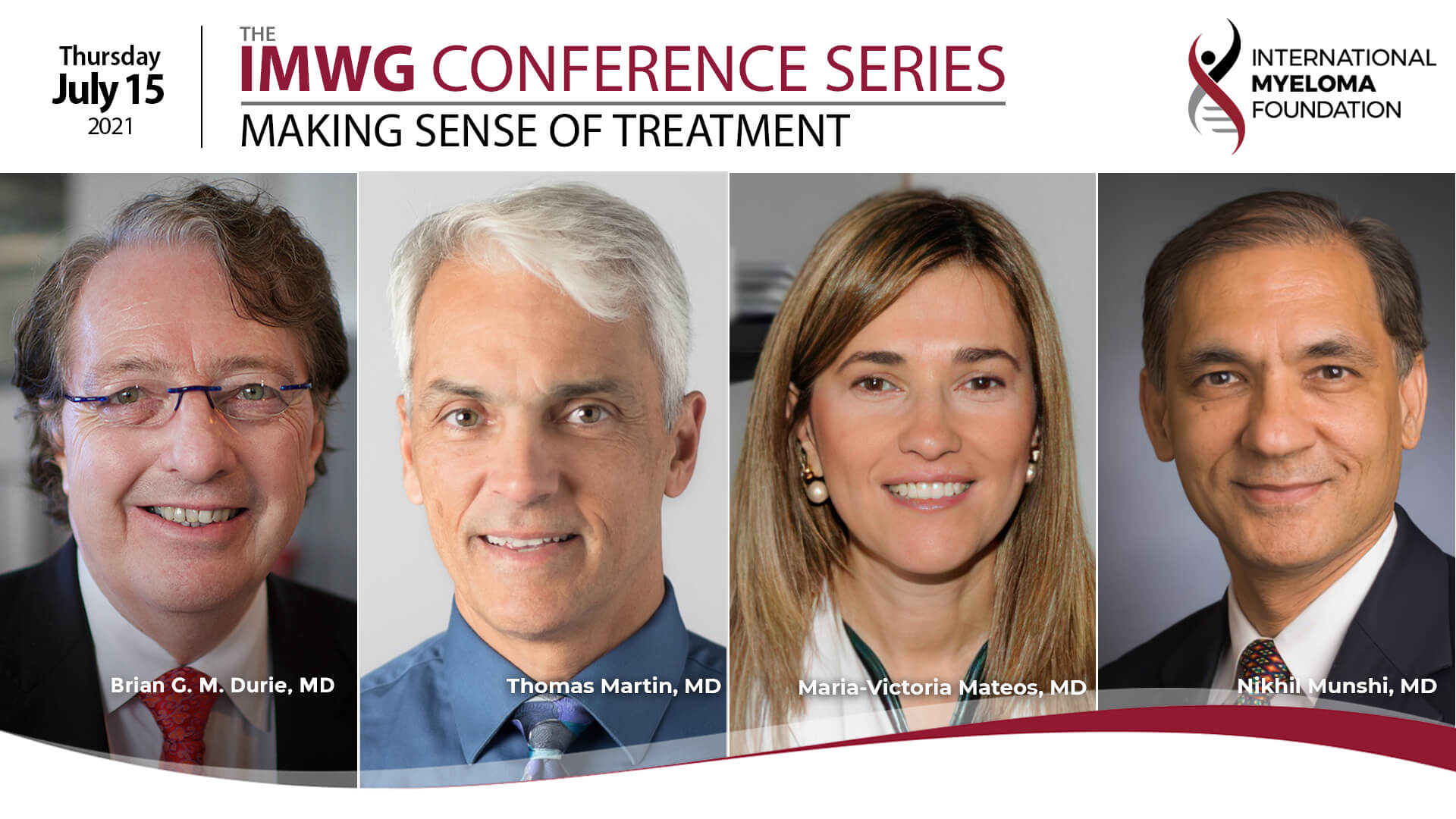
I'd like to welcome everyone to the IMWG Conference Series: Making Sense of Treatment. This is an event which normally occurs in person at the time of the EHA meeting. We're all very sad that we're continuing with this in a virtual fashion. But, next year, I'm optimistic that we will all be together.
The guests for today, I'm very, very pleased to welcome Dr. Tom Martin from the University of California in San Francisco. Welcome, Tom. Very pleased to welcome Dr. Mary V. Mateos from the University of Salamanca in Spain. And, Dr. Nikhil Munshi from the Dana-Farber in Boston. At the time of the IMWG, Nikhil actually received the Robert A. Kyle Lifetime Achievement Award. Congratulations again to Nikhil for that special event. Again, we will be able to celebrate again in person next year, Nikhil.
Dr. Nikhil Munshi:
Thank you so much, Brian. It was an unbelievable honor.
Dr. Brian G.M. Durie:
Let's go ahead. We have sponsors for this today. Amgen, Janssen, Karyopharm, Oncopeptides and Takeda Oncology. Starting with ASCO, which was a virtual ASCO this year, there were 4,782 abstracts, which was down a bit from the normal number of abstracts for ASCO. There were 282 myeloma related abstracts, 26 oral, 32 poster discussions, 106 poster sessions. The rest were for publication only. A lot of interesting abstracts.
Today, we're going to focus on a few which I think are helpful for discussion. But, just to let everyone know, the IMF actually has taped 42 principal investigators talking about their abstracts. Those interviews, three to five minute interviews, for 42 abstracts between ASCO and EHA are available for playback actually on the IMF website. One of those is the playback with Saad Uzmani who presented at ASCO, the update on the cell-to-cell study, the CARTITUDE-1 analysis.
I think that this particular update was really pretty amazing for everyone with the median follow up of 18 months. The overall response rate, 98%, and stringency are 80%. The PFS response duration, 66% at 18 months. I'll be interested in everyone's reaction to this. But, I have to say, personally, I was amazed to see these results, which... Very, very promising. But, also, made note of the fact that there were some newer concerns about delayed neuro toxicities and best ways to possibly mitigate against those.
We also had an update. This time was provided by Amrita Krishnan. Again, her video is taped on this. She updated everyone on the results of the bispecific teclistamab, BCMA-CD3 bispecific antibody in relapse refractory myeloma. Again, quite promising results. The 40 patients response rate, 65%, with deep responses obviously less impressive than CAR T. But, significant deep responses. In the case of teclistamab, toxicities are acceptable and manageable. Another presentation, elranatamab, excuse me. Unfortunately, this bispecific from Pfizer, this study actually had to be discontinued because of concerns about toxicity. Very exciting and very active agent. But, we're waiting to hear further about that.
When we start to look at these exciting new therapies, and I brought them up first because those are the things that people are most interested to hear about. If we focus on the CAR T first, the first point is that ABECMA, the BMS cell gene product, was approved by the FDA and is rolling out in the US. Tom and Nikhil, I don't know if you'd like to comment on how is that going. Maybe Tom first. I know that you had enrolled at least one or two patients already. How is that going from your standpoint?
Dr. Thomas Martin:
I think it's been a little bit challenging. It's mostly because everybody's been awaiting the rollout of CAR T and the approval of CAR Ts. Across the United States, we all have had probably anywhere between 10... 50 patients that we think were eligible for this product and are waiting. We just overloaded the system with people that are actually eligible to receive the product.
We're trying to do a lot of maneuvers to try to keep people in the lineup to get their CAR. We're awaiting slot allocation from BMS to get these people onto CAR Ts. We literally still have a list of 25 to 30 right now at UCSF. Right now, we're getting four slots per month...
Dr. Brian G.M. Durie:
Oh, wow.
Dr. Thomas Martin:
... of BMS. So, it's going slow. I think they're hoping that that will increase soon. But, certainly, having a second CAR on the market will help. We're awaiting that at the end of the year. I don't know [inaudible] How are you guys doing?
Dr. Brian G.M. Durie:
Yeah. Can I just ask Tom before you stop there, have you had a patient actually receive the CARs yet or not?
Dr. Thomas Martin:
Yes.
Dr. Brian G.M. Durie:
Yeah. Okay, good. Yeah, yeah.
Dr. Thomas Martin:
We've actually had literally one patient that has been treated with this.
Dr. Brian G.M. Durie:
One patient so far. Okay.
Dr. Thomas Martin:
Yeah.
Dr. Brian G.M. Durie:
All right. Nikhil, what's your take on this?
Dr. Nikhil Munshi:
I totally, totally echo and share Tom's comments that it has been a challenge although the product was approved end of March. If you ask anybody, we have first patient, the CARs are being produced, not infused yet. And, we have a long list of patient, exactly as Tom mentioned. It has been a challenge and partly the production is a problem. I think once the scale up to the level that the demand is, then things might get eased up.
When patients were on study, we were all complaining that we don't have slots. Patients are waiting and waiting. After becoming commercial, we are still waiting for slots. That's our problem. But, I think that's a transient thing. Again, there are hundreds of patients from all over across the country who want this. The demand is so high that we can really understand why there's an issue. I think in next few months it'll ease off.
I think learning from this and also having a second product, as Tom said, might ease up the availability. And then, we'll have more patients being treated. But, the bottom line is, besides all the negative we have said, I think the great hope and the main line is that these treatments are now commercially available. We don't have to stick to a very strict criteria we were using for the studies. Patients with low-secretory disease or non-secretory disease, or with little bit of cardiac issue or patients who require bridging therapy, they cannot get this or that. Those are all gone because it's commercial. We do what is best for the patient, and we can treat this patient. So, there's a really great time to be doing this as soon as this becomes a little bit more accessible and available.
Dr. Brian G.M. Durie:
Right. Right. Right. Mary V., what's the outlook in Europe? What is the timeline? What is happening in Europe right now?
Dr. Maria V. Mateos:
Yeah, fortunately, the committee that advised to the European Medicine Agency gave its positive opinion some weeks ago, also for ID Cell. This means that the European Medicine Agency will approve it very soon. Hopefully, in 2022, we will have a commercially available also ID Cell in Europe, or at least in Spain. I think that this is good and, well, going or taking into consideration your learning process and how many patients are candidates, we hope that we will have slots for our patients here in Europe. But, I think that I completely agree with what Nikhil said. I think that the situation is excellent because this means that many patients are going to be available to receive ID Cell or other BCMA CAR Ts. This means that the need does exist, and hopefully we will have available also here in Europe.
Dr. Brian G.M. Durie:
Right. What is your reaction to the new update on the CARTITUDE study. The results, obviously, are very promising.
Dr. Maria V. Mateos:
Yeah, sure. The results are great and, in principle, are unprecedented for the population in which the trial was conducted. This is applicable to [inaudible] coming from the CAR T too, as well as also from ID Cell, coming from the karma. Because, patients, after more than six prior lines of therapy, almost all of them tripled refractory with this great overall response rate on the medium progression for survival for [inaudible] over approximately two years. Indeed, the PFS cure, we seen [inaudible] yet because many patients were [inaudible] so that the before the medium follow up, well, are unprecedented. I think that the situation is excellent.
Dr. Brian G.M. Durie:
Yeah. So, obviously, we're optimistic that there will be a favorable ruling from the FDA and probably the European agencies as well. Yes. Yes. In the bigger picture, obviously, there are trials going on. Maybe, Tom, back to you. What do you think about the earlier use of these products? We're all thinking that that's probably the way to go.
Dr. Thomas Martin:
Yeah. I would certainly concur with that. We are, number one, I think losing a lot of patients who would be eligible because they've had so many prior lines of therapy and their counts can't remain stable, or their disease can't remain stable for them actually to cross the line after the CARs are produced and for them to be able to receive it. If we can time it earlier in their disease course, there's so many advantages of that.
The T-cells are less heavily pretreated. Hopefully, they're less exhausted and hopefully they're more robust. Their disease is under better control. They can go into the CAR T-cell therapy again with less burden of disease. And then, post-CAR, likely with less burden of the disease. There'll be less toxicity. I would say less late neurotoxicity, less CRS. And, again, better count recovery. It's all going to bode, I think, for us to use these favorably in an earlier line of therapy. I personally think that it's going to eventually replace autologous transplant because it provides a more robust anti-myeloma effect with actually less toxicity than high dose Melphalan in that regard. That's where I think we should position ourselves.
Dr. Brian G.M. Durie:
Absolutely. Yeah. The discussion has been that these toxicities, particularly those later neuro toxicities, we probably will see less if the T-cells are used earlier. Yeah. Nikhil, what's your thinking? What do you see as the ideal positioning for CAR Ts?
Dr. Nikhil Munshi:
Yeah, it's certainly going to be early on. But, I think the interesting observation is, overall as, Maria V. said, the responses are so incredible. It kills the cells. 96, 97% patients get response. And, 70 plus percent patients get CR. This is million of six line, prior lines of treatment. Now, in ASCO, they also presented CARTITUDE-2 data, only 20 patients. It's a small number. But, if you look at the CARTITUDE-2 data, it's exactly identical. 98, 96% response rate. 80% CR rate and 73% on CARTITUDE-1. There's no real difference. The only thing is that the CARTITIUDE-1 data is so good, how much more can you improve on a 75% CR rate?
Dr. Brian G.M. Durie:
Absolutely.
Dr. Nikhil Munshi:
I think that's a good problem. But, I don't know we would get any earlier more results because almost we are reaching limit. Except, I think the durability is going to be of critical importance. If we do it early, other response is durable compared to when we do it in line six line of treatment. I think that's going to be the critical important point. And then, of course, toxicity and how to mitigate it and everything else.
Dr. Brian G.M. Durie:
Right, right, right. The final point here is next generation CARs. Mary V., how do you see that? I mean, we'll have these two products hopefully available commercially. What should we really be looking for or focused on with a next generation CAR product? What is it that we really need in terms of improvement, do you think?
Dr. Maria V. Mateos:
I think that ASCO, EHA and especially us in 2020 brought us different BCMA CAR Ts, trying to increase the T-lymphocytes with a naive stencil memory phenotype in order to increase the persistence with final results in longer durability of the response. I think that ID Cell and [inaudible] are excellent. They will be the first commercialized BCMA CAR Ts. But, this is going to be a starting point.
ASCO brought us a new BCMA and CD19 CAR T, increasing the specificity. We have some fully human BCMA CAR Ts in order to improve the safety profile and in order to increase the persistent. Hopefully, but I am not completely sure, the next step will be the allogenic CAR T as a 2020 percent, a trial. And, EHA and ASCO, another one, from my point of view is to that sample size is rather small. But, results are not so positive as we expected. Safety profile is excellent because CRS and neurotoxicity and even [inaudible] disease is very, very low. But, efficacy from my point of view is not so positive as the results that we have right now with the [inaudible] BCMA CAR Ts. We will see in the future.
Dr. Brian G.M. Durie:
Right. Right. But, I think that it will be hard to demonstrate the added benefit with such a high, early response rate with, for example, the CARTITIDE studies. I mean, it's going to be hard to show that something is better.
Dr. Maria V. Mateos:
As Nikhil said, I think that we have to work more on the depth of the response and the durability, and the sustained MRT activity rate and how this translate in outcomes. I think that this will be the space in which we can improve these results.
Dr. Brian G.M. Durie:
Right. Right. Okay. With all of this, where will the buy specifics fit in? Maybe, Tom, you might want to jump into that one first. Obviously, the big difference is that with the bispecifics there's ongoing IV or SubQ therapy. Right now, the trials are open-ended. With a couple of trials already discontinued, there continue to be concerns about toxicity, especially neurotoxicity. What do you see as the perspective for the bispecifics?
Dr. Thomas Martin:
I'm pretty excited about the bispecifics, in fact. I think it does, and it's going to, reach a broader myeloma population. These are off the shelf compounds. They're going to be able to be used in the community. They're going to be able to be used in academic centers. Whereas CARs really can be done right now in academic centers. It's going to be a much larger and a much more broad population.
Now, the response rates have been about 60 to 70%. They do have a response rate that's a little lower than CARs. But, again, more people are going to be able to, I think, achieve benefit from these because you can use it in patients who are actively progressing. Whereas you can't do that with CARs. They have to actually be ready to have their T-cells collected and be manufactured and then be able to be infused. I think that the bispecifics are going to give CARs a run for their money.
The CARs are going to... For the healthy and the strong and the people who can come to the academic center. But, the bispecifics are going to be used broadly, and I think can be used up to age... We have some people that are 80, 82, three years old getting bispecifics. And, they're doing fine actually in complete response. They do get deep durable responses. We'll have to see. I am more concerned, like you said, on the toxicity, the long term toxicity. Most of that is immunosuppression.
[Inaudible] working with some late CMV reactivation, some reactivation of other viruses that just hang out in the body like one called parvovirus. Instead, we just have to be careful of how much therapy do they really need. I like this in what you say course of therapy, six months. I would love the six months and give it either stringency or stop. Give them a break.
Dr. Brian G.M. Durie:
Right. Exactly. Yeah. Nikhil, what's your take? Similar?
Dr. Nikhil Munshi:
Yeah, I think bispecific definitely are here to stay. I think they're functional. They are relatively easier to administer and the toxicity are bit less than what you see with the CAR T. After saying that, I think there is a clear difference in my mind between the depth of response you get with CAR T-cells and even the frequency of response. Bispecific, you take any type, teclistamab, daratumumab, or any other. 60, 65% response rate. 30% to also CR rate. They don't reach the same that CAR T does. Definitely superior. I think we have to keep that in mind. But, we'll find the right use of bispecific. Is it maybe a post-CAR T maintenance. You can give six months of bispecific, or some such use. I think they're really important, they really work. Their place will be determined over time, based on their depth of response and the duration of response.
Dr. Brian G.M. Durie:
Right, right. Any added comments, Mary V.?
Dr. Maria V. Mateos:
No, just to mention that, in principle, the efficacy seems to be a bit better for CAR T than bispecifics. I think that it is spending the durability of the response PFS and overall survival. Because, we don't have any data from any of the BCMA bispecific monoclonal antibodies. I think that definitely they are going to be much more available than BCMA CAR Ts, but we have to consider the durability of the response.
Dr. Brian G.M. Durie:
All right. Okay. Let's move on. Another very interesting abstract was from Philippe Moreau, whom we all know very well, presenting an update part two of the CASSIOPEIA study. For me, obviously, there was a validation of the benefit of the quad over the triplet. But, one thing that struck me was that there was not added benefit of the dara maintenance for the patients receiving the quad therapy. Maybe coming from Europe, maybe Mary V., what was your take on the CASSIOPEIA Part two data set?
Dr. Maria V. Mateos:
Well, this is an interesting study. But, with some, I would say, issues or problems. Because, the main problem from my point of view is that the control arm is observation. We know that observation is not anymore the standard of care for maintenance. This is the first point. The second one is data was given every eight weeks, and this is not the conventional schedule for data to [inaudible]. The third point, the maintenance is today, in principle, something given as continuous therapy. Here, maintenance was stopped at two years. If we consider all this information, my take home message is induction, transplant, and consolidation are very important. Because, I think that the benefit observed in the progression for survival from the second randomization is basically derived from the induction and consolidation. It's true that when a data is given as part of the induction and consolidation, maintenance with data seems to add no significant benefit.
I would say that we need a longer follow up, because I personally consider that the arm with no maintenance, these patients will start to relapse sooner than later. But, the main problem is that as the treatment was fixed only two years, I don't know if we are going to have time enough in order to see the differences. But, in principle, I think that, and this is very unfortunate, but the maintenance therapy is not going to change. The standard of care will continue being lenalidomide until the data from the [inaudible] study, in which data plus lenalidomide is being compared with lenalidomide. This is my point of view.
Dr. Brian G.M. Durie:
Right. Right. Any additional takes on this Tom or Nikhil? I think a very good analysis, Mary V. Very, very helpful in taking us through. Doesn't change our thinking about dara maintenance yet, probably.
Dr. Nikhil Munshi:
Not at the moment. Yeah.
Dr. Brian G.M. Durie:
Right. Moving on forward, we also had an update on the upfront autologous stem cell transplant versus carfilzomib cytoxin dex. Again, with maintenance as part of the protocol. Again, we have an interview with the investigator here, Kwee Yong. The interesting thing here is that the KCd and autologous stem cell consolidation seem to be equivalent. But, despite both of those, the high risk patients were still continuing to relapse early. Nikhil, maybe I'll go to you first. Any particular takes on this study?
Dr. Nikhil Munshi:
Not exactly, except I think if you're judging the role of transplant, and role of transplant has been judged for many, many, many years now. It has persisted in many ways. It depends on what induction you use and, into some action also, what maintenance we use. Because, post transplant maintenance plays a significant role. Not having an immunomodulatory drug in induction in the consolidation component, maintenance component, I think makes me a little bit more uncomfortable in how I analyze the role of transplant here.
I think there's enough data around that clearly says that transplant does provide the benefit. There are also issues with transplant that we are beginning to think about. When we think of what may replace the transplant, it's not going to be something that is going to be standard chemotherapy. I think CAR T-cells would be the one, as Tom earlier mentioned, is what I would look at being replaced. That's a study that I would look at happening, which is actually in the process at multiple companies, to compare that to replace transplant.
Dr. Brian G.M. Durie:
Right, right. Maybe before I get more comments, maybe you could just comment. You did have one presentation where you looked at the impact of transplant on second primary malignancies, and you showed that there was probably a 2% difference. Six some percent versus four some percent difference with the second primary malignancies. Do you want to comment on that at all?
Dr. Nikhil Munshi:
Yeah. This is a really interesting study from a large database that was collected from the Veterans Administration Hospitals. Over 8,000 patients were included in this analysis. And, with a seven and a half year follow up, there was a 5% incidence of second malignancy. However, if you look at patients who were transplanted, the second malignancy was 6.6%, versus those who were not transplanted, it was 4.8%. Like exactly you said, there was a 2% difference, statistically highly significant. And then, also, brings in the point, where does transplant do this? We also had a presentation at a previous Mahmut Kemal [inaudible] presented data that when myeloma relapses after transplant, there is significantly higher mutational burden on almost 2,000 over the control arm, which is RBD alone, suggesting that even myeloma is a little bit more complex.
Now, what it means as in outcome wise, that is still for us to see. But, the second malignancy presented here was very intriguing data. That post transplant, there is higher incidence of second malignancy. It also highlights the fact that high dose Melphalan might be causing DNA damage, not only to myeloma cells for whatever reason, but also to normal cells that are exposed and does it.
I think there was also a component that we studied in this one to look at differences, racial differences, African American versus Caucasian population. We didn't find a significant difference there except for the prostate cancer, which is a known association, higher association in African American. To your question, Brian, in transplant setting, I think there is higher incidence of SPM that we are to keep in mind.
Dr. Brian G.M. Durie:
Right, right, right. Just to wrap up in terms of thinking about transplant and induction, the data with the CASSIOPEIA we just talked about, do we really think that the way forward is going to be with the four drug combinations? It seems that the data are consistently strong with four drugs versus three drugs. Tom, maybe you want to take this one first. Do you think that really we're headed towards a four drug induction now?
Dr. Thomas Martin:
I do. We're going to have, in the next one to three years, probably four studies read out of four versus three drugs. That will be in transplant eligible and also in transplant ineligible patients. Expect that in every one of those studies, the four is going to win over three. These are randomized phase three trials. These potentially will lead to approval of a CD38 plus VRD as frontline therapy. That will be the way that we'll be able to use them here in the US. We don't have a phase three result at the current time. But, we're all very impressed by the phase two GRIFFIN study data. I think we'll all switch over to a four drug start.
But, your second question, do we then do a transplant, is a trickier question. Right now, transplant certainly is part of the treatment regimen. It certainly decreases disease and gets us to the minimal residual disease status that we want to be at with transplant. Nothing has knocked it off the totem pole just yet. My prediction is a four drug combination followed by a CAR is what's going to knock it out. Then whether or not we need a bispecific for a little maintenance afterwards will be an interesting question. But, I do think that we're going to change the paradigm at some point. It's going to be four drugs to start plus or minus transplant, and we're going to use MRD as our goal.
Dr. Brian G.M. Durie:
Right. Right. Maria V., do you think we're going to be using four drugs?
Dr. Maria V. Mateos:
Yeah, sure. I think that the anti CD38 mono [inaudible] antibody plus PI [inaudible] and dexamethasone will be the new standard of care. In Europe, I can imagine that data or [inaudible] combination with VRD will be the next standard of care. Concerning transplant, yeah, I think that transplant today continues being the standard of care. But, I personally consider that a risk status and minimal residual disease will drive our decision.
Personally, I consider that some patients with no high risk cytogenetic abnormalities or high risk features achieving optimal response MRD negativity, maybe they can skip autologous extensive transplantation. This is something that the French group is evaluating in a prospective clinical trial. I think that this is the way in which we can potentially skip a transplant in some patients. The next step, as Tom mentioned, is to go to the phase three randomized study, comparing transplant with CAR T. And, if CAR T is superior, CAR T will be the next standard of care.
Dr. Brian G.M. Durie:
Right. Absolutely. Nikhil, maybe just a comment on the MRD piece. If, for example, dara VRD has achieved MRD negativity at 10th minus five or higher, what about transplant?
Dr. Nikhil Munshi:
Yeah, no. I was actually going to ask both my colleagues here that I would agree of what they have said. Whether using four drugs or three drugs versus transplant or not. But, if somebody gets into MRD negative, if it's a three drug regimen, do you need a fourth drug there? Also, would you wait to add the fourth drug after three cycles and see if they're getting into MRD negativity? Because, we may not need the fourth drug. The argument would be that the proportion of patients getting MRD negativity three, is around 20%. If you add the fourth drug, it'll be higher. We don't know the real number yet because they haven't been studied like that.
But, if you look at the FMD [inaudible] study where, again, the induction was not optimal, it was not six cycle before you do transplant, but with whatever the induction was, which was three cycles so far with RVD, and then five more cycles later, the MRD negativity at the end of the eighth cycle for RVD was around 20% or a little lower. And, MRD negativity was 30% with transplant. There was an increase of 50% MRD negativity with transplant.
Now, would we... That data clearly showed that those who did get transplant and got MRD negativity, or did not get transplant, MRD negativity had the same outcome. I think we need to wait for the resource of the studies to make a point whether transplant is needed or not if they're MRD negative. To some extent in good risk patients, better adding the fourth drug, whichever it is. It could be you can keep dara and take [inaudible] out or otherwise. But, whether you would need the fourth drug or not, if you do get MRD negativity, or when do you add the fourth drug, if you are not getting it. These are the good questions for us to study in the coming couple of years.
Dr. Brian G.M. Durie:
Right. Right. Right. Just to move on. We've already touched on this, Tom and Mary V. already said that will the new immune therapies become the consolidation of choice. It seems that there's definitely a possibility of that. But, we will need studies, obviously, to show that possibility. But, I think that talking about three drugs, I think that we were probably all pretty impressed to see the follow up from Thierry Facon of the Maia study with the dara [inaudible] versus [inaudible], and with the updated PFS over half the patient's cell in remission at five years. Pretty remarkable. Then, obviously, pretty impressive overall survival. For a triple therapy in the older patient, non-transplant, really pretty good results. Mary V., you want to comment about this first? This seems like a pretty strong standard of care, perhaps.
Dr. Maria V. Mateos:
Absolutely. I think that dara [inaudible] is really the winner in the management of the transplant in a [inaudible] or newly diagnosed myeloma patient. I think that we've never seen such as a medium progression for survival in a clinical trial in this population, medium PFS, of approximately five years.
Dr. Brian G.M. Durie:
Exactly.
Dr. Maria V. Mateos:
However, from... Yeah, this is great. This translate into a benefit in overall survival. But, I am just a bit intriguing about the response rate after rescue therapies. Because, if you see the progression for survival and the overall survival, there are not major differences. We have to consider that all these patients are going to be refractory to daratumumab and lenalidomide.
I think that if this small difference between PFS and OS is applicable to the elderly population, meaning that this population is going to receive just one line of therapy, I think that is perfect. But, we have to evaluate what is the response to the rescue therapies to the young population included in the Maia patients of 65, 66. For me, this is the only caveat or question mark I put to the Maia study.
But, definitely, I think that dara [inaudible] should be the standard of care for the transplant ineligible newly diagnosed myeloma patients. Another important point, maybe the control arm for the upcoming phase three clinical studies. But, I consider that it's difficult because with this medium progression for survival, it will take many years in order to demonstrate superiority. Therefore, Nikhil is here, we need a new [inaudible] rates in order to conduct the clinical trials with appropriate control arms.
Dr. Brian G.M. Durie:
Right. Yeah. Very good point.
Dr. Nikhil Munshi:
Brian is spearheading this effort and I think we, hopefully... Not hopefully. We will win and we will get it.
Dr. Brian G.M. Durie:
Yes.
Dr. Maria V. Mateos:
Okay.
Dr. Brian G.M. Durie:
Absolutely. Absolutely. Any further thoughts Tom or Nikhil? I mean, obviously, these are amazingly positive results. I think, for me at least, surprisingly better than any of us anticipated really.
Dr. Nikhil Munshi:
Yeah. This is without even exposure to [inaudible] inhibitor, which would be a second line available and which is one of the top drug anyway. I think these are amazing. It does set up daratumumab as a standard of care for newly diagnosed patient in this age group. The only caveat for American population would be that we do consider 70 and above, 70 and below as transplant eligible. Our older population is a little bit older than Maia. But, this is very real, tolerated treatment. DRD is a great regimen for this patient population.
Dr. Brian G.M. Durie:
Right. Right. Absolutely. Okay. Another two or three abstracts looked at the role of mass spectrometry, and I'll be interested in your take on what will be the role for mass spectrometry testing. Angela Dispenzieri from Mayo presented testing with the high sensitivity mass spectrometry in the STAMINA trial. She showed that it was actually the MASS-FIX results were an excellent independent predictor of both PFS and overall survival.
The data are a little bit incomplete, but compared well with MRD testing using NGF. Mary V., you are very familiar. Your colleague, Noemi Puig, presented analysis of Mass Spec in the GEM 012 study. Again, showed that Mass Spec was a complimentary tool in assessing outcome for patients. Really pretty interesting. Then there was another presentation looking at depth of response in ultra high risk myeloma. Really a lot of emerging data on Mass Spec. Maybe, Mary V. first, since the Spanish study was presented. Is the Mass Spec ongoing testing, is that a good way to assess MRD testing in an ongoing way? What do you think?
Dr. Maria V. Mateos:
Well, first I consider mass spectometry definitely is more sensitive that the conventional electrophoresis in monofixation. Concerning the minimal residual disease, I would say that today it's a complimentary technique. As mass spectometry is more sensitive than in monofixation, I think that it is going to help us to optimize the timing in which we have to go to the bone marrow. This is important because we are going to be much more precise when we go to the bone marrow. Maybe the probability of having MRD negativity is going to be higher.
In the Spanish approach, there is a good concordance between next generation flow and mass spectometry. Some discrepancies have been accorded, but also for me, it's important to see how both MRD by next generation flow. MRD by mass spectometry are good surrogate rate markers, predicting PFS and out and overall survival. But, I would say today from the audience. I think that mass spectometry, the idea is not [inaudible] to replace minimal [inaudible] in the bone marrow or outside the bone marrow. Its something complimentary. We are implementing this technique in all of our clinical studies, just in order to have further knowledge and, I repeat, complimentary techniques.
Dr. Brian G.M. Durie:
Right. Can I ask you, do you have any sense yet of the outcomes for patients who are NGF or NGS negative, but positive with Mass Spec? Is this a subpopulation that's important?
Dr. Maria V. Mateos:
Absolutely. Both. Well, discrepancies in both directions are important. But, we need a longer follow up in order to see if... Well, if patients with... Well, we have observed some patients in which the mass is positive and the MRDs negative with extra medullary disease. This is an important consideration. With mass spectometry is negative, but the bone marrow is positive, we have to wait because this means that there maybe minimal receival. This is in the bone marrow. Is more sensitive. And, we have to repeat it...
Dr. Brian G.M. Durie:
Wait...
Dr. Maria V. Mateos:
Because, maybe the MRD will be negative in the upcoming months. This is what we are doing in all of our clinical studies in order to have much more information. Especially, it will be helpful in order to detect maybe earlier relapses. Now, we are utilizing serum free light chain or in monofixation, and maybe mass spectometry can inform us about early relapses. We will see. But, from my point of view, it's interesting. In the future, maybe mass spectometry could replace serum protein, electrophoresis. And, in mono fixation because it's more sensitive and much more specific, no interference with the monoclonal antibodies we are using more and more in the clinic.
Dr. Brian G.M. Durie:
Exactly.
Dr. Maria V. Mateos:
Maybe this will be the future.
Dr. Brian G.M. Durie:
Right. But, Tom, for example, will it be easy for us just to get used to switching over from SPEP and immunofixation and use Mass Spec? How do you see that happening?
Dr. Thomas Martin:
Yeah, that's going to... Actually, there's a challenge. There's a definite challenge in terms of implementing this technology. I do think the technology is going to be complimentary. But, perhaps better utilized than bone marrow biopsies and NGF and NGS. Patients don't want to undergo multiple bone marrow biopsies. You can only do it maybe every six months, once a year. This you can do every couple of months.
Dr. Brian G.M. Durie:
Whenever you want. Yeah.
Dr. Thomas Martin:
... times a year. It's pretty easy. A blood test. You can't have difficulty getting a blood test, which is great. We all have to, I think, get comfortable with this. Start sending MASS back together with the SPEP the IFE, to see how these correlate and to see how the reporting is going to continue to be done using both of these. I think it's going to be challenging actually. It's going to be challenging to look at when the SPEP and the IFE is undetectable, but we see a rise in the Mass Spec. What do we do?
Dr. Brian G.M. Durie:
Exactly. Yes. Yes. Nikhil, yeah, what do you think?
Dr. Nikhil Munshi:
I think, because it is blood tests, we are all very gung ho about Mass Spec. But, I would raise a word of caution here. It's a great technology. It detects very low level of protein. But, where is that protein coming from? Is it coming from a live myeloma cell, or is it coming from an extra vascular space where the protein is deposited? Or, amyloid where the protein is deposited and it's coming back to the circulation, which this very, very sensitive method is able to pick up.
Similar to our experience with MRD measurement, where we know patients in VGPR could be MRD negative. What does it mean? Well, it is a circulating protein, which is still degrading. And, after six months or so, the VGPR patient becomes a CR. And then, he's still MRD negative. Now, we are going even below CR and we are able to measure even very tiny amount of protein. What does it mean?
I think we have a little bit more homework to do. I think it's a good technology. But, as Tom said, and Maria we said, I think if used in a practical term, will be complimentary so we don't do bone marrow every three months or six months. We might do Mass Spec as a screening tool and then eventually do MRD as more ultimate tool. I would think NGA for NGS would still be our ultimate go to final surrogacy marker. Mass Spec being intermediate to do something quicker.
Dr. Brian G.M. Durie:
Right, right. Thank you. Yes. Yes. Okay. Then interesting data on imaging. I have to say we've really been struggling with the best way to implement imaging, especially at low levels of disease. This was an interesting study by Martin Kaiser, looking at whole body MRI, showing that it did pick up disease that was missed using whole body FDG PET. Really pretty interesting. Maybe go back to you, Mary V. In terms of screening patients with early disease, whole body low dose CT is I guess the standard, right?
Dr. Maria V. Mateos:
Yeah. It's true. I think that, in this study, I think that the conclusions were that, in principle, whole body MRI was able to detect more lesions than PET/CT. But, from my point of view, we have to be cautious because the sample size was rather small. Only 60 patients. Indeed, I don't know if in this study, the new criteria published by Yelena [inaudible] in order to evaluate the response throughout PET/CT was considered in this study.
I think that MRI and PET/CT are, again, complimentary techniques. I think that whole body low dose CT's an excellent technique in order to evaluate the bone disease. PET is excellent from the metabolic point of view. And, MRI is able to detect more disease burden, bone marrow infiltration. I think that the comparison is good in this studying. In principle, whole body MRI is able to detect more lesions. But, I would like to wait to see more studies, long term follow up. Because, today, I think that whole body low dose CT is the standard of care in many sites. I think that it should continue being the standard of care, or ideally PET/CT in order to complement with the metabolic part.
Dr. Brian G.M. Durie:
Absolutely. Any additional thoughts. Yes?
Dr. Nikhil Munshi:
I think Philippe Moreau had a good paper from IFM study, comparing MRI and CT. He had 93% diagnostic value for both, very similar. I think I agree this is interesting data here. But, may want to wait to get a little bit larger study, more granularity to the data and see what it would mean, whether MRI or PET/CT have equivalent or differential ability to detect. High risk [inaudible] I don't know whether there is anything to do with high risk where we see more extra [inaudible], which is where I would've expected CT to be more sensitive. I think I would keep it open for now.
Dr. Brian G.M. Durie:
Yes. Okay. Just moving forward. Another interesting study actually from Thierry Facon. This was a little bit surprising for me, but he really showed excellent results in the elderly subpopulation receiving the combination of selinexor with bortezomib and dexamethasone. This was for patients over age 65 and with benefit for both PFS and overall survival. Maybe, Tom, maybe go with you first. What was your take on this? Is this a useful regimen for older patients?
Dr. Thomas Martin:
I actually have some reservations about this. We have...
Dr. Brian G.M. Durie:
Okay. All right.
Dr. Thomas Martin:
We have so many agents to be used in early relapse. For me, honestly, two very toxic drugs. One is bortezomib because of neuropathy. A lot of patients who receive bortezomib is frontline therapy. They've received their maximum amount because they have neuropathy and then don't use it anymore. That's hard. Then selinexor, even at a weekly dosing of selinexor, it's toxic and there are other choices that you could make. We have daratumumab, isatuximab. [inaudible]. We have pomalidomide.
Dr. Brian G.M. Durie:
All the new agents that we'll touch on in a minute.
Dr. Thomas Martin:
Correct. And, all these new agents coming down that potentially are, again, a little less toxic. I'm not sure that this changes my administration of salvage therapies for relapse refractory myeloma.
Dr. Brian G.M. Durie:
Okay. Mary V.
Dr. Maria V. Mateos:
I think that if we extrapolated this data, just coming from the Boston study conducted in relapse and refractory myeloma patients after one to three prior lines of therapy, I agree with Tom. I think that we are not going to use much more this combination in this situation. But, if we put together all data we have a coming from selinexor, in combination with the daratumamab, pomalidomide, the CAR [inaudible] I definitely see the role of BCMA targeted therapy moving earlier on. We have previously discussed maybe as part of the first relapsing the upcoming years. And, maybe in third line, four line and beyond, there will be a place to recapture selinexor in combination with whatever partner. Personally, I consider that the results are reported in combination with CAR [inaudible]. Maybe where I think that quite good, and I would say that selinexor given just once per week is much more better tolerated and is a good compliment for whatever standard of care.
Dr. Brian G.M. Durie:
Yes. Okay. I think we all agree. This was interesting. A little bit surprising. But, yes, the positioning of this, we're not sure. All right. Before we close, normally this presentation is done right between the IMWG summit and the EHA. All of you did participate in the IMWG summit this year, and we've already touched on several items that were discussed there.
But, one point... Well, the two points I've got on this slide, perhaps Mary V., you could give your take on the discussions related to smoldering myeloma. The two takeaways that I had is that there seemed to be quite good acceptance of the 2/20/20 scoring system for the classification of high risk smoldering and also identification of ultra high risk smoldering. And then, also, some consensus related to treatment as well. You want to comment on that a little bit?
Dr. Maria V. Mateos:
Yeah, sure. I think that the 2/20/20, maybe we can say is far from being optimal, definitely. Is based on clinical markers, but I think that is worldwide available. When we establish how to identify high risk smoldering myeloma in every hospital, I think that we have to plan this type of models. The 2/20/20 model is able to identify smoldering myeloma patients at high risk of progression to multiple myeloma. This is the first important thing because every physician has to evaluate the progression risk in every smoldering myeloma. This is my main comment.
The second one is we can optimize. Of course, we can implement with the genomic and molecular studies because definitely we have to dissect patients based on molecular markers. But, we have also to consider the availability of these novel techniques. The other point is that the ultra high risk, we can identify the more ultra high risk based on clinical and molecular markers. The idea would be to remove or to implement the definition of myeloma with more patients in which the risk of progression to myeloma will be higher than 80%.
The next step, and maybe this is a personal opinion, we have to plan not only clinical markers defined in myeloma, but maybe also genomic markers or molecular markers. Concerning early treatment, I think that the only treatment today is well established and there are at least two phase three randomized studies in which the control arm is [inaudible] medicine, and the [inaudible] arm [inaudible] plus anti CD30H monoclonal antibodies. The next step is to go to curative approaches, and even in order to incorporate the CAR T-cells, not only in order to replace transplant, but maybe also to this high risk smoldering myeloma.
Dr. Brian G.M. Durie:
Yeah. Thank you for that. Yeah. A number of important points. And then, briefly, Tom, maybe you could give our audience a capsule summary of what you guys are planning with the immune therapy committee for the registry and the virtual biobank. Just a capsule summary of what looks like is going to move forward rather quickly now.
Dr. Thomas Martin:
Yeah, thanks Brian. We, through the IMWG, are going to put together a registry where we're going to follow patients longitudinally from when they need or are at the time point that they're going to have an immunotherapy. These are the novel immunotherapies, like the bispecific T-cell engagers or belantamab mafodotin of BCMA ADC, or a CAR T-cell. We want to follow these patients over time.
Some are going to receive... The order of administration of these therapies will differ. Some will receive belantamab first and then a CAR. Some will get a CAR and then a BiTE. Some might get a BiTE then belantamab and a CAR. We want to see if the order matters or the target. We're going to have BCMA targeted therapies. We're going to have GPRC5D targeted therapies, et cetera, et cetera. Does it matter which order do you get them? I think this is going to be an ongoing database that hopefully it's going to open up for us paths in the future of what may be the best way to sequence some of these drugs, which we just don't know how to do.
And then, we also have a virtual biobank with Dr. Munshi's going to be on our steering committee as well as Brian. That is so everybody, all patients, a lot of patients have donated samples to their local center, which has been great. There's been a lot of correlative science done on those. But, we want to see, can we take those data and actually merge them internationally together and actually pool the data and say, "Okay, if we pull all these data, can we find out more about these samples and what are the correlative science that can improve therapy for myeloma?" So, it's very exciting actually, and I'm happy [inaudible]
Dr. Brian G.M. Durie:
Yeah. Congratulations on working hard to bring these elements together. Then just some final points before we close. We also talked a lot about the newer therapies, the new monoclonal antibodies and new agents such as cell mods. Also, the recently approved agents like Meflufen and the like. So, maybe Nikhil, what do you think are the most promising of the other agents that maybe we haven't talked about? For example, the CelMods. Are the CelMods destined to replace the image, or what do you see as the future for CelMods?
Dr. Nikhil Munshi:
I think CelMods are extremely interesting. They are using this E3 ligase directed approaches. The two of them already undergone the clinical evaluation. [inaudible] is one of them. [inaudible] is other one. Those have shown very good efficacy, even in those patients who had previously received end relapse from lenalidomide and pomalidomide. These are newer generation of what do we call immunomodulator, or officially call CelMods, that do target IKZF one and three. Through that, they are able to have significantly more degradation leading to its clinical activity.
I think they're exceedingly interesting. They are, for various good reason, biological for our purpose and clinical for our purpose and probably financial and regulatory for the company purpose. For us, patients would end up getting really good access to the new drugs. Whether they will replace the old drug, hard to say at the moment. Depending upon their efficacy, et cetera, we'll have to decide whether they would be. But, they are here to stay and they will have a significant role both in all the three induction consideration, and very importantly, for maintenance.
And, there are going to be many more of these degraders, which are going to come about. Not just targeting E3 ligase of one type, but all different E3 ligases, on one hand and other eventual target, not just IKZF1 and IKZF3 but other targets that are myeloma specific. I think we'll have a huge new plethora of drug, which will be in the broad category of degraders that are going to be importantly available for myeloma. It will also include other monoclonal antibodies. We are already beginning to have targets of GPRC5D, FCRL5 and similar other newer targets. We have very exciting pipeline of newer agents that will be replacing the old agent and/or supplementing the old agents.
Dr. Brian G.M. Durie:
Yeah. Thank you so much for that overview summary. Yeah. I think that we're running out of time. I'll just comment. We also had excellent presentation by Dr. Evangelos Terpos from Greece about the COVID situation for myeloma patients, with excellent data looking at antibody levels and vaccinated myeloma patients. Which, for me at least, were quite sobering. That level's often quite low, particularly in some cases with active therapy using the monoclonal antibodies and anti PCMA therapies. And, talking about possibly the value of a booster for patients who have this immune issue. Maybe Mary V., do you anticipate that maybe we'll end up using booster shots to try to enhance antibodies?
Dr. Maria V. Mateos:
Who knows? Maybe. Definitely we have to follow the recommendations because we can't administer, at least here in Europe, a booster without any specific label for it. I think that what we have to do right now is to vaccinate as much as possible to all of our patients. We are in principle evaluated the immune response, but maybe there is some cellular response that we are not going to be able to detect in an antibody title. We will see. But, maybe not only patients, but all of us will have to receive some boosters, some subsequent doses.
Dr. Nikhil Munshi:
I think we are not giving booster at the moment automatically. But, I think that's an important consideration. It's more access and availability for booster at the moment. But, I had an anecdotal patient who got a different vaccine and had an immune response. Is it booster or was it a different vaccine? We don't know. But, I think there is a lack of response and we need to do something to improve it and/or take proper precaution for our patients. They don't respond the same as normal patients.
Dr. Thomas Martin:
In our circumstance, when we've tested patients who are receiving a BCMA targeted therapy, it's the minority patients that are actually having an antibodies response. People that don't have an antibody response, we are asking them to use the mask, practice social distancing, and act like you are an unvaccinated patient, unfortunately.
Dr. Brian G.M. Durie:
With that, I'd like to thank our participants for a very, very informative and helpful discussion this past hour. Thank you to Nikhil Munshi. Thank you to Maria V. Mateos. Thank you to Dr. Tom Martin. Really, really appreciate your input. Obviously, thanks again to our sponsors for the session, Amgen, Janssen, Karyopharm, Oncopeptides, and Takeda Oncology. Thank you so much.
