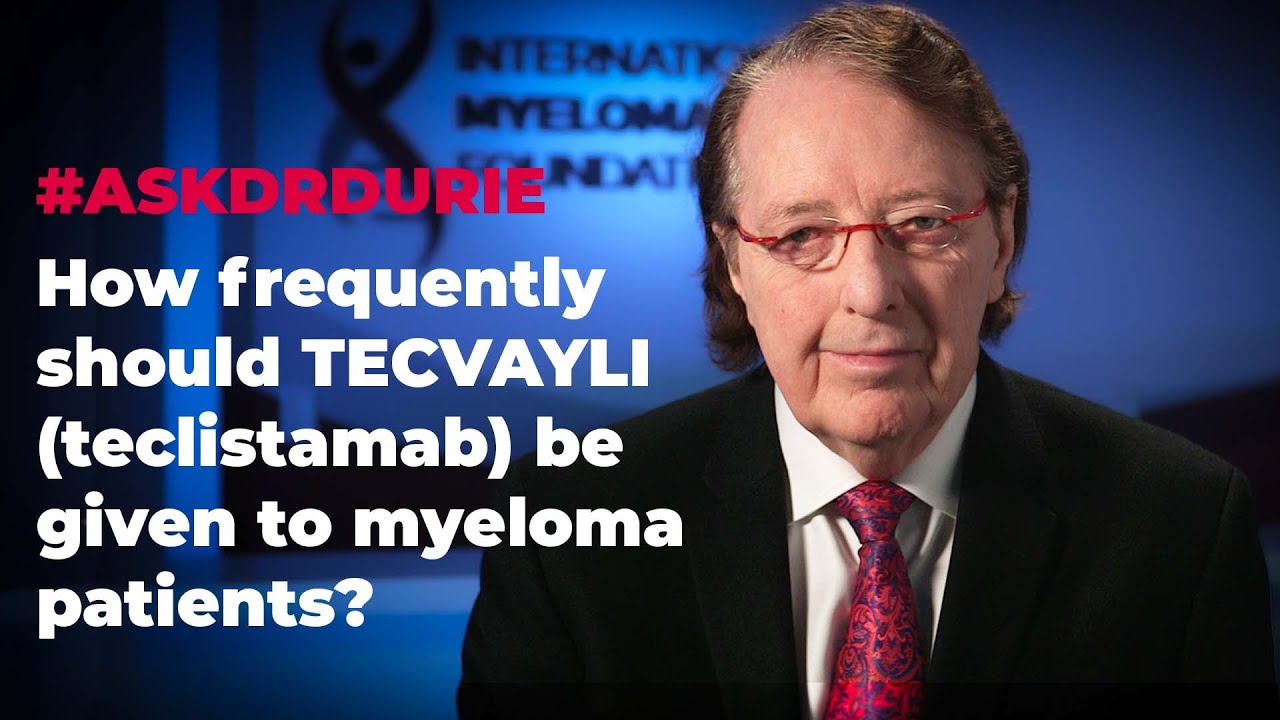
Frequency of TECVAYLI (teclistamab) Administration for Myeloma Patients
In this week's Ask Dr. Durie, IMF Chief Scientific Officer and multiple myeloma expert Dr. Brian G.M. Durie discusses a recent real-world analysis of Teclistamab, an anti-BCMA bispecific antibody approved by the FDA. The analysis, presented at the ASCO meeting in 2024, evaluated the safety and efficacy of reducing the frequency of Teclistamab dosing.
A real-world analysis of TECVAYLI® (teclistamab) was presented at the ASCO meeting in 2024. The analysis compared patients on the full once-a-week dose schedule with those on reduced dosing frequencies. The overall response rate in the real-world analysis remained consistent with the MajesTEC-1 study at 62%.
Reducing the dose frequency to every two weeks or once a month may lower the risk of infections and other toxicities while maintaining treatment benefit. Further analyses are needed, but initial findings suggest that dose reduction can improve the quality of life for patients without compromising efficacy.
The Bottom Line: Reducing the frequency of Tecvayli dosing from weekly to every two weeks or monthly appears to maintain treatment efficacy while potentially reducing the likelihood of adverse effects and improving patients' quality of life.
View the transcript
This week's Ask Dr. Durie, comes from a patient who is concerned about the frequency of the treatment with Teclistamab, which is an anti-BCMA bispecific antibody recently approved by the FDA and now in widespread use in the United States. So the answer is that there is assessment that reducing the dose of Teclistamab, can be achieved safely. And a real-world analysis was presented at the ASCO meeting in 2024. In this particular real-world analysis, results were assessed looking at patients who stayed on the full once-a-week dose schedule compared with those who reduced to every two weeks or once a month.
The importance of this real-world analysis is that the overall response rate stayed the same as in the original MajesTEC-1 registration trial. And in this real-world analysis, the overall response rate was 62%. And so what this meant was that the dose reduction could be considered to reduce the likelihood of infections and other toxicities and to improve the quality of life of therapy without compromising the benefit. And so the bottom line here is that although further analyses are required, it seems that this reduction from the weekly to every two weeks or even once a month, can be a sensible thing to do because it retains the efficacy or benefit and gives a chance to reduce the likelihood of infections and other toxicities and improve the quality of life for treated patients. So really good news for the real-world use of Teclistamab.
 Dr. Brian G.M. Durie (1942-2025) was the co-founder of the IMF. He was a Professor of Medicine, Hematologist/Oncologist, and Honoree MD at the University of Brussels.