


Dr. Joe Mikhael:
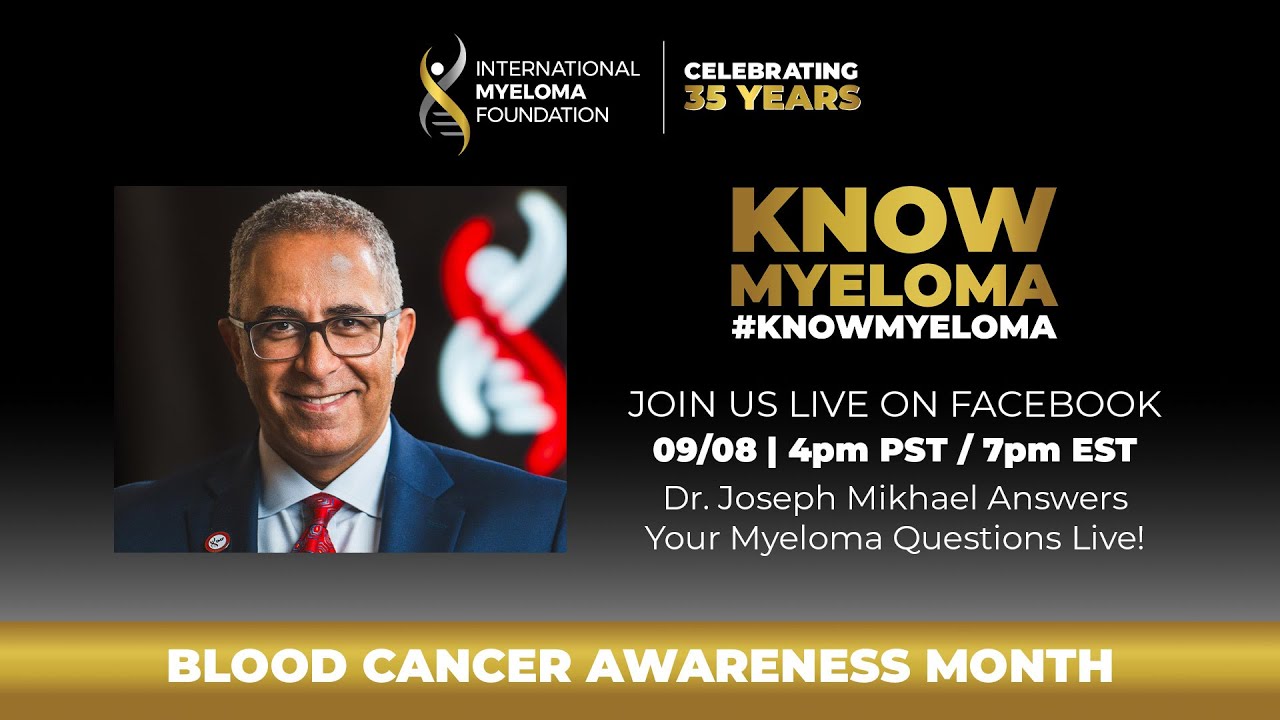
Hello, everybody, and welcome to this Facebook live. This is Dr. Joe here, Joseph Mikhael. I am the chief medical officer of the International Myeloma Foundation. Welcome to Blood Cancer Awareness Month, if you've not already been welcomed. Since the 1st of September, here we are already one week into Blood Cancer Awareness Month. And one of the things we're doing to celebrate Blood Cancer Awareness Month is to kick off with this Facebook live where you can ask Dr. Joe anything, hopefully related to multiple myeloma. I mean, I know a little bit about a few other things in life, but really the focus tonight, of course, is multiple myeloma. And it's great to see that a lot of people are joining, more are joining. As you join, just send me a quick note in the comments saying, "Hi, Dr. Joe. This is who I am, and this is where I'm coming from." And whether you're from Canada, Argentina, Ireland, South Africa, or Idaho, you just tell me where you're coming from. We're thankful to have everybody here.
Before we start answering the questions that I know are going to stream in, because hundreds of you warned me that questions are coming, a couple of quick things. So, first of all, in honor of Blood Cancer Awareness Month, we create a hashtag that we would love you to use as you interact with us on social media, as you interact with your friends and your family and your coworkers on social media.
This year, it is going to be #knowmyeloma, K-N-O-W, myeloma, because the whole point is we want people to know about multiple myeloma. I don't want people to have to say, "What is multiple myeloma? Oh, I know what multiple myeloma is because my friend shared a video. My friend shared information about what myeloma is." Because the more that people will know about myeloma, the more we will be able to fulfill our mission. And indeed, we want people to know what myeloma is so we can catch the disease earlier, so we can intervene earlier, so people can live longer and live better. Our goal at the IMF is we want every myeloma patient to live life to the fullest, unburdened by the disease. That is our goal.
Well, thanks, everybody. I see already some people are using the #knowmyeloma. Well done. And hello to Donna, and Chris, and Ron, and Bob, and Peter, and London, and Lori, and Paula, and Andrea, and Donna, and Terry, and Yvonne. Okay, I'm not going to be able to give all of the names. But Joyce, and Betsy, and Debbie, and Barbara, and Marge, and Diane. Wow, look at you all. You are just pouring in, and I love that. So, thank you so much for joining us tonight.
So, the other quick comment I was going to make, and I'll remind people at the end too, as you interact with us, you can share with others, please do use that hashtag of K-N-O-W, myeloma, and it's going to widen our reach and widen our impact.
So, let's get going with the questions because we've only got 30 minutes. We've got 27 minutes now because I'm Joe introduction. Let's keep telling us where you're coming from. We've got people from Miami and from New York and North Carolina, even Los Angeles, where the home of the IMF is. But we want you to start sending in your questions. I will try to get through as many questions as I can. But I'll also remind you that there are lots of ways that you can send in questions. You can make a phone call directly to our info line or email our info line or leave a message for our info line where you can speak to someone. You can actually come to the website and talk to our chatbot. And we have Myelo, as he or she is affectionately known. You can ask Myelo a question at any time of day or night. Or just use any of our social media platforms and add the #asktheimf. I'll try to answer them during Facebook lives. We do videos. We do live meetings. Sometimes we do special segments on a really important question because lots of people asked it. And sometimes, of course, we'll put it in our publications. And we publish a Myeloma Minute. I write a blog. We have a blog every week. So, there's lots of ways in which you can interact with us.
All right. Let's get these questions rolling. Here comes a great question. "Hi, Dr. Joe. I have a question on behalf of high-risk patients. Every time they hear about poor outcomes, it's understandably unsettling. The question is, if a high-risk patient has been responding well for years and is MRD negative, is it reasonable to feel confident that their disease is under good control and more manageable?"
Terry, first of all, you know I love you, but what a fantastic question. So, to remind people, when we talk about multiple myeloma, like with any cancer or, frankly, any disease, there tend to be forms of the disease that are more aggressive, what we call high risk, and forms of the disease that may be slightly less aggressive, what we call standard risk or maybe even low risk.
We approximate that 20 to 25% of patients with myeloma have so-called high-risk disease. And we base that on... There's different criteria. In fact, we have brand new criteria. We just wrote about it in a blog that was a consensus between the International Myeloma Working Group and the International Myeloma Society to really define what is high-risk myeloma. But it's not perfect. And typically, what that means is, why we want to make that definition is, we know those patients typically need more aggressive disease. We want to make sure we get their disease down and keep it down. It's really important that we get them to MRD negativity or what we call minimal residual disease negativity, where we get rid of every measurable bit of the disease. In other patients with standard-risk myeloma, we want that as well. But sometimes we can understand or tolerate that we can't get down as low, and we want to keep them there.
But to answer your question, Terry, not everybody who has a high-risk designation necessarily, if you will, behaves high risk, which means that the disease comes back quickly. Sometimes people do really respond well, especially with our newer treatments, especially with being able to measure MRD negativity. So I sometimes describe it this way. High-risk myeloma just means that someone's got a sports car or a car that has more horsepower. It doesn't necessarily mean it's always going to drive very fast. Sometimes the Prius is passing the Porsche. Say that 10 times. Sometimes the Prius is passing the Porsche on the freeway because the disease that may be designated high risk is not behaving high risk. So, I think you can feel confident when you have achieved MRD negativity and remained in it for a long period of time. We have seen a massive improvement in outcomes in myeloma, and survival is what we mean typically when we use the word outcomes. And a lot of that we're seeing now in high-risk patients because of the new treatments that we have.
Okay, wow, the questions are really pouring in. "My chemo brought me to negative MRD. So why is it wise to still get a stem cell transplant? I have high-risk myeloma."
Well, thank you for that really great question. That's incredibly thoughtful. Right now, the best evidence we have, if someone is eligible for a stem cell transplant, where we give them high-dose chemotherapy and we give them, if you will, their own stem cells back to grow a new bone marrow after we've previously collected them, the best evidence we have is that when patients are eligible for a transplant, that they should get it because it will keep them in remission for longer and even keep them alive for longer. There is some emerging evidence that maybe if someone has achieved MRD negativity, that no more measurable disease, before transplant, that it may not be necessary. But that has not been validated yet in high-risk myeloma. And we need more time because we need to prove that that's the case over the longer term.
So, I would take great confidence in the fact that you have achieved MRD negativity and talk to your doctors about what the options are. Sometimes we delay transplant, sometimes we go ahead with it. But when someone has high-risk myeloma, we typically go ahead with transplant because that's probably the scenario where people benefit the most from the transplant. Because even in MRD negativity, high risk means the disease can come back a little bit more quickly. And so we want to make sure that it stays down for the longer period of time. So, really, really good question. I appreciate that question very much.
"Hi, Dr. Joe. Your thoughts on reducing treatment frequency..." Oh, sorry, the questions jump around here a little bit. "... with teclistamab." And I'll extend this out to other bispecifics.
So, bispecific antibodies are a very important tool we have now in multiple myeloma. We have four of them, actually, now approved. And interestingly, they're approved after someone has had four prior lines of therapy, so we use it later in the disease course. And these drugs work... They're called bispecifics. They work because they have basically two arms. One arm grabs onto the myeloma. Another arm grabs onto a local T-cell and activates and engages that T-cell, think of a T-cell like a soldier cell of the body, to destroy their own myeloma. So, it's a beautiful way of us employing your own immune system to take out the myeloma.
When we designed these trials and did the original clinical trials, these drugs were pretty much used every week, every week, every week. But we've come to learn that when we keep doing that, it really can deplete someone's own good immune system because these T-cells also take out some of your good plasma cells, not just the myeloma cells. And so we have been working on systems of backing off the frequency. I would not say we've perfected it yet, but I'm going to say that we have, generally speaking, come to this conclusion for drugs like teclistamab, elranatamab, and linvoseltamab, all that target BCMA, as well as talquetamab, which has a different target on the myeloma cell, that we typically would give it weekly for about 8 to 12 weeks. Assuming someone is responding, we often back down to every other week. And then at about six months, we make a determination, somewhere between six months and a year, is it still working very well? We might even be able to back off to once a month. We don't have perfect trials to prove that yet. We're doing those studies now. But that has typically been the way that we're approaching it.
Here's a great question from Mindy. "Are there other ways to strengthen bones beside taking Zometa? #knowmyeloma"
Well done, Mindy. You've got the hashtag there. So, the quick answer is yes. And it reminds me to tell everyone that even though we have all these great therapies in myeloma, often while we're treating patients to take down their myeloma, we also want to re-strengthen their bones because many patients have had thinning, if not breaking, of the bones because of the multiple myeloma. We primarily have Zometa or zoledronic acid as our primary therapy, but we do have other treatments now. So there are others from the same class, and there's yet another new class of drug that we use, in particular in patients who may have kidney dysfunction because we may be nervous to use that in patients with zoledronic acid or with Zometa. So, yes, there are other ways of doing it. And it is important because we want to make sure that patients' bones get strengthened so that they don't have that same risk of developing fractures later.
Here's a great question from Donna. "I get Velcade in my arm. Is it normal to get a red rash that disappears after a few days?"
So, thank you for sharing with us, Donna. The short answer is yes. We sometimes see a small, typically not much more than a quarter or a couple of quarters, rash. It could be a little bit bigger in some patients. That is just there for a few days and goes away. And if it does go away and it's not particularly itchy or painful, generally speaking, we don't worry about that. Typically, over time, it doesn't keep happening. Obviously, this is good to discuss with your team, but we don't want you to be alarmed by it. It's partly just kind of a local reaction to the drug. It doesn't happen to every patient who's receiving it, whether they receive it in their arm or in other places. But that is something to discuss with your team, but does not appear immediately to be worrisome.
Bob asks, "Do I have recommendations to relieve an itchy head from lenalidomide or from Revlimid?"
Great question, Bob. One of the known side effects of these drugs is that it can cause a rash, and sometimes a rash can be particularly itchy. Depending on how severe the rash is and how severe the itchiness is, often we have to stop the drug for a while, give someone some medication, either some steroids. Sometimes we add some anti-itch kind of medications, Benadryl or things like that. And then we reintroduce the drug. If it keeps happening every time, we sometimes have to significantly dose reduce the drug. And in a small percentage of people, about 5%, we actually have to stop the drug.
So, it depends on how severe that itchiness is and if that process has been taken to try and reduce it. I do have a few patients in my practice and have many over the years who end up having just a little bit of itchiness. And they balance that with the benefit of still taking the drug. And that, obviously, can be discussed with your team. But typically, we give them an antihistamine or Benadryl, something like that, over the counter. Nothing too fancy that reduces it. But if it really becomes persistent and it's severe and it's bothering you and affecting your quality of life, then other options may have to be looked at. Because as I say all the time, we don't treat myeloma, we treat people. And we have to ensure that we give the very best quality of life possible to patients.
Here's a question. "I've been on DVR," so I assume that's Darzalex, Velcade, and Revlimid, or sometimes we call it VRD, "for three years with autologous stem cell transplant in December of 2022." Okay, so two-and-a-half years ago, almost three years now. "I started at 100% and ended at 10%, plus or minus, after the transplant. My M spike has started to climb in the last three months. Would CAR T be a likely next treatment?"
Great question, Bob. Obviously, it's hard to be very specific in this scenario because this has to be discussed with your team. But I think it's a good opportunity for us to speak about the fact that we have more options than ever at first relapse of multiple myeloma. I'm sorry to hear that the M spike is climbing. It probably means that the disease is waking up. It has been over two years. But it's not been over four years. So you're in a category where we don't necessarily say it's particularly high risk, but we would have hoped that the disease would have stayed in remission for longer. And so we have to think about options.
So, one of those options always to consider is CAR T-cell therapy. Again, CAR T-cell therapy is this novel, amazing treatment that we can use as early as first relapse with the process as follows, where we take T-cells out of a patient. Those same T-cells that I was describing earlier that we engage with a bispecific, we take those T-cells out of a patient, and we basically train those T-cells to attack their myeloma. It's called CAR T because we put... CAR stands for chimeric antigen receptor. We basically put a receptor on the outside of these T-cells that hones in on the multiple myeloma when it gets re-infused to the patient.
And we have very strong evidence right now, Bob, that that CAR T-cell therapy may be superior to any other treatment that we have at first relapse when we compared it to the typical triplets that we might use. And so, I think it is something to consider. It does come with some risks, both in the short term and the long term. Thankfully, those risks are minimizing over time. But we see some tremendous outcomes with CAR T. So, I think that's something to discuss with your team because it is challenging. I was just actually earlier today having a discussion with another myeloma doctor about when do we provide CAR T for patients at first relapse. And your situation is one in which we would have that discussion. And based on what your preferences are and what is available to you locally, a decision can be made between that.
Okay. Here is a great question from Carol. Tough question. Oh, and it just dropped. It's amazing how when the questions line up here, when we have as many questions as we do, it drops. But I saw it quickly. Carol was asking, "Is there any work on helping people to restore their immune systems? Because myeloma is such an onslaught on the immune system, and indeed, sadly, a lot of myeloma patients die of infections."
Well, this is such a great question because this is one of the reasons why we are seeking to do so much more with what I called earlier immunotherapy or using someone's own immune system to destroy their myeloma. Because a lot of the older treatments that we use, not only does the myeloma itself deplete your immune system... Because remember, this is a cancer of the immune system. This is what makes myeloma so much more complicated than many other cancers. I'm not minimizing those other cancers. I'm just saying they exist in a breast or in a colon or in a lung. Here, this is existing within your own immune system. So, your own immune system is depleted because of the cancer. Then when we give chemotherapy and other treatment, it depletes the immune system even more. And so, these patients really, as you know, can be very low on their immune system, and often we have to supplement them and so on.
So, yes, there is a tremendous amount of work trying to understand it, understand the immune system better. How can we make sure our T-cells don't get exhausted? How do we replace partly immunity with giving IVIG? And then how can we back off some of our treatments? One key principle, though, that I always mention when it comes to this topic, we learned, sadly, a little bit about this during the pandemic when we saw patients having COVID and not having COVID. The worst thing for someone's immune system is very active multiple myeloma. Controlling the myeloma is fundamental because that allows, if you will, the opportunity for that irregular immune system to grow back. And so that's why we balance trying to treat a patient by not trying to over-treat a patient so that we get enough of the disease under control, but not so much that there's a so-called friendly fire against their own immune system.
Allison asks, "Is there any treatment to reverse peripheral neuropathy in the hand especially?"
Oh, Allison, how many days have I spent in clinic praying and wishing I had a way to truly reverse neuropathy. You'll see commercials for it. You'll see advertisements for it. But I'll be very honest. When someone has significant neuropathy, either from their myeloma or from a treatment that they've had with myeloma, and some of our drugs can put us at risk of that, it's very hard to reverse, which is why we want to be so careful to take strategies to prevent it. Often we use, for example, drugs like bortezomib subcutaneously only once a week instead of twice a week, or not even using certain drugs, like thalidomide, unless we have to. And then also detecting any sense of neuropathy, which is typically numbness and tingling, tips of the fingers, tips of the toes, sole of the feet. And as soon as that appears, that we make a change. We reduce the drug, we reduce its frequency, maybe even stop it, so that we don't get to the point where it's so severe that it can't be reversed.
Someone asks, actually, another great question about CAR T, almost the exact same question as before. But here's a great question. "Do you have any recommendations for doctors that specialize in myeloma in the Colorado Springs or the Denver area?"
Well, thank you for this question, Casey. We do know. I was just talking to a doctor today from Colorado. So, the quick answer is yes. Reach out to us through the website. The website, you'll be able to find the number or the link to the info line. And we keep a list of docs that we know well and we work with well that we can share with you in your region because we want to connect you. This is absolutely important. We really strongly recommend as much as possible that someone interacts with someone, with a physician who's an expert in myeloma.
I do a lot of this in my own clinic. I work primarily for the IMF, but I continue to have a clinic. I prefer to call it the expert opinion as opposed to the second opinion. Second opinion makes it sound like the first one was wrong, and very often the first one was right. We just want to support and help through, give more information, guide some of the the details of the treatment going forward. And so, we're here for you at the IMF, Casey. We want to be able to match you up with someone who can take care of you locally.
Okay. "Dr. Joe, is there a way to measure the quantity of T-cells before starting CAR T? I ask because I am on a bispecific."
Well, thanks, Nance. What a very detailed and important question. The short answer is, it's complicated and it's hard. Because even though we have some measures of T-cells, it's hard for us to measure how effective they are. It's like looking at a soldier from a distance. They may look like they're fit and ready and healthy for a battle, but they may not be. And some of our colleagues and friends around the world are really working hard to have better measures of what we call T-cell health. We would all love to have a T-cell spa where we could go and strengthen our T-cells and rejuvenate them so that they could be effective.
That being said, we have learned that it is, generally speaking, difficult to collect T-cells from someone, to go through a CAR T-cell program, if they are currently on a T-cell therapy with a bispecific antibody. We usually want to break in between, because that bispecific antibody, you're constantly engaging those T-cells, and you're activating them and they're working, and you're not giving enough time to rest so we can collect them and manufacture them as CAR T. So, for most of us, we would prefer to do the opposite, which is go to CAR T and then do a bispecific.
But if someone is on a bispecific, it doesn't mean they can't get CAR T, but we would typically like to give them a bit of a break. What does a bit of a break mean? Well, it depends on what myeloma doctor you ask. Some would say four weeks. Some will say three months. Some might even say six months. Typically, we like to give a different line of therapy in between that can give those T-cells a rest. But I wish I had, Nance, that perfect test to be able to measure T-cells. I do hope in the near future that we will be able to do more of that.
Judith asks a great question. "Are there age limitations for bispecific," sometimes I'll call BiTEs or, "bispecific T-cell engagers and CAR T treatments?"
This one I'm going to answer pretty emphatically, Judith. Really, no. We try not to have age limitations, frankly, on anything because age doesn't tell you the whole story. It used to be we talked a lot about age was kind of the cutoff for transplant. And in some countries in the world, they just say, "Hey, if you're over 65, you don't get a transplant, period." We've tried to be a bit more open to studying patients' frailty and what we call comorbidities, how healthy they are, how difficult the process is going to be. Because, of course, we don't want to make the treatment worse for the patient than the disease itself. But we are learning that we can do CAR T-cell therapy and, indeed, absolutely, bispecifics in older and even more frail patients. In the first CAR T trial, in the first CARMA trial, there was an 84-year-old patient on that clinical trial. We do CAR T-cell therapy in patients in their 60s, 70s, 80s, and bispecific antibodies, similarly, which is a little bit easier on the system than CAR T, we can give to older and more fail patients. So, age by itself should not be a limitation. But of course, this has to be discussed with the team.
Catherine asks, "How many times can you do CAR T?"
Well, generally speaking, we do it once now that we have other options that we can do. One of the things that encourages me, in the earliest days of CAR Ts, we were very afraid that if someone had a CAR T and their disease progressed, that we wouldn't have options for them. But we have developed more options, which is great. But there have been some patients, primarily some who have previously been on a clinical trial and some just in clinical practice, where we have had more than one CAR T. I had a dear patient of mine who had two CAR Ts. But, much like I described earlier, we want a break clearly in between to give the opportunity for those T-cells to regenerate. We have to look back and say, "Well, how quickly did the person relapse? How well did the first CAR T work? Would we want to go back to that way of treating the myeloma, or do we want to go a different way?"
Okay. Carrie asks, "Hello from Winnipeg, Canada." I have a soft spot for us Canadians. For those who don't know, I was born and raised in Canada, in the nation's capital. I was visiting there last week in Ottawa. And so I have a bit of a soft spot for our Canadians. "We are hearing CAR T is available to us next year. How effective is this after first relapse?"
It's extremely effective. Obviously, it can't be predicted in any one patient. But in the two large clinical trials where we saw CAR T given to myeloma patients, it dramatically outperformed the typical triplet therapies that we would use. With one of the CAR Ts, we're still three years out before the average time to progression has been. So, it's really remarkable. Obviously, it's not perfect. It comes with some risks. Not every single patient responds, although we're seeing response rates now in over 90%, which is remarkable. And I have been strongly advocating for CAR T to make its way north of the border, and I hope it'll be there before too long.
Wow, the questions just keep pouring in. I wish I had time to answer them all. I think I'll try and take two more. And thank you, Jill, for your comment about the T-cell spa. I thought you might like that. Here's a great question from Kevin. "What is the difference between multiple myeloma and plasma cell leukemia?"
The simplest way for me to answer this is, plasma cell leukemia is really a subset of myeloma. We typically put it in the high-risk category. Typically, plasma cells, which are the cells of myeloma, these are the cells that normally live in your bone marrow that make the good antibodies that help us fight off infection, they should live in the bone marrow. But sometimes they can grow a bit more aggressively and escape the marrow and start circulating in the blood.
Now, if I look super carefully, almost every myeloma patient might have the very occasional plasma cell that's made it into the blood. But once you get to a certain level, we call that plasma cell leukemia. It's just, from the old word leukemia, referring to white cells, leukos, emia, in the blood. It's just there are cells in the blood and not just in the bone marrow. So, really, plasma cell leukemia is a form of multiple myeloma. It's not really a totally different disease. But it does tend to be more aggressive. Those plasma cells, they're showing to us that they don't need that comfortable, warm, and cozy environment of the bone marrow. They can go live out on their own. And so they tend to be a little bit more aggressive.
Wow, so many more questions. I think I'll just be able to take one more here. The question from Pam says, "Do you think it's better to use Revlimid alone or with dara after transplant if you do not reach MRD?"
Wow, Pam, this tells me you've been studying and learning, because this is a really contentious, not contentious maybe, is an open topic in myeloma. Where for years we showed that when you treat patients with lenalidomide or Revlimid maintenance therapy, they not only stay in remission longer, they can actually live longer, which is remarkable. But there is now increasing evidence of other clinical trials saying, "Well, can we make that even better if we add daratumumab to it?" And daratumumab tends to be pretty easy to take. It's a once-a-month injection usually by that time.
And so, the evidence is mounting. I think it depends on various features. If someone has high-risk myeloma, we typically don't want to just use Revlimid alone. If someone is MRD positive, then we have some evidence that maybe adding the daratumumab for up to two years, if that achieves MRD negativity, that may be reasonable than stopping the dara and just continuing the Revlimid and then discontinuing the Revlimid at some point. And that is also an area of discussion. So, that's kind of a long-winded way, Pam, of saying we don't really know, but we are seeing much more use of adding daratumumab to the lenalidomide, especially if patients are MRD positive.
Well, I am just sorry that I can't get to more questions. 30 minutes flies by like that. But I want to remind everybody that you have a job here. Thank you for joining us, but please share this video. Share thoughts. Oh, use that hashtag, remember, K-N-O-W, myeloma, #knowmyeloma. We want more people to know about myeloma during Blood Cancer Awareness Month in the month of September. Of course, there are other blood cancers that are being thought of this month, like lymphoma and leukemia. But we know that myeloma is often unknown and is often forgotten. So, please, please keep sending in your questions. We collect them all. I'll do my very best to answer them at future events. It looks like, Jason, we might have to tack on another Facebook live. But there is also another Facebook live coming at the end of September with my dear friend, Beth Faiman. My wife calls her Sparkly. So make sure you don't miss that.
And I also want to take a moment to thank our sponsors for Blood Cancer Awareness Month that include Adaptive Biotechnologies, Bristol Myers Squibb, GSK, Johnson & Johnson, Karyopharm Therapeutics, Pfizer, The Binding Site, Regeneron, and Sanofi. And most of all, I want to thank you for listening in today. I hope this has been helpful to you. I know it's kind of like a rapid-fire approach, but we want to answer as many questions as we can. I'm sorry if I didn't get to your question, but we'll do our very best to get it very soon. So, thank you again, everybody. And I'm so grateful that you've joined me. Please know myeloma during Blood Cancer Awareness Month in September. Thanks very much.

