MagnetisMM-3 Results: Elranatamab in Relapsed Myeloma
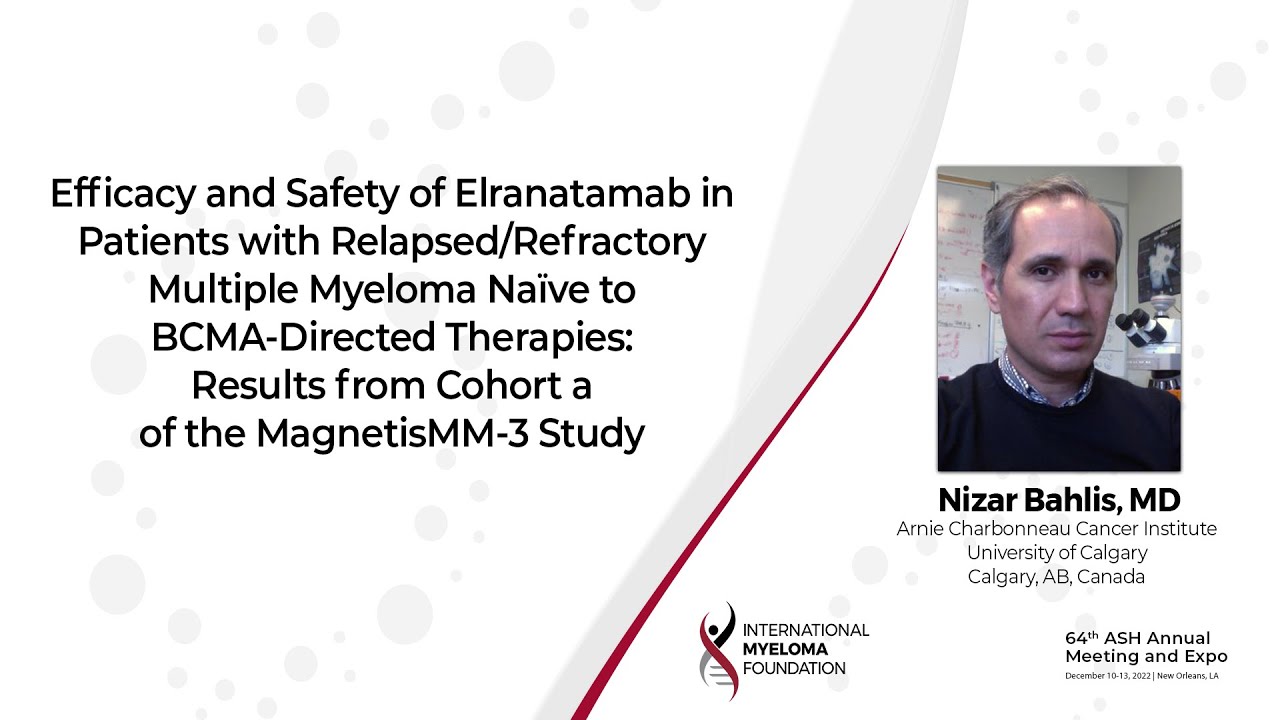
Dr. Nizar Bahlis presents the results of the ongoing MagnetisMM-3 clinical trial looking at the effects of elranatamab in people with multiple myeloma whose cancer did not respond to treatment at all or came back after responding to previous treatment.
Abstract title:
Efficacy and Safety of Elranatamab in Patients with Relapsed/Refractory Multiple Myeloma Naïve to B-Cell Maturation Antigen (BCMA)-Directed Therapies: Results from Cohort a of the Magnetismm-3 Study
Purpose of the trial:
Elranatamab is a humanized bispecific antibody that targets both B-cell maturation antigen (BCMA)-expressing multiple myeloma (MM) cells and CD3-expressing T cells. MagnetisMM-3 (NCT04649359) is an open-label, multicenter, non-randomized, phase 2 study to evaluate the safety and efficacy of elranatamab monotherapy in patients (pts) with relapsed/refractory MM (RRMM). Results in pts with RRMM and no prior BCMA-targeted treatment (Cohort A) are presented.
Video summary:
MagnetisMM-3 enrolled pts refractory to at least 1 proteasome inhibitor, 1 immunomodulatory drug, and 1 anti-CD38 antibody. Pts received subcutaneous elranatamab 76 mg QW on a 28-day cycle with a 2-step-up priming dose regimen (12 mg and 32 mg) administered during the first week. Primary endpoint was objective response rate (ORR) by blinded independent central review (BICR) per IMWG criteria. Objective response was defined as confirmed stringent complete response, complete response, very good partial response, or partial response. Treatment-emergent adverse events (TEAEs) were graded by CTCAE v5.0, and cytokine release syndrome (CRS) and immune effector cell-associated neurotoxicity syndrome (ICANS) by ASTCT criteria. Data cut-off: June 17, 2022 (~6 months after last pt’s initial dose).
A total of 123 pts were enrolled and treated with elranatamab in Cohort A. Median age was 68.0 years (range, 36−89), 55.3% were male, 58.5% were White, 13.0% were Asian and 7.3% were Black/African American. At baseline, pts had an ECOG performance status of 0 (36.6%), 1 (57.7%) or 2 (5.7%); 25.2% of pts had high risk cytogenetics, 15.4% had R-ISS III, and 31.7% had extramedullary disease. Pts had received a median of 5.0 (range, 2−22) prior lines of therapy; 96.7% and 42.3% of pts were triple-class- and penta-drug refractory, respectively.
Conclusions:
Results suggest that subcutaneous 76 mg QW elranatamab is efficacious and has a manageable safety profile in pts with triple-class- and penta-drug refractory MM and no prior BCMA-targeted treatment. These results support continued development of elranatamab for pts with MM.
Trial information:
ASH 2022: Abstract #159
Authors:
Nizar Jacques Bahlis, MD, Michael H. Tomasson, MD, Mohamad Mohty, MD PhD, Ruben Niesvizky, MD, Ajay K. Nooka, MD, MPH, FACP, Salomon Manier, MD, PhD, Christopher Maisel, MD, Yogesh Jethava, MD, Joaquin Martinez-Lopez, MD, PhD, H Miles Prince, MD, Bertrand Arnulf, Paula Rodriguez Otero, Guenther Koehne, MD, PhD, Cyrille Touzeau, Noopur Raje, MD, Shinsuke Iida, MD, PhD, Marc-Steffen Raab, Eric Leip, PhD, Sharon Sullivan, PhD, Umberto Conte, PharmD, Andrea Viqueira, MD and Alexander M Lesokhin, MD