Doctor Bio:
Dr. Alessandra Romano is a hematologist at the University of Catania in Catania, Italy. Her interests involve the modulation of microenvironment sustaining progression and chemoresistance in lymphoma and multiple myeloma.




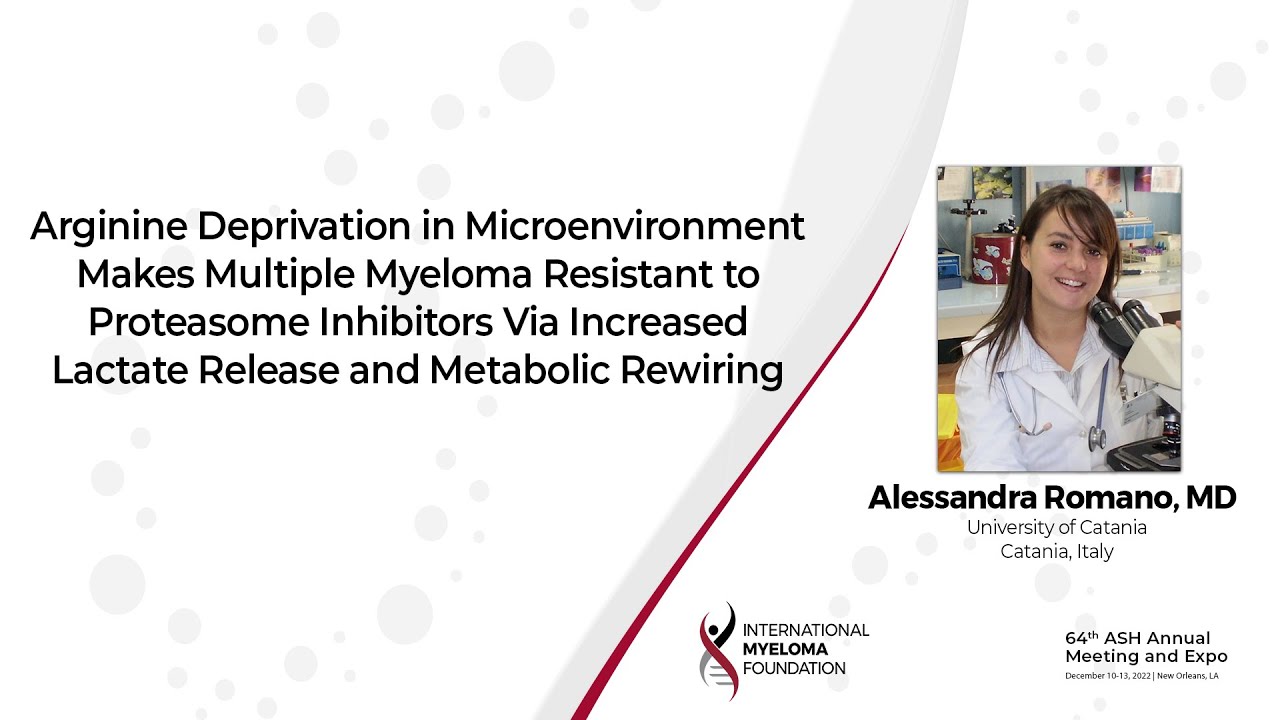
Arginine Deprivation in Microenvironment Makes Multiple Myeloma Resistant to Proteasome Inhibitors Via Increased Lactate Release and Metabolic Rewiring
In multiple myeloma (MM) malignant plasma cells (PC) can induce metabolic changes in the local microenvironment that are closely related to drug resistance and disease progression. Our group previously demonstrated that Myeloid-derived suppressor cells produce arginase (ARG-1) that induce a reduction in the microenvironment of arginine (Arg), a non-essential amino acid, whose deficiency in the microenvironment plays an important role in the immune-escape mechanisms and in bortezomib (BTZ) resistance.
In bortezomib (BTZ)-refractory patients, the arginine degrading enzyme Arginase 1 (ARG1) was increased in peripheral blood and bone marrow. Sera of MM, but not MGUS patients, conferred BTZ-resistance to U266 cell line in an ARG1 dependent manner, an effect partially reverted by treatment with nor-NOHA (an aspecific Arg-1 inhibitor). To dissect better the effects of high concentrations of lactate in tumor microenvironment, they cultured HMCLs in medium with lactate for 3 days. After 72h, HMCLs chronically exposed to high lactate concentration were unable to increase oxygen consumption, as detected by Sea Horse analysis. Compared to controls, both U266 and NCI-H929 exhibited lower basal and maximal respiration, recapitulating metabolic rewiring observed in chronic arginine deprivation.
Taken together, our data suggest that metabolic rewiring associated to arginine deprivation induces increased lactate availability in the microenvironment, which is in turn able to protect mitochondria against PI-induced cytotoxicity. This effect can be counteracted only blocking lactate import by MCT1 transporter using AZD3965, but not inhibiting the GPR81 signaling.
ASH 2022: Abstract #3159
Cesarina Giallongo, PhD, Grazia Scandura, Alessandro Barbato, Enrico La Spina, Lucia Longhitano, PhD, Tatiana Zuppelli, Ilaria Dulcamare, Research Fellow, Nunziatina Laura Parrinello, PhD, Sebastiano Giallongo, Francesca Polito, Rosaria Oteri, Mohammed Aguennouz, Giuseppe A. Palumbo, MD, PhD, Marco Lolicato, Giovanni Li Volti, MD, PhD, Francesco Di Raimondo, MD, Daniele Tibullo, PhD and Alessandra Romano, MD, PhD
Doctor Bio:
Dr. Alessandra Romano is a hematologist at the University of Catania in Catania, Italy. Her interests involve the modulation of microenvironment sustaining progression and chemoresistance in lymphoma and multiple myeloma.

