This week's "Ask Dr. Durie" comes from a patient who has been watching the news and couldn't quite understand what was the controversy about using CAR-T, a new immune therapy earlier in the course of the disease. There was an ODAC government hearing to review the results with CAR-T therapy, Abecma and Carvykti earlier in the disease course.
And this meeting was held because there were some concerns about possible side effects and problems using the immune therapy, the CAR-T therapy, earlier in the disease course. After the review of all of the findings. The order committee on March 15th actually voted strongly in favor of approving the earlier of use of the CAR T therapy. However, just to be aware, what were the concerns that were leading to the controversy where maybe they might have voted against it?
the main one was what's called bridging therapy. When you harvest the T cells to be engineered such that they will attack the myeloma, they are sent off to the lab for manufacturing. And during a period of time, which is at least 4-to-6 weeks and sometimes longer, the myeloma has to be kept under control. And so, the doctor recommends and you go ahead with treatment to control the myeloma called bridging therapy.
Now, if the myeloma is very active, it may be quite tricky to get the myeloma under control and also avoid a lot of side effects using higher dose chemo to to get the myeloma down and into some degree of control. And so, this can be so bad that patients maybe just can't wait for the cells to be manufactured.
But nonetheless, mostly this can be managed and patients can get through it. Obviously, with CAR T-cell therapy, there is dramatic impact on the myeloma and because of this, some other side effects occur. there are, reactions called cytokine release syndrome, which can really, cause activation of, chemicals in the blood. there can be impact on the blood counts with risk of infection, and then there can also be, neurologic side effects.
There also can be some delayed neurologic side effects. So recently some patients have had problems where they've developed something called Bell's palsy, which is an inflammation of one of the cranial nerves, which can cause temporary paralysis in the face area and then even have some difficulties, which are almost like developing Parkinson's disease. And so these are real concerns that that caught the FDA's attention for sure. But nonetheless, CAR-T therapy is so dramatically effective in a high percentage of patients, 75-to-even-98% of patients with relapsed/refractory disease can have a response.
These are deep responses and can be long lasting beyond one year. And so the BOTTOM LINE is that this is a very effective therapy CAR T-cell therapy works very well. The earlier that you use it, the better the results can expect it to be. And also the tolerance will be better. earlier in the disease, it will be easier to manage the bridging therapy and get through, to infusing the engineered T cells. And so, a little bit of controversy. But the BOTTOM LINE is that the ODAC hearing boded positively, and we are actually now waiting for the final opinion from the FDA, which we do think will be supportive of the use of CAR T-cell therapy in this earlier disease setting.



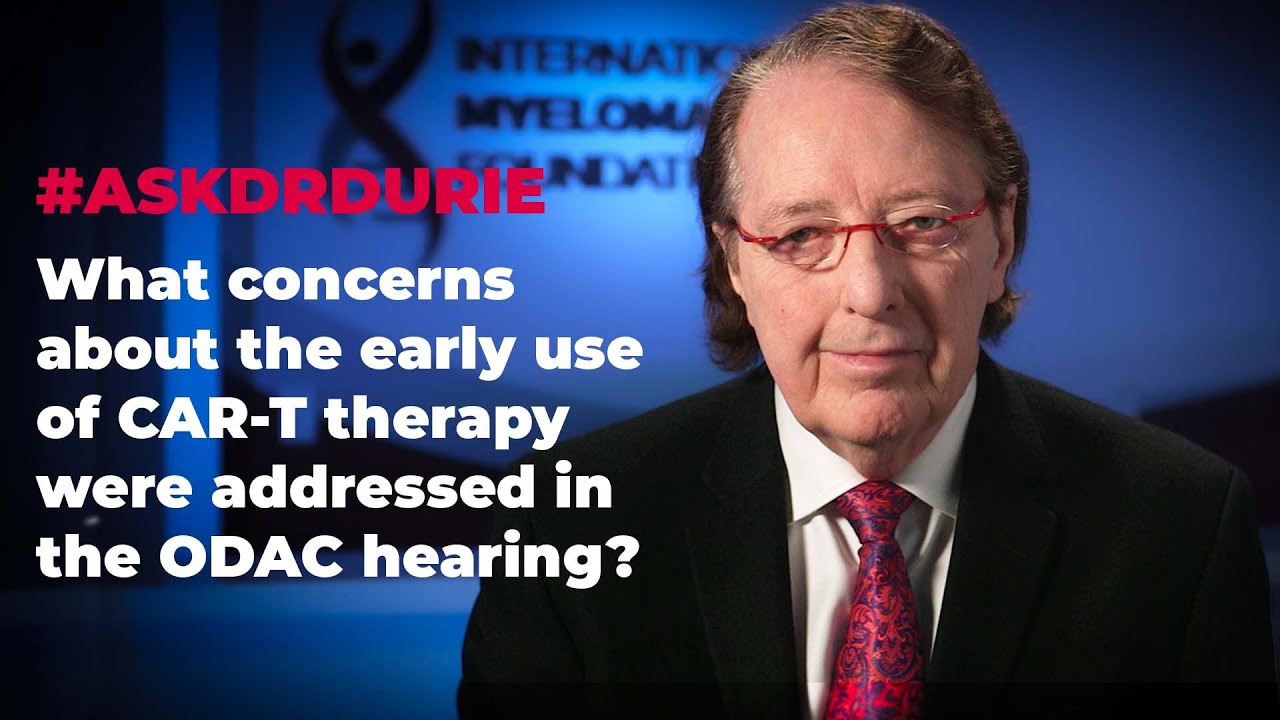
 Dr. Brian G.M. Durie (1942-2025) was the co-founder of the IMF. He was a Professor of Medicine, Hematologist/Oncologist, and Honoree MD at the University of Brussels.
