

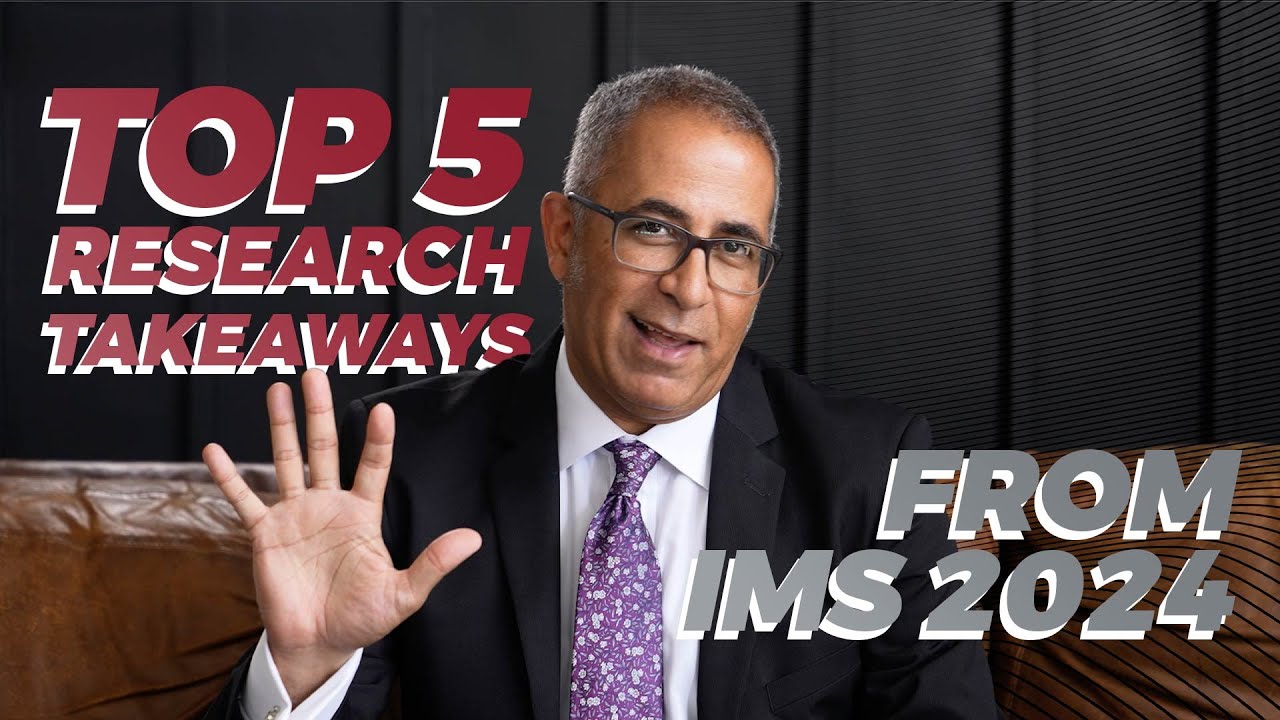
New myeloma research was presented at the International Myeloma Society's annual meeting in Rio de Janeiro in Brazil, and today I'm going to briefly summarize the key impactful research that will affect myeloma patients.
Let me give you Dr. Joe's five big highlights. Number one, quadruplet therapies upfront. One of the plenary abstracts was the Cepheus Trial that added Daratumumab to VRd, or Velcade, Revlimid, and dexamethasone, in patients not going to autologous stem cell transplant. This further adds to the evidence that we have more recently of adding isatuximab to VRd that literally all patients should be receiving quadruplet therapies upfront, or at least those who are eligible to receive a quadruplet therapy.
Issue number two, impactful research number two, was more consolidation and maintenance in frontline therapy. What do I mean by that? When patients receive those quadruplets or their frontline therapy, we want to get them to the deepest remission possible, and now we're looking at different strategies of prolonging the consolidation or giving more consolidation after transplant or giving more maintenance after transplant. There was a very good study that presented adding Daratumumab to lenalidomide in maintenance therapy, and we will likely be doing this more so in the future.
Issue number three was MRD-guided therapy. MRD, of course, is minimal residual disease. This is where we can measure down to tiny, tiny amounts of myeloma left within a patient, and we know that that is a step towards a cure and a step towards giving someone a long remission. And so instead of just giving a certain number of cycles or giving therapy until the disease wakes up again, we're starting to use this incredible tool to think about periods of time when we can stop therapy on patients and have it guide whether or not patients get less or more therapy thereafter. One of the clinical trials that was presented, the MIDAS trial, is now built on this platform of MRD guidance.
And then issue number four is what we do at early relapse, at that first relapse, and we saw some really amazing data updating us of that drug blenrep or belantamab, which is an antibody drug conjugate, meaning it's a drug that hooks onto the myeloma cell and drops a toxin into it to be able to help destroy the myeloma cell. We saw combinations with blenrep that really improved not only people's time and remission but even their overall survival, so we're very likely to see blenrep come back to the clinic very soon. And also we saw data with CAR T-cell therapy, real world data or large registry reports of what we can do with CAR T-cell therapy to make it even more effective and in particular, to make it safer for our patients so they're less likely to have the side effects.
Last issue, number five, is really a view into the future of new things that are coming in multiple myeloma. I found this particularly exciting that we have ways of targeting CAR T-cell therapy in different parts of the myeloma cell like GPRC-5D, maybe even doing ALLO CAR T, where we don't have to take T-cells from a patient, we actually just collect T-cells from healthy donors and create a CAR T product that we can directly give to patients and so many other things.
These are really exciting times in multiple myeloma. It's amazing to me how often we can do these updates because the field is changing so much. Make sure you subscribe to our YouTube channel at the International Myeloma Foundation, so you can be up-to-date with all of these amazing changes. Also, we're always available to you at myeloma.org where you can find information there or even be guided by our chatbot, Myelo, as you learn more about multiple myeloma.