


Twenty Years, One Mission: The NLB marks a milestone at ONS 2026
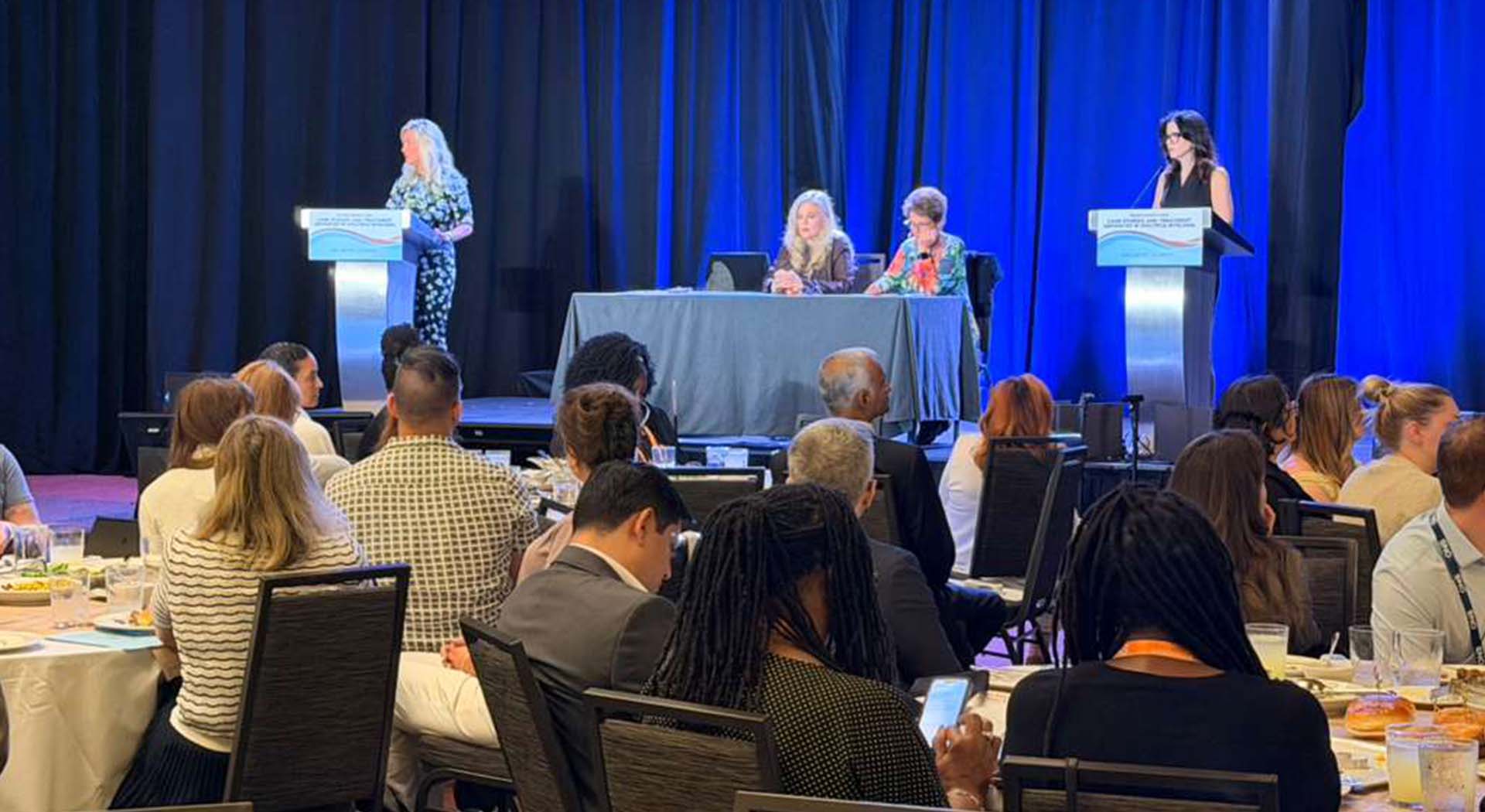
The IMF Nurse Leadership Board (NLB) presented its 19th consecutive symposium at the 51st Annual Congress of the Oncology Nursing Society (ONS) in May 2026 in San Antonio, Texas. The program – “Transforming Care: Case Studies and Treatment Advances in Multiple Myeloma” – was attended by nearly 600 nurses, who wanted to hear from four exceptional myeloma nurse leaders.
By Diane Moran, IMF Senior Vice President, Strategic Planning
The occasion also marked the 20th anniversary of the NLB itself, reflecting how far myeloma treatment has advanced and how much the oncology nurse’s role has grown. “For 20 years, the NLB has been dedicated to one thing: making sure oncology nurses have the knowledge and tools to give every myeloma patient the best possible care,” said Beth Faiman, who chaired the NLB symposium. “The enthusiasm we see from the nurses coming together year after year tells us this work matters to nurses and, most importantly, to patients.”
Understanding the diagnosis
The symposium opened with Teresa Miceli introducing “Jason,” a 64-year-old man whose myeloma was diagnosed through routine blood tests. After referral to a hematologist-oncologist, Jason had blood and urine tests to measure his myeloma protein (M-protein), whole-body imaging to evaluate bone damage, and a bone marrow biopsy. The tests confirmed his diagnosis. Since no high-risk features were present, his myeloma was defined as standard risk.
The current standard of care for newly diagnosed multiple myeloma (NDMM) is induction therapy followed by consolidation and maintenance. The induction 4-drug (quadruplet) regimen combines an anti-CD38 monoclonal antibody Darzalex® (daratumumab) or Sarclisa® (isatuximab), a proteasome inhibitor Velcade® (bortezomib), an immunomodulatory agent Revlimid® (lenalidomide), and dexamethasone (generic steroid medication). These 4-drug combinations produce significantly deeper responses than older 3-drug (triplet) regimens.
Next, patients may receive consolidation of either additional cycles of treatment or high-dose chemotherapy (HDT) with autologous stem cell transplant (ASCT). After either choice of consolidation, a lower-intensity treatment designed to sustain remission (maintenance therapy) continues indefinitely. “A key role of nurses is to ensure patients receive the appropriate supportive care that includes bone-strengthening agents and medications that prevent blood clots,” explained Ms. Miceli.
“Minimal residual disease (MRD) negativity at 10-6 means that for every million bone marrow cells tested, there was less than one myeloma cell,” said Dr. Faiman. “Patients who are MRD-negative tend to have longer remissions and better long-term outcomes. Nurses can help patients and care partners understand test results, including MRD.”
Ms. Miceli also spoke about health equity. Americans of African descent have 2 to 3 times the rate of myeloma compared with the general population. They also have a higher rate of MGUS, a benign condition that has a low chance of progressing to myeloma. Black Americans with myeloma are twice as likely to die from it compared with their White counterparts. Black patients are less likely to receive the latest treatments or take part in clinical trials. Research suggests that when treated equally, Black Americans can achieve superior outcomes compared with White patients, as they tend to have less biologically aggressive myeloma. Nurses can help reduce disparities by advocating for appropriate care of each individual patient.
When myeloma relapses
Tiffany Richards presented two cases of patients whose myeloma returned after initial treatment. “People with myeloma are living longer than ever. For many, their first relapse is actually harder than their diagnosis, when treatment was unknown territory. At relapse, they know exactly what treatment involves: side effects, disruptions to daily life, and the hard work of getting through it,” said Dr. Richards. “As nurses, we need to encourage patients and care partners to be active participants in treatment decisions that take into account their goals and preferences.”
Dr. Faiman reviewed the many excellent treatments available at myeloma relapse. For example, Sarclisa works by blocking a protein that myeloma cells depend on to survive. Blenrep® (belantamab mafodotin), an antibody-drug conjugate (ADC), delivers toxic particles directly to myeloma cells. Both drugs are used in combination and often with modified dosing schedules. The steroid-free combination of Tecvayli® (teclistamab) + Darzalex [Tec-Dara] was approved by the FDA in March 2026 and shows impressive progression-free survival (PFS) in patients with 1 prior line of therapy.
CAR T-cell products Carvykti® (ciltacabtagene autoleucel) and Abecma® (idecabtagene vicleucel) are FDA-approved after 1 or 2 prior lines of therapy, respectively. CAR-T therapy collects a patient’s own immune cells and trains them to recognize and attack myeloma cells before these cells are returned to the patient. “Carvykti shows deep responses and long remissions with no additional anti-myeloma therapy. For CAR-T therapy, it is best to start planning early, before experiencing relapse. Nurses can explain the process to patients and care partners, and help with access to this highly effective therapy,” said Dr. Richards.
Dr. Richards introduced “Mercedes,” 68, with high-risk multiple myeloma (HRMM). Treated with induction therapy, an autologous stem cell transplant, and maintenance therapy, Mercedes and her care team planned for CAR-T therapy at her next relapse. When her myeloma protein levels began to rise despite no symptoms, Mercedes was confirmed as an excellent candidate and received CAR-T therapy. She experienced Grade 2 cytokine-release syndrome (CRS), a manageable and expected immune response. She remains in complete remission without ongoing anti-myeloma therapy, and she receives monthly IVIG infusions and other infection prevention medication.
Dr. Richards also presented the case of “John,” also 68, with standard-risk myeloma who was the sole caregiver for his wife, who was living with dementia. When John experienced a symptomatic relapse, the team helped select treatment that fit his life. Through shared decision-making, they chose Blenrep + Velcade + dexamethasone [BVd]. Mild vision changes, a known side effect, led John to use rideshare transportation to appointments. A dose hold and modified schedule restored his vision while keeping his myeloma under control. “Every patient is unique,” said Dr. Richards. “We need to understand who the patient is, what their life looks like, and what they are able to manage.”
The promise of bispecific antibodies
Donna D. Catamero presented the final session. Unlike current CAR-T therapy, bispecific antibodies are available “off the shelf” and ready to use. They work by binding to both myeloma cells and T cells, bringing the two together so the immune system can destroy myeloma. The FDA has already approved 4 bispecific antibodies for myeloma: Tecvayli, Elrexfio® (elranatamab), Lynozyfic™ (linvoseltamab), and Talvey® (talquetamab).
“Lucy,” 75, was diagnosed with myeloma in 2019 and had received several lines of therapy. At relapse in early 2025, she chose treatment with a bispecific antibody. At an academic myeloma center, she received initial step-up doses, a carefully staged approach to limit early side effects. She then transitioned to a local practice for ongoing treatment. This model is becoming increasingly common, with an academic center initiating therapy and a community practice continuing it, with clear communication and structured handoffs between teams. By March 2026, Lucy had achieved a stringent complete response (sCR).
“Ranjeet,” diagnosed in 2022 with HRMM, had multiple therapies including a CAR-T product, but his myeloma progressed approximately a year later. He began treatment with Talvey, a bispecific antibody targeting GPRC5D, a protein on myeloma cells, which can be an effective option even after prior CAR-T therapy. His case highlighted a distinctive set of side effects associated with GPRC5D-targeted therapy: skin, nail, and mouth changes such as altered taste and dry mouth. “Patients are often surprised by these side effects because they are unlike anything they have experienced from their prior myeloma therapies,” said Ms. Catamero. “Proactive education, practical solutions like dietary modifications and topical treatments – plus strong emotional support – are essential. When patients know what to expect and feel truly supported, they are more likely to stay on therapy, and that is how they get the full benefit of these remarkable drugs.” Because bispecific antibodies affect the immune system, patients also require anti viral prophylaxis, updated vaccinations, and often monthly IVIG infusions to maintain immune function throughout treatment.
Looking ahead
The NLB symposium closed with a look at the promising myeloma therapies in development, including bispecific antibodies, trispecific antibodies, CELMoDs, and BCL-2 inhibitors. FDA approval of several new agents is anticipated, including anitocabtagene autoleucel (a CAR-T product that targets BCMA, a protein on the surface of myeloma cells), arlocabtagene autoleucel (the first CAR-T product to target GPRC5D), and iberdomide and mezigdomide (oral CELMoD agents). “These advances give patients and their families new reasons to be hopeful about the future,” concluded Dr. Faiman. “Through sharing stories of our patients and highlighting the latest research, we aim to empower oncology nurses to engage and educate each patient and care partner, reduce disparities, and enhance shared decision-making. We want every patient to achieve their best possible outcomes.”
In closing
“All NLB presenters were experts, and passionate about their work,” said one nurse in the post-symposium evaluation. “Very informative, clear, and concise,” said another. The 2026 ONS symposium attendees demonstrated substantial knowledge gains on pre- and post-testing, an encouraging sign that the symposium is translating complex science into actionable nursing practice.
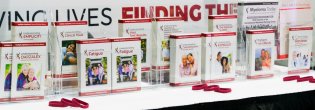
Slides from the symposium are available at imf-ons.myeloma.org (password: ons2026). An on-demand version of the symposium offering 1.5 credit hours of certified nursing education (CNE) will be available on medscape.com. The NLB acknowledges Rebecca Lu for content and case development.
(This article was originally published in the 2026 Summer Edition of the IMF's quarterly publication, Myeloma Today. Read the full publication here.)