



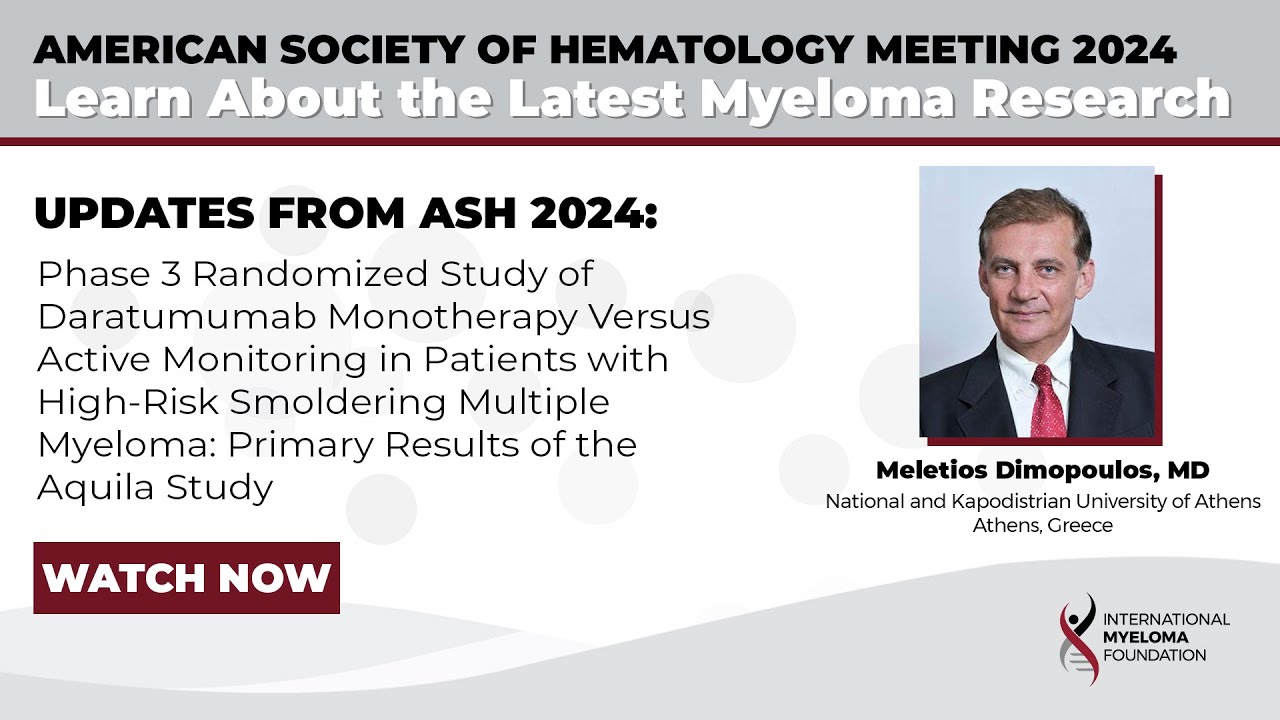
The study evaluates Daratumumab (DARA) in delaying progression from high-risk smoldering multiple myeloma (SMM) to active multiple myeloma (MM). It investigates DARA's efficacy as monotherapy compared to active monitoring in delaying disease progression and its impact on progression-free survival (PFS), overall response rate (ORR), and overall survival (OS).
Key Points:
- Daratumumab (DARA) showed significant improvement in progression-free survival (PFS) compared to active monitoring (HR 0.49, 95% CI 0.36-0.67, P <0.0001).
- Overall response rate (ORR) was notably higher with DARA (63.4%) versus active monitoring (2.0%, P <0.0001).
- DARA delayed the need for first-line MM treatment significantly longer than active monitoring (HR 0.46, 95% CI 0.33-0.62, nominal P <0.0001).
- Positive trends were observed for secondary endpoints including PFS on first-line MM treatment (PFS2) and overall survival (OS).
Authors:
Meletios-Athanasios Dimopoulos, Peter M. Voorhees, Fredrik Schjesvold, Yael C. Cohen, Vania Hungria, Irwindeep Sandhu, Jindriska Lindsay, Ross Ian Baker, Kenshi Suzuki, Hiroshi Kosugi, Mark-David Levin, Meral Beksac, Keith Stockerl-Goldstein, Albert Oriol, Gabor Mikala, Gonzalo Martin Garate, Koen Theunissen, Ivan Spicka, Anne K. Mylin, Sara Bringhen, Katarina Uttervall, Bartosz Michal Pula, Eva Medvedova, Andrew J. Cowan, Philippe Moreau, Maria-Victoria Mateos, Hartmut Goldschmidt, Tahamtan Ahmadi, Linlin Sha, Els Rousseau, Liang Li, Robyn M. Dennis, Robin Carson, Vincent Rajkumar
