


ODAC votes against belantamab mafodotin in combination with bortezomib and dexamethasone (3-5), and in combination with pomalidomide and dexamethasone (1-7); FDA extends review period for Blenrep, PDUFA action date moved to October 23, 2025
On Thursday, July 17, the Oncologic Drugs Advisory Committee (ODAC) of the U.S. Food and Drug Administration (FDA) held an advisory meeting to discuss BLA 761440—the application submitted by GlaxoSmithKline LLC, to use Blenrep (belantamab mafodotin) for the treatment of adults with relapsed/refractory multiple myeloma in combination with bortezomib and dexamethasone in patients who have received at least one prior line of therapy; and in combination with pomalidomide and dexamethasone in patients who have received at least one prior line of therapy including lenalidomide.
[UPDATE: On Wednesday, July 23, GSK announced via a press release that the FDA "has extended the review period for the Biologics License Application (BLA) for Blenrep (belantamab mafodotin-blmf) combinations for the treatment of patients with relapsed or refractory multiple myeloma who have received at least one prior line of therapy. The new Prescription Drug User Fee Act (PDUFA) action date is October 23, 2025 and provides the FDA with time to review additional information provided in support of the application."]
As an advisory committee, ODAC provides independent expert advice and recommendations to the FDA, which are not binding. Thus, the FDA still has the opportunity to approve the combinations and will consider efficacy, additional safety data, and patient impact beyond the questions addressed during the ODAC meeting.
International Myeloma Foundation (IMF) Interim CEO and Senior Vice President of Strategic Planning Diane Moran RN, MA, EdM, and IMF Scientific Advisory Board Member Saad Usmani MD, MBA, FACP, FASCO (Memorial Sloan Kettering Cancer Center — New York, NY) were among the speakers at the open public hearing who advocated for Blenrep’s approval.
IMF Scientific Advisory Board Member Dr. Saad Usmani shared his affirming insights about Blenrep, as a practicing hematologist/oncologist, and as a myeloma researcher and expert: “I’ve had the privilege of treating multiple myeloma patients over the past 18 years, in the states of Arkansas, in North Carolina, and more recently, in the tri-state area in the northeast. I’ve had direct and indirect interactions with patients, caregivers, and oncologists in urban, suburban, and rural settings.”
“Access to myeloma drugs in rural and suburban communities remains a significant challenge. It contributes to disparities and treatment outcomes. Patients in these areas often face limited availability of specialized care, few clinical trial options, and delays in diagnosis. [To be] specific, access to novel and immune cellular therapies is almost nonexistent for many of these myeloma patients due to travel distances to tertiary care centers, and the challenges in logistics. This is especially true for elderly or socio-economically disadvantaged patients as you’ve heard from several colleagues.”
“Additionally, I hear from our suburban and rural providers about the challenges of timely referrals, especially for commercial cellular therapy options. So, having an effective off-the-shelf option like belantamab mafodotin triplets will be very important to improve the multiple myeloma care access across the United States.”
“As a practicing clinician, I have no doubt, hearing the testimonies and talks from both sides, about the positive primary endpoint results of the DREAMM-7 and DREAMM-8 trials and the dosing and schedules [on] ocular side effects and their management. I do feel, as a clinician, [that] this tips the benefit-risk scale in favor of belantamab triplets for my patients.”
“At our center, we have advanced relapsed/refractory myeloma patients who responded to belantamab as therapy back in 2020 and 2021 who remain on treatment with sustained responses with minimal ocular side effects to this day. That’s a testament that mitigation strategies can be effective and help our patients. Within the lines, we have a novel belantamab triplet with every 8-week dosing which is actually enrolling across the United States in various communities—urban, suburban, and rural communities. That would not be possible if logistics were a real issue.”
“Every patient facing cancer deserves hope that access to new innovative treatments. Oncologists and patients must be empowered to explore all available options together, weighing the potential benefits and risks as a team. These conversations are vital. They ensure that care is not only evidence-based but also deeply personal. New therapies may offer improved outcomes even when side effects are possible. We observe this in our clinics every day, and we try to do our best to create that balance for our patients. As oncologists, we would really appreciate it if you could give us the opportunity to provide the best in care, grounded in both science and compassion,” said Dr. Usmani, in closing.
Speaking on behalf of the organization, IMF Interim CEO and SVP of Strategic Planning Diane Moran boldly expressed: “we are speaking today to strongly support BLA 761440—the application submitted by GlaxoSmithKline LLC, for the use of Blenrep (belantamab mafodotin).”
“The International Myeloma Foundation (IMF) brings both the patient voice and the science to this conversation. As the convenor of the International Myeloma Working Group (IMWG)—a global network of 350 myeloma experts—and in partnership with more than 150 myeloma support groups across the U.S., we serve as a bridge between evidence and lived experience. These are our superpowers: convening world-class research while standing shoulder to shoulder with patients navigating an incurable and unforgiving disease,” she continued.
“Belantamab mafodotin offers an evidence-based path forward for patients who need options. When it was first introduced, it brought promise—and for many, meaningful benefits. We have seen patients, even when treated as a single agent, experience deep and durable responses. Some have successfully stayed in treatment for years. These experiences have been echoed by many in the IMWG, whose clinical expertise spans the globe and many who have served as investigators in belantamab pivotal trials.”
“Today, we have even stronger data to support belantamab's value. The DREAMM-7 and DREAMM-8 trials clearly demonstrate that belantamab, when used in combination with bortezomib or pomalidomide, provides significant efficacy in early relapse—especially in triplet-versus-triplet comparisons. This is not just incremental progress—it is a validated option that builds on the scientific momentum in BCMA-targeted therapy. BCMA-directed therapies have transformed the care of patients with relapsed myeloma, improving dramatically the progression free and overall survival of patients.”
“We also now understand how to better manage the ocular side effects. With real-world clinical experience, physicians are mitigating these risks effectively through dose adjustments and proactive monitoring. These adverse effects are real—but importantly, they are reversible. And for many patients, the benefit in progression-free survival (PFS) outweighs the potential risks.”
“This proposed indication is more than a regulatory milestone—it is a lifeline. It is a chance to expand the toolbox for patients who need time they do not currently have,” Diane further stated.
Myeloma patient and advocate Jane Gallegos also gave her testimonial during the open public hearing. She recounted her initial diagnosis and the several failed attempts at treatments and transplant, which eventually led her to the care of myeloma specialist and IMF Chief Medical Officer Joseph Mikhael MD, Med, FRCPC, FACP, FASCO (TGen, City of Hope Cancer Center — Phoenix, AZ).
“[Dr. Mikhael and I] met, and I was enrolled in a clinical trial. He and his team met with me and my husband and said that he had one more drug to try. He explained the possible side effects, including cysts on the corneas. This drug was called Blenrep. He said that if this didn’t work, I could be gone in a matter of weeks.”
“I will never forget the genuine care and kindness that he showed us that day. The results were nothing short of miraculous. The myeloma did not like this drug — that was three years ago. I do get infusions of Blenrep and gamma globulin from time to time, as a preventative measure, although there’s no sign of cancer in the blood work or the PET scans. The cysts do cause blurred vision, but there is no pain. I do use preservative-free eye drops several times a day, which helps tremendously. The cornea specialist I see regularly said there’s no permanent damage to my eyes from this drug. Are the cysts annoying? Yes. But the trade-off is worth it. I am still here, enjoying this second chance of life that I have been given,” said Jane.
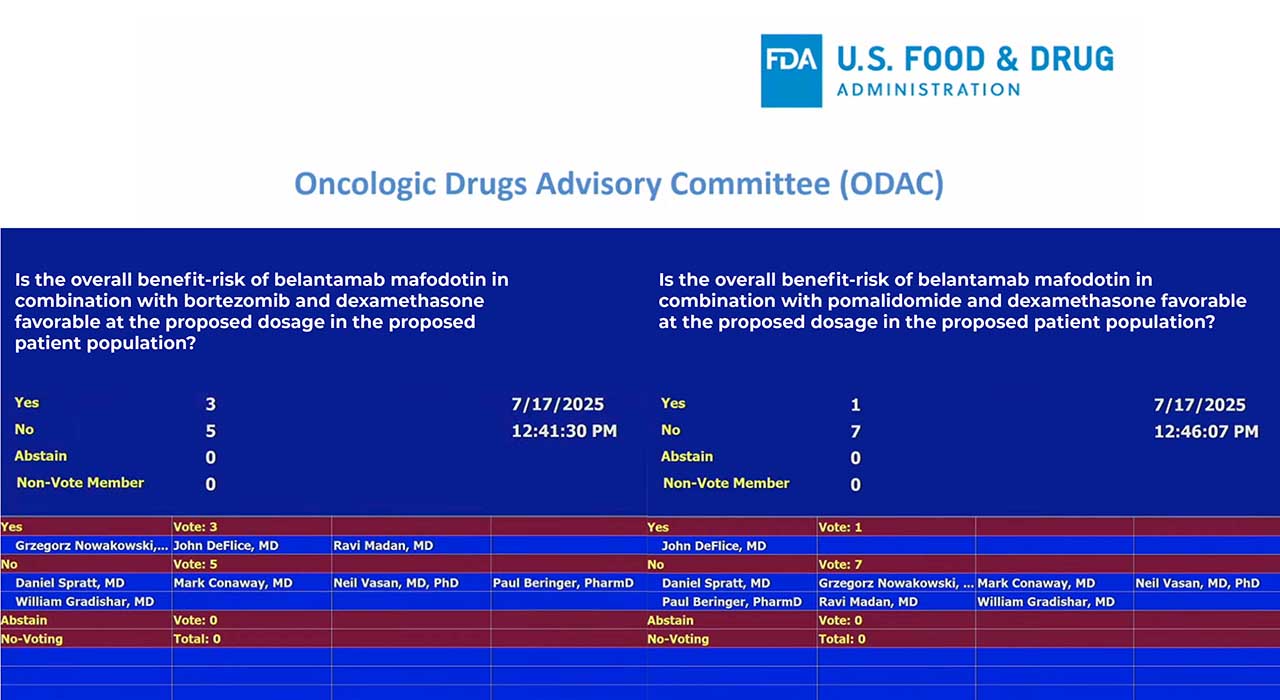
After deliberating on the benefits vs risks, and giving due consideration to all the presentations and testimonials made, the ODAC committee cast their votes to address these two questions: (1) Is the overall benefit-risk of belantamab mafodotin in combination with bortezomib and dexamethasone favorable at the proposed dosage in the proposed patient population? (Yes-3; No-5); and (2) Is the overall benefit-risk of belantamab mafodotin in combination with pomalidomide and dexamethasone favorable at the proposed dosage in the proposed patient population? (Yes-1; No-7).
In a press release, GSK said that it "notes that the U.S. Food and Drug Administration (FDA) Oncologic Drugs Advisory Committee (ODAC) voted against the overall benefit/risk profile at the proposed dosage of Blenrep (belantamab mafodotin-blmf) combinations. The belantamab mafodotin combinations were evaluated in adults with relapsed or refractory multiple myeloma who have received at least one prior line of therapy."
As of Wednesday, July 23, "the FDA has extended the review period for Blenrep. The new action date is October 23, 2025 and provides the FDA with time to review additional information provided in support of the application," announced GSK in a press release.
"GSK remains confident in the benefit/risk profile of Blenrep (belantamab mafodotin-blmf) and will continue to work closely with the FDA as they complete their review for Blenrep in patients with relapsed or refractory multiple myeloma where there is high unmet need for novel treatment options that extend survival."
IMF Still Advocates for Blenrep's FDA Approval, Despite Legitimate Safety Concerns Raised
Despite legitimate safety concerns raised by the FDA-ODAC on Blenrep, the IMF is still in favor of its approval, while fully supporting patient safety.
The IMF is encouraging myeloma patients to keep advocating for themselves and for the treatments and care that they deserve. Our mission of finding a cure continues, and our vision is clear: A world where every myeloma patient can live life to the fullest, unburdened by the disease.
To view the FDA ODAC Advisory Committee meeting in its entirety, watch the video.