
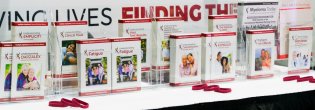


NLB Symposium at the 2024 ONS Congress
Nurse leaders educate peers about new therapies and regimens for patients with myeloma
By Diane Moran, Senior Vice President, Strategic Planning
On April 25, the IMF Nurse Leadership Board (NLB) presented its long-standing symposium at the 49th Annual Oncology Nursing Society (ONS) Congress held in Washington, DC. “Case Studies for Nurses: New Therapies and Regimens for Patients with Multiple Myeloma” was led by a distinguished faculty of NLB members Beth Faiman, Kevin Brigle, Patricia Mangan, and Donna Catamero.
“This is the 18th year that the IMF has organized a symposium at the ONS Annual Congress,” said Beth Faiman, who chaired the symposium. “This is one of the main ways the NLB shares nursing best practices and the latest data that contributes to improved patient care.” Approximately 550 nurses from across the U.S. attended the NLB symposium at the ONS Congress.
“Carl”
Kevin Brigle began by introducing the first case: “’Carl’ is a 61-year-old male who has a history of hypertension and prostate cancer that was successfully treated with radiation therapy. He experienced back pain after helping his son build a swing set for his two grandkids.” Kevin explained that Carl visited his doctor several times for his back pain before the advanced practice nurse ordered blood tests that showed an abnormal protein. Carl was referred to a hematologist-oncologist who ordered a full myeloma workup. “Myeloma is one of the worst cancers for delayed diagnosis,” Kevin explained, since the initial symptoms of myeloma, like fatigue and pain, are non-specific.
In the context of the case, Kevin discussed disparities. Black Americans of African descent have 2–3 times the rate of myeloma and MGUS (a precancerous condition that has a low chance of progressing to myeloma). Unfortunately, Black Americans with myeloma are twice as likely to die from myeloma compared with their White counterparts, perhaps because Black patients are less likely to receive the latest treatments, an autologous stem cell transplant, or participate in clinical trials. Research, however, suggests that when treated equally, Black Americans can achieve superior outcomes compared with White patients, possibly because, as a group, they tend to have less biologically aggressive myeloma. “Nurses are crucial to reducing disparities,” said Kevin, who explained that awareness of these disparities and ensuring each patient is treated equally are essential steps.
“Margaret”
The good news is that people with myeloma are living longer than ever,” began Patricia Mangan, who introduced the second case, “Margaret.” Diagnosed with myeloma in 2016 when she was 63 years old, Margaret began to experience a biochemical relapse in 2018 when her light chains began gradually increasing. Patricia said that for many patients, the first relapse is harder psychologically than their initial diagnosis since every patient hopes they will be among the small percentage of patients with myeloma who never relapse after their first therapy. Margaret received several different therapies before her oncologist suggested CAR T-cell therapy may be a good next option.
Patricia explained that in CAR T-cell therapy, a patient’s T-cells are harvested, engineered to target myeloma, and reinfused back into the patient. “Manufacturing the CAR T cells can typically take a month or two, and some patients may need bridging therapy during this period.” She explained that to access CAR T-cell therapy, patients need to consult with a qualified center to undergo assessments to ensure they are medically able to receive the therapy and understand what their insurance will cover.” Margaret consulted with a CAR T-cell center and received a BCMA-directed CAR T-cell therapy in November 2022. Although Margaret experienced some of the typical side effects of cytokine release syndrome (CRS) and low blood counts, she attained a complete response (CR).
“It is exciting that CAR T-cell therapy is now available to more patients with myeloma,” said Beth, explaining that the two currently approved CAR T-cell products are now available after only 1 or 2 prior lines of therapy. Beth also highlighted the new guidelines for infection prevention in patients with myeloma. “Unfortunately, infection is the leading cause of death in patients with myeloma,” she said. Beth discussed several medications that can help prevent infections in patients with myeloma and when their use is recommended.
IVIG replacement during CAR T-cell or bispecific antibody therapy is recommended to treat or prevent infections,” said Beth, mentioning that patients on these therapies have experienced infections not commonly seen in patients receiving other myeloma therapies.
“We are very fortunate to have three bispecific antibody products available for our patients with myeloma,” began Donna Catemero, explaining that bispecific antibodies are an “off the shelf” treatment that has one side that is attracted to myeloma cells and the other side that is attracted to T cells. “The bispecific antibody leads the patient’s T cells by the hand to the myeloma cells. The T cells release cytotoxic cytokines that kill myeloma cells.” Both Donna and Beth explained that bispecific antibodies are given with step-up dosing to limit the degree of CRS a patient experiences. They explained that optimal sequencing of therapies for myeloma is an evolving process, but patients can receive CAR T and bispecific antibodies in either order. Donna continued the case of Margaret and introduced “Robert,” both of whom received bispecific antibody therapy.
“Robert”
Donna explained that clinical trials have enabled new therapies like CAR T and bispecific antibodies for patients with myeloma. She explained that some patients believe myths about clinical trials, which prevent them from considering them as a treatment option. “Some patients worry that if they participate in a clinical trial, they could receive a placebo and not active treatment. In myeloma clinical trials, a patient will never receive less than the standard of care. Many phase III trials compare a standard of care regimen to a new proposed regimen.” Donna explained that minority patients in the U.S. participate in clinical trials at half the rate of their percentage in the U.S. population, which is problematic since drugs may interact differently in different populations. “Without sufficient participation in clinical trials by all groups, we may not understand these differences.”
Minimal residual disease (MRD)
“It is exciting that we have so many new drugs in development,” Beth said, reviewing drugs in development. “Earlier this month, an FDA committee recommended minimal residual disease (MRD) as an endpoint for myeloma clinical trials,” she continued, saying this may facilitate the development of drugs for myeloma. Attaining MRD-negativity means that, depending on the sensitivity of the test used, not even 1 myeloma cell is found in 100,000 or 1,000,000 sampled bone marrow plasma cells.
“Through sharing stories of our patients and highlighting the latest research, we aim to empower oncology nurses to engage and educate each patient and their care partners, reduce disparities, and enhance shared decision-making,” said Beth in closing.
The NLB’s Certified Nurse Educator (CNE) accreditation video program will be made available online in the near future. Visit nlb.myeloma.org to learn how the NLB is improving the nursing care and self-care of patients with myeloma via publications, symposia, multimedia, and research.
(This article was published in the 2024 Summer Edition of the IMF's quarterly publication, Myeloma Today. Read the full publication here.)