

State of Myeloma 2025: New Treatments & Research
With very encouraging data and results of various myeloma research efforts unveiled at the 2025 American Society of Clinical Oncology (ASCO) annual summit in Chicago, IL, and the European Hematology Association (EHA) Congress in Milan, Italy, the future of myeloma research looks bright and promising this year.
From quadruplet treatments to bispecific and trispecific antibodies, CAR T-cell therapy, immunotherapies, antibody-drug conjugates, and more, the ASCO and EHA sessions were bustling with activity and in-depth discussions on newer and more innovative approaches to myeloma treatments.
So, what is the state of multiple myeloma in 2025, in terms of statistical data?
According to the National Cancer Institute’s Surveillance, Epidemiology, and End Results (SEER) Program, there are 36,110 estimated new cases of multiple myeloma in 2025. There were an estimated 192,144 people living with myeloma in the U.S. in 2022.
Multiple myeloma represents 1.8 percent of all new cancer cases in the U.S. and is relatively rare. Based on 2018-2021 data (excluding 2020 due to COVID-19), approximately 0.8 percent of men and women will be diagnosed with myeloma in their lifetimes.
Rate of New Cases and Deaths
The rate of new cases of myeloma was 7.3 per 100,000 men and women per year. The death rate was 2.9 per 100,000 men and women per year. These rates are age-adjusted and based on 2018–2022 cases and 2019–2023 deaths.
Survival Statistics
Relative Survival
Five-year relative survival for multiple myeloma is currently at 62.4 percent (based on data from SEER 21- excluding IL, from 2015-2021). SEER defines relative survival as “an estimate of the percentage of patients who would be expected to survive the effects of their cancer” and “excludes the risk of dying from other causes.”
Survival By Stage
For myeloma, only 3.4% of people are diagnosed when it’s still in the early, localized stage. People with localized myeloma have about an 80.7% chance of living five years after diagnosis. SEER defines cancer stage at diagnosis as referring to how far the cancer has spread in the body. This stage helps doctors decide on the best treatment and affects the length of survival. If the cancer is only in the place where it started, it’s called localized or stage 1. If it has spread, it’s called regional or distant.
Who is prone to multiple myeloma?
Myeloma is a rare type of cancer, but it happens more often in men than in women. The disease is also more common among non-Hispanic Black people. People who have had a condition called monoclonal gammopathy of undetermined significance (MGUS) are at a higher risk. From 2018 to 2022, about 7.3 out of every 100,000 people got myeloma each year (number adjusted for age).
Changes over time
From 2013 to 2022, the number of new myeloma cases each year has stayed about the same. However, the death rate has gone down by about 2.6% each year from 2014 to 2023.
Watching how the number of new cases, deaths, and survival rates change over time helps scientists see if progress is being made and where more research is needed—like finding better ways to detect or treat the disease.
Revolutionizing Treatment for Relapsed Myeloma
Significant advancements in myeloma treatments have emerged in 2025—with newer therapies such as CAR T-cell therapy and bispecific antibodies being used in earlier lines of treatment.
While the disease remains incurable, the considerable expansion of treatment options has led to longer survival and improved quality of life for myeloma patients.
Targeted approach
CAR T therapy, immunomodulatory drugs, and bispecific antibodies provide more targeted approaches with fewer side effects, as compared to traditional treatments such as chemotherapy. For example, the bispecific antibody isatuximab is currently being used in combination with other therapies to help improve progression-free survival (PFS).
Early-stage treatment on the rise
Notably, early-stage treatment for myeloma is becoming a primary focus. CAR T therapy (such as cilta-cel and ide-cel) is currently being used in earlier lines of therapy for relapsed/refractory myeloma patients.
More personalized approach to treatment
Even better, treatment decisions are increasingly becoming more personalized in their approach. Individual patient characteristics such as age, disease stage, and prior therapies are looked into for a more personalized approach to treatment.
Focus on minimal residual disease (MRD)
Current treatments are focusing more on achieving minimal residual disease (MRD) negativity, leading to longer progression-free survival.
Challenges remain
However, some challenges still need to be hurdled, especially in the relapsed/refractory setting where many patients still experience relapse or develop resistance to treatment. New therapies also have their share of side effects, while offering advantages.
Looking Ahead: The Journey Toward a Cure
Extensive and intensive research continues, as researchers aim to improve and expand treatment options further, and potentially, find a cure for myeloma. There is still a need to discover more curative approaches to the disease.
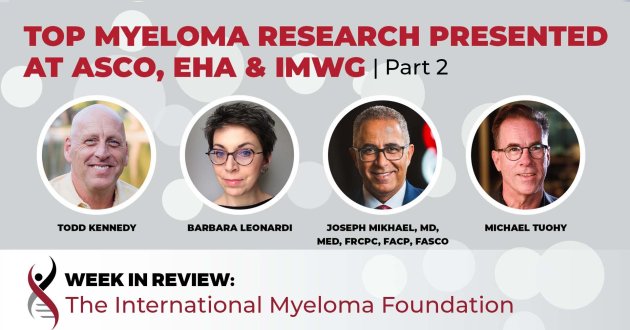
Upcoming webinar on Top Myeloma Research from ASCO, EHA, and IMWG: The Patient Perspective
Curious about what’s current in myeloma research? You can still register for the IMF’s upcoming webinar on Top Myeloma Research Presented at ASCO, EHA & IMWG 2025: The Patient Perspective, which will take place virtually on Tuesday, July 1st, 3:00 PM PST / 4:00 PM MT / 5:00 PM CT / 6:00 PM ET.
Along with patient advocates and support group leaders, IMF Chief Medical Officer Dr. Joseph Mikhael will discuss Top Myeloma Research presented at the June 2025 American Society of Clinical Oncology (ASCO) Annual Conference, the IMF International Myeloma Working Group (IMWG) Summit, and the European Hematology Association (EHA) Annual Conference.
Dr. Mikhael will highlight scientific abstracts from the June 2025 ASCO Annual Conference, the IMF IMWG Summit, and the EHA Annual Conference and will explain data in approachable terms that patients can use in their everyday care decision-making.
Don’t miss it!