


Content appearing on this page is not provided by the IMF. The IMF neither warrants nor guarantees the accuracy of such content. The IMF would like its audience to know that the content is not a substitute for advice and service provided by qualified and licensed medical professionals and should not be relied on with respect to any health matters. Any health-related information found on this page is only made available as part of a general educational service.
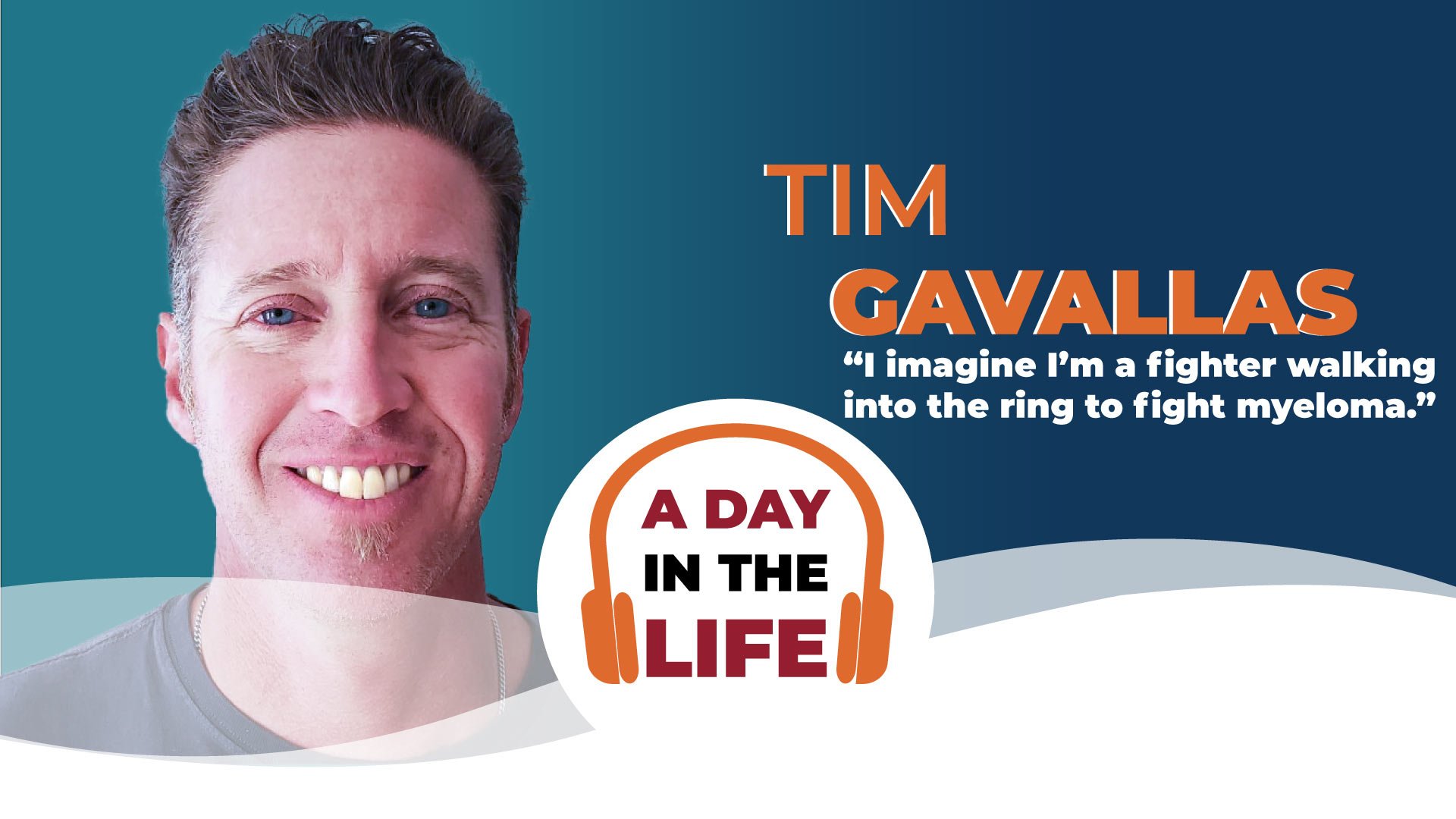
The “A Day in the Life” podcast from the International Myeloma Foundation features messages of hope and resilience for myeloma patients, caregivers, and their loved ones. This episode features an interview with seven-year multiple myeloma survivor Tim Gavallas. Tim is a police officer in Watertown, Connecticut; a father of twin boys; an avid hiker, kayaker, ice-fisher, and more.
Transcript:
Host: You are listening to A Day in the Life podcast brought to you by the International Myeloma Foundation. Today we’re talking to Tim Gavallas. He’s a police officer in Watertown, Connecticut, who is living with multiple myeloma. And I might add, he’s living well despite having the disease. My first question for you is I understand you recently took a camping trip with your family. How was that trip?
Tim Gavallas: We had a great time. We went up to Lake George in New York. I brought my RV up there. We camped out. We played some mini-golf, went go-carting. We even did a tour through the Ft. William Henry fort up there.
My brother was up there with his family, and they came and visited us at the campground one night. And my nieces and my boys got to play, and do a campfire and do the s’mores and everything.
My dad came up the next day and took us all out to dinner. And I also had some friends that went up there with their boats, and they were camping out on one of the islands on the lake. And we hung out with them on Friday, and went boating. The boys got to go tubing. We had a great time up there.
Host: It’s great to get connected, especially during this pandemic right now. And the reason I ask you about this trip, is because as you know, at the International Myeloma Foundation, we always want to encourage patients to live full — as full lives as possible. And what’s interesting about you, is that I understand you are really into the outdoors and an athlete. And some of things that I’m aware that you do include kayaking, ice-fishing, mountain climbing, and you’ve done many obstacle competitions. My question for you is, how has a myeloma diagnosis affected your ability to do, or made you adapt to do any of these activities that you enjoy?
Tim Gavallas: Yeah, I really love the outdoors. And I did do a lot of obstacle racing around the time of my diagnosis. And weightlifting too. Obviously, when I was diagnosed, the way it affects your bones, I had to really scale back with the weightlifting. So now I still do it, but I got to go lighter. I make it harder by doing more reps, and slowing them down. But I’m still able to do a lot of what I used to do. Not really a mountain climber. I’m a hiker. That’s a whole other level when you do the mountain climbing. But yeah, I’m still able to live my life, pretty close to the way I was before.
Host: I think that’s really inspirational for myeloma patients out there, especially those who have been recently diagnosed, and are wondering if they are going to be able to engage in those activities they’ve always done. And one thing that’s really amazing, is that I understand you recently traveled Tanzania, and did you hike or climb Mt. Kilimanjaro, and what was that trip like? What were some of the stories or memories you have of that experience?
Tim Gavallas: Yeah, it was amazing. So every continent has their highest mountain, and Africa’s highest mountain is Mt. Kilmanjaro. And what’s unique about that mountain is you can hike from the base to the summit. It doesn’t require any technical climbing skills, where some of the other mountains, Everest is the most famous, you’ve got to know how to rope-climb and all that kind of stuff. But just being out there in Africa was amazing. The people are wonderful and friendly. There was 12 of us on our team, went out. We raised money for the Connecticut Special Olympics. We actually raised $161,000 for them. And what was neat about going up the moment is you need to hire a guide service. And they required two guides for every person. So we had 12 of us, we had 6 guides, plus there was a chef. And then they assigned everyone their own personal bag carrier. They carry a big duffle bag, and you just carry a small daypack every day. And then they have all the other porters that carry all the other gear. So there was about 45 people it took to get the 12 of us up and down the mountain. And they’re just amazing athletes…some of them were carrying a backpack on the front, a bag on the head, and they’d go by you like you were standing still. The climb it took about five days up and two days down. And just the comradery we had as a whole group is something that we’re gonna cherish forever. A really neat memory is on the way down. See, you go through several different arctic, different climate zones, starting with the tropical rainforest and ending up in an arctic zone. So in the beginning there’s lush forests and monkeys. And when you get at the top, there’s big piles of snow. The wind is blowing. It is really cold up there.
And so on the way down, you go through one called the alpine desert. And it’s 15,000 feet, and it’s just like you would imagine a desert. Just sand and rocks. A lot of people would take the rocks and write their names. And it just pretty much stays forever. There’s not high wind up there, and nothing is going to disturb it. So I had an idea to do something special. And I got our whole group together. And there was probably about three of four of the group who knew about my multiple myeloma diagnosis. And I explained this story to them and told them, “If you told me seven years ago when was diagnosed that I’d be hiking up the tallest mountain in Africa, I wouldn’t believe you. But you know, here I am. And what I did is I took my trekking pole and I made the cancer ribbons in it. Everybody in the group and our guide we took rocks, and we made a big cancer ribbon out of rocks. And I had my picture taken with the guides, with the summit of Mt. Kilimanjaro behind us and our head guy Rashid said that every time he led a group up that mountain, he was going to stop there and talk about, you know, my story. And I think it’s neat, I hope that it would give a lot of people hope, you know that they are doing that. And something they can take away from it.
Host: Definitely. That’s very…That’s great that you took the effort to educate and raise awareness even while you were doing this hike. A little different question for you now. You were talking a little bit about your family. And I understand you are parent of twin boys. Um, one of the things myeloma patients have difficulty with when they are first diagnosed, is how is this going to affect their parenting? And what advice would you give to another parent who may have just been diagnosed with myeloma.
Tim Gavallas: Right. First thing is that there is hope. You know more and more it is becoming a treatable disease than just an immediate death sentence. You know when I was diagnosed, my boys were only four years old, and now they are eleven years old. And I think the hardest thing is just talking to them about the multiple myeloma. My sons know that I have it. They don’t understand exactly what it is. But next month I will be doing a stem cell transplant, so I am going to have to bring them a little bit more up to speed.
Host: You mentioned that you are scheduled for the stem cell transplant next month. How are you feeling about having to undergo this regimen? How are you mentally preparing?
Tim Gavallas: Like I said, the hardest thing is going to be talking to my sons about it. It’s going to be a little bit harder too with the COVID epidemic we have. I don’t think they are going to be able to come up to visit me, but luckily we have the FaceTime with the modern technology. I do belong to the Connecticut Myeloma Fighters Support Group with Michael and Robin Tuohy. And they gave a wealth of information, right from the beginning. And I want to say everyone in the group, besides me, has undergone a stem cell transplant. So I have been able through the years to listen to their stories, and see people as they go through. And you know, they couldn’t come to the meetings right away, but their spouses would come and give us updates. So I kind of know what to expect.
Host: Well we’re all pulling for you. It takes a lot of fortitude to go for that procedure. And last year, you spoke at the American Society of Hematology annual conference as part of the IMF’s Brian D. Novis Grant Awards reception. And I read your speech, and one of the, it was a great speech throughout, but one of the quotes that really stood out to me was, “I imagine I’m a fighter walking into the ring to fight myeloma.” When did you develop this attitude of beign a fighter against myeloma? How soon after you were diagnosed were you able to develop sort of this fighting mentality?
Tim Gavallas: It was pretty quick. You know the first thing was sadness of course. My boys had just turned four. Omigosh are they going to grow up without me? Will they even remember who I am? But very quickly, I thought I’m not going out like that. I got this idea that when I walk into the cancer center, I’m walking down that arena towards the ring. You know, I got the fans all there, and I just imagine that I’m a fighter. And I step in the ring, and I’m getting my treatment, and it just help me to land that knockout blow into myeloma. Just win the fight.
Host: Speaking of, one of the themes of that reception was the theme of resilience. I know you have spoken about this before, but what can you share with our listeners, what resilience means to you?
Tim Gavallas: Yeah, like I said, I really enjoy hiking and backpacking. And if you look at a mountain, and from the bottom it can look so high and so far away, but you know you can conquer that by just taking it one step at a time, and just never giving up, and never quitting and you’re going to get there.
Host: How would you set another patient’s mind at ease if they were just diagnosed and had a lot of fear, and they weren’t able to find that resilient attitude that you have?
Tim Gavallas: The most important thing is to get your information from reliable sources, such as the IMF. If you do a random Internet search, you might find some wrong information, or dated information. But there’s always new drugs, and new treatments coming all the time. It’s just such a changing pace. It’s getting better and better for us as patients. And another thing to, get involved in a support group. If you visit the IMF website, they list support groups throughout the country. Mosf of the places…most places have one close to where you live. And you get involved, you can meet people that are going through it and that can help you connect with somebody. I know for me, I connect with Michael Tuohy. He was around my age when he was diagnosed, and he had young children too. He was able to really help me out and put my mind at ease.
Host: And how old were you when you were diagnosed, and what was that like for you?
Tim Gavallas: I was 38 years old. It was hard when it first happened because you just don’t know. You don’t know what to expect. But like I mentioned with the support group, I got in the elevator. I saw the little poster for the meeting. And I think it was the next day or the day after. So I got to get plugged in right away. It was like a huge weight being lifted off my chest. Huge. I can’t stress enough about getting into a Support Group. I didn’t know what to expect. I didn’t know if it was going to be, a “Woe is me” type thing. But just the opposite: very positive and just information. Always new information coming out.
Host: And is there any other thoughts you’d like to share with listeners in maybe any of the other questions I’ve asked?
Tim Gavalllas: I just value every day, and I treat it as a gift. I look to make memories, especially with my sons. They grow up so fast. There’d be times when I might be tired, and I had a long day at work, and I come home. They’ll ask me to play catch or something like that. You know without having the myeloma, maybe some of those times, you might say no because you are tired. I always make sure I get up, and I go out and just make those memories, the lasting memories. You know in the end that’s all you are going to take with you. And I thank the Lord for every day. I get up every morning. I hit my knees. And I thank him for another day. Life is gift.
Host: Definitely. I think that’s all my questions for you. Are there any sort of treatments that you’ve gone through that you’d like to talk about or what some of the rough points have been or some of the things you didn’t expect.
Tim Gavallas: Not really. I’m been really lucky with my treatments. I started with the Rev, Dex, and Velcade. And I was just on Revilmid for a long time. And then my numbers came up a little bit. I tried Ninlaro. It didn’t work. Now I’m on daratumumab. It’s an IV treatment. And I know a lot of people had a little bit of side effects with it. But I was lucky, I didn’t have any side effects with it. I’m doing great on it. And actually just started doing it with it sub-q (subcutaneous). So my last treatment, I was the first one in the doctor’s office that got it sub-Q. And even that, I had no issues with it. It’s working great.
Host: After the stem cell transplant, if you can see that far ahead. What are you looking forward to? What are you planning in your mind? What’s next?
Tim Gavallas: As far as like treatment goes, I hear that you can be on a low dose. Maybe like 5 mg of Revlimid, which would be good. Plus to get off the dexamethasone would be real nice. And just as far as like normal living, I look forward to planning another vacation with family next year. Maybe go up to Maine. I know the stem cell, it’s going to kind of knock me down a little bit. Kind of make me weak and tired. I just look forward to getting my body back up to where I am now after that.
Host: Well we wish you the best of luck. I know this was a little short today. But I wanted to thank you for taking your time, and for everyone who’s listening, Tim is actually on shift right now as a police officer in Watertown, Connecticut. So thank you for taking the time today to talk to us.
Tim Gavallas: Thank you for having me!

