Top Takeaways from The IMF Conference Series: Highlights from ASCO, IMWG, and EHA 2026 (https://www.myeloma.org/blog/takeaways-imf-conference-series-asco-imwg-eha-2026)
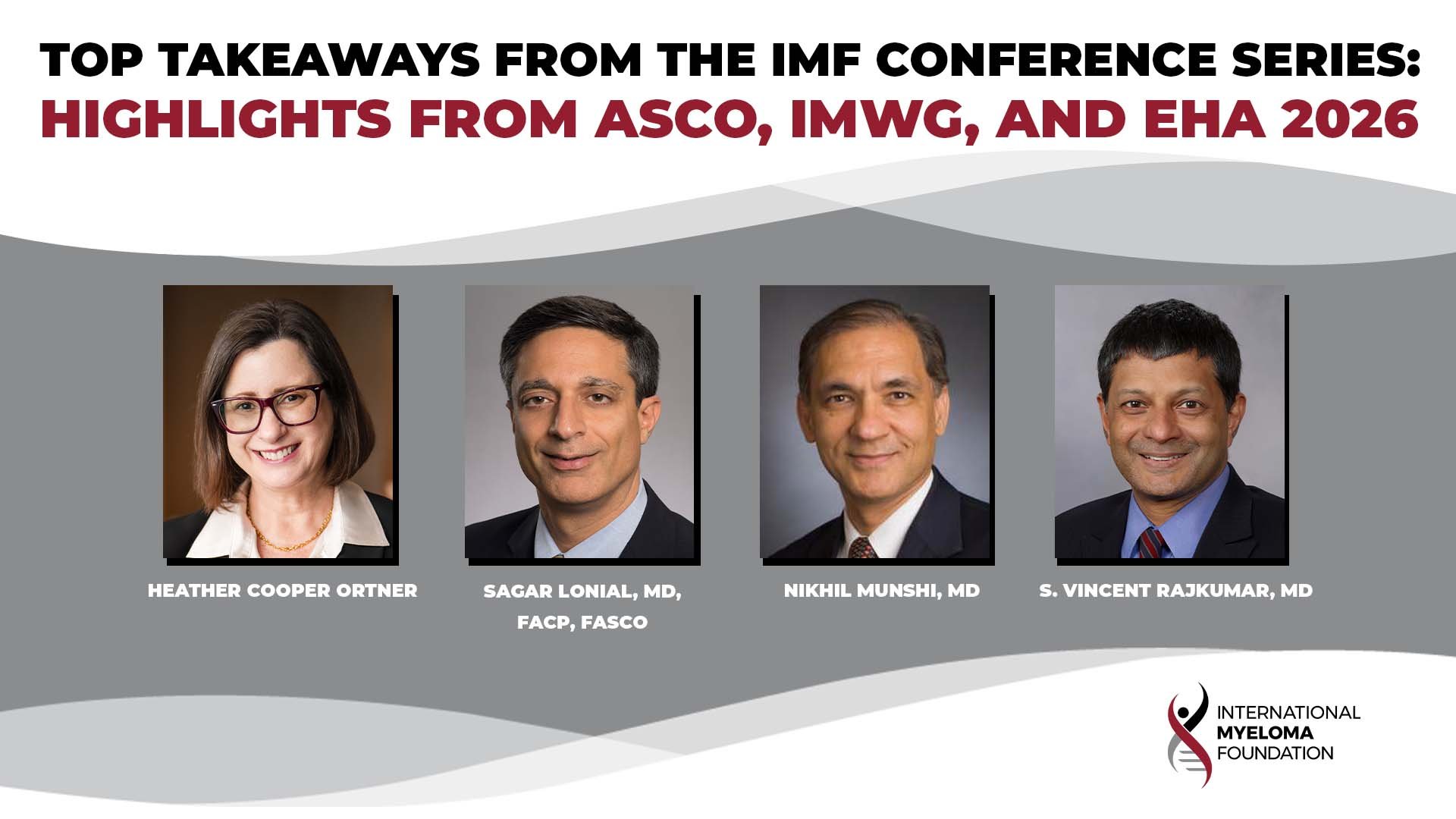
The IMF Conference Series talks about key myeloma research from ASCO, IMWG, and EHA 2026
In this IMF Conference Series webinar, International Myeloma Foundation (IMF) President & CEO Heather Cooper Ortner, along with highly esteemed myeloma expert panelists: IMF Chairperson of the Board Dr. S. Vincent Rajkumar; IMF Vice Chairperson Dr. Sagar Lonial; and IMF Board and Scientific Advisory Board Member Dr. Nikhil Munshi review the most important findings from the ASCO, IMWG, and EHA 2026 annual meetings.
With new clinical trial results presented at the American Society of Clinical Oncology (ASCO) Annual Meeting, the European Hematology Association (EHA) Congress, and the International Myeloma Working Group (IMWG) Summit, continued progress toward longer-lasting remissions and potentially, cure for some patients with multiple myeloma seem to be on the horizon.
The IMF Conference Series webinar focused on practice-changing evidence supporting earlier use of advanced immunotherapies, improving survival with current frontline treatment, and an expanding pipeline expected to deliver 5-7 new therapies over the next 2–3 years.
Here are some of the top takeaways from the webinar. (EDITOR’S NOTE: Topics of discussion and panelists’ views have been edited for conciseness and clarity.)
Standard of care for transplant-eligible newly diagnosed myeloma
The panel agreed that the current standard for newly diagnosed multiple myeloma (NDMM) remains quadruplet induction therapy followed by autologous stem cell transplant (ASCT) for eligible patients (particularly those with high-risk disease) and risk-adapted maintenance therapy.
According to Dr. Rajkumar, approximately 80% of transplant-eligible (TE) patients remain progression-free, 4 years after treatment. Dr. Lonial added that, with steadily improving outcomes, achieving cure is no longer viewed as an unrealistic goal but as an active area of research, while Dr. Munshi noted that high-risk patients continue to benefit from more intensive transplant and maintenance strategies.
Earlier use of immunotherapy after first relapse
Among the meeting's most significant findings were new data supporting earlier use of immunotherapy after first relapse. Results from the MonumenTAL-3 trial (https://library.ehaweb.org/eha/2026/eha-2026/4206654/peter.voorhees.phase.3.randomized.study.of.talquetamab.28tal29.plus.daratumumab.html?f=menu%3D6%2Abrowseby%3D8%2Asortby%3D2%2Ace_id%3D2934%2Amarker%3D6764) showed that talquetamab-based combinations achieved an approximately 81% progression-free survival (PFS) rate at 2 years.
Meanwhile, the MajesTEC-9 study (https://library.ehaweb.org/eha/2026/eha-2026/4206749/cyrille.touzeau.majestec-9.a.phase.3.study.of.teclistamab.monotherapy.vs.html?f=listing%3D0%2Abrowseby%3D8%2Asortby%3D1%2Asearch%3DMajesTEC-9) demonstrated strong activity with single-agent teclistamab in patients previously treated with daratumumab. The experts emphasized that treatment goals at first relapse should mirror those used in NDMM—achieving the deepest and most durable remissions possible.
Sequencing CAR T and bispecific antibody therapies
The discussion addressed one of the most important treatment decisions facing patients: whether CAR T-cell therapy or bispecific antibodies should be used first. Dr. Munshi said CAR T-cell therapy generally remains the preferred first immunotherapy because it produces response rates of 90-95% as a single treatment.
However, combinations such as teclistamab plus daratumumab are narrowing that gap, with response rates approaching 85-90%. The panel advised using CAR T before BCMA-directed bispecific antibodies whenever possible to preserve future treatment options and maintain T-cell function. When disease returns, switching to therapies targeting a different protein, such as GPRC5D, is considered a practical sequencing strategy.
Immunotherapy and side effect management
Experts expressed confidence that newer immunotherapies are becoming easier to manage as physicians gain experience. Dr. Rajkumar compared today's bispecific antibodies with the early experience of bortezomib, noting that optimized dosing schedules, preventive treatments such as intravenous immunoglobulin (IVIG) and tocilizumab, and greater clinical familiarity are steadily improving safety.
Researchers also continue to study delayed neurological side effects associated with CAR T-cell therapy, including the rare Parkinsonism reported after ciltacabtagene autoleucel (cilta-cel), which occurs in approximately 3-4% of patients and requires early recognition and treatment.
The growing role of early intervention in high-risk smoldering myeloma
For patients with high-risk smoldering multiple myeloma, the panel highlighted the growing role of early intervention. The AQUILA trial (https://www.nejm.org/doi/abs/10.1056/NEJMoa2409029)established daratumumab as the first approved treatment for high-risk smoldering myeloma after demonstrating that early therapy delayed progression to active disease and improved overall survival.
Achieving long-term disease control or functional cure
Ongoing studies, including the ASCENT (https://library.ehaweb.org/eha/2026/eha-2026/4206761/shaji.kumar.aggressive.smoldering.curative.approach.evaluating.novel.therapies.html?f=listing%3D0%2Abrowseby%3D8%2Asortby%3D1%2Asearch%3DAQUILA) and CESAR trials (https://clinicaltrials.gov/study/NCT02415413), are evaluating whether more intensive treatment can achieve long-term disease control or even functional cure. The experts stressed that patients should first have their risk carefully confirmed (preferably at a major myeloma center) before beginning treatment.
Identifying ultra-high-risk myeloma
Researchers are refining how they identify patients with the most aggressive disease. Dr. Munshi explained that ultra-high-risk multiple myeloma represents approximately 5-7% of patients, and ongoing genomic research aims to better define this group and identify those who may benefit from earlier combinations of CAR T-cell therapy, bispecific antibodies, or other novel immunotherapies.
Updated definition of high-risk disease
The panel reviewed the IMWG's updated definition of high-risk disease, which incorporates specific genetic abnormalities and combinations of chromosomal changes to better identify patients who may require more intensive treatment.
Next-generation CELMoDs
Another major focus was the next generation of cereblon E3 ligase modulators (CELMoDs). Mezigdomide and iberdomide demonstrated encouraging activity across several treatment settings and are expected to become important partners for CAR T-cell therapy and bispecific antibodies, while also being studied as maintenance therapy and for improving T-cell fitness before CAR T-cell collection.
Mezigdomide appears particularly active against extramedullary disease, while iberdomide may offer a more favorable side-effect profile than lenalidomide. A head-to-head maintenance trial comparing iberdomide with lenalidomide has completed enrollment.
The importance of MRD
Minimal residual disease (MRD) testing remained a central topic throughout the discussion. The panel emphasized that MRD currently serves three important roles: it is an accepted surrogate endpoint supporting accelerated drug approvals; a powerful prognostic marker because patients who become MRD-negative generally experience longer survival; and a potential future marker of cure when MRD negativity is sustained after all treatment has stopped.
However, the experts cautioned that MRD results alone should not yet determine whether treatment should be intensified, reduced, or discontinued outside clinical trials. In patients with high-risk disease, sustained MRD negativity at a sensitivity of 10-6 does not currently justify skipping ASCT.
Q&A session
During an extended Q&A session, the panel addressed several practical concerns frequently raised by patients and caregivers.
- Multiple myeloma is not considered a hereditary disease in the traditional sense, with only a very small increase in risk among close relatives.
- Patients were reassured that generic lenalidomide is chemically and clinically equivalent to the branded drug, making it a safe alternative where available.
- Current evidence continues to support maintenance therapy after transplant for all patients, although studies are evaluating whether shorter, fixed-duration maintenance may be appropriate for some individuals in the future.
- Eligibility for CAR T-cell therapy depends more on overall health and functional status than chronological age, with some centers successfully treating patients up to 85 years old.
- For standard-risk patients receiving quadruplet induction, transplant, and maintenance, the panel estimated that 7–8 years of good disease control is now a realistic expectation using one or two lines of therapy.
- Despite increasingly intensive treatments, patients who achieve MRD negativity generally maintain quality of life equal to or better than those with persistent disease, and quality of life is expected to play an increasingly important role in selecting future therapies as treatment effectiveness continues to improve.
Looking ahead: What’s next in myeloma therapies?
The panel projected that 5-7 new myeloma therapies could receive regulatory approval within the next 2-3 years.
Among the most anticipated are anitocabtagene autoleucel (anito-cel), mezigdomide, iberdomide, GPRC5D-directed CAR T-cell therapies, trispecific antibodies, and a new formulation of venetoclax.
Together, these advances are expected to expand treatment options while improving both survival and quality of life for people living with multiple myeloma.
In case you missed the IMF Conference Series, you can still watch the replay. (https://www.myeloma.org/videos/imf-conference-series-highlights-asco-imwg-eha-2026)