Top Takeaways from Q&A with Dr. Shaji Kumar: On Smoldering Multiple Myeloma, the New Definition of High-Risk Myeloma, and the IMF and IMWG’s Roles in Improving and Advancing Care (https://www.myeloma.org/blog/top-takeaways-dr-shaji-kumar-interview)
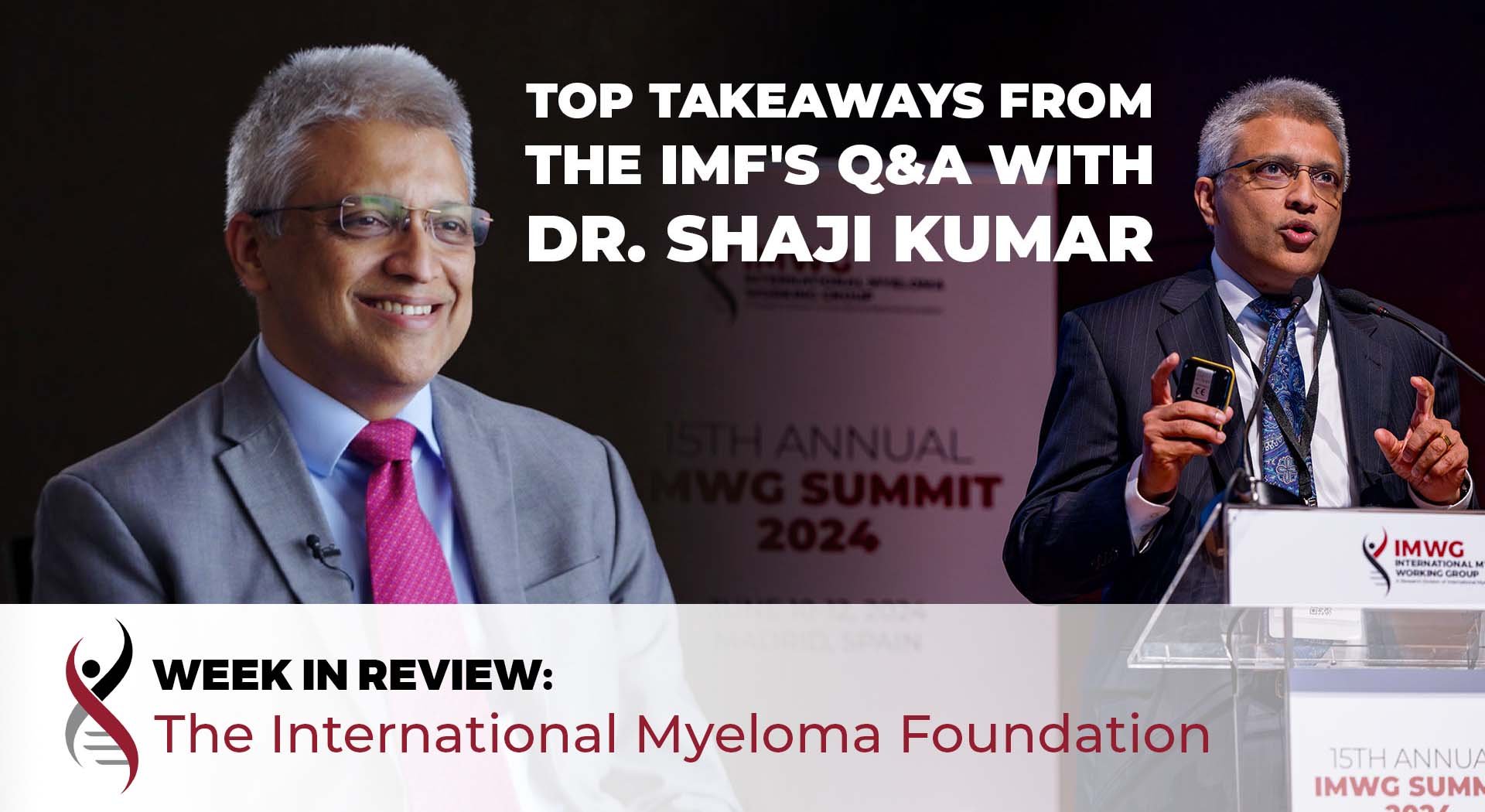
Dr. Shaji Kumar on Smoldering Myeloma, High-Risk Disease & What’s Next
Scope and Methodology
This week’s blog summarizes the top takeaways from a recent Q&A interview with IMF Scientific Advisory Board Member and IMWG Member Dr. Shaji Kumar (Mayo Clinic — Rochester, MN). Content was developed by the International Myeloma Foundation medical editorial team based on the IMF video and transcript (https://www.myeloma.org/videos/can-we-prevent-multiple-myeloma-dr-shaji-kumar-risk-mgus-early-treatment) of the interview. It is intended for patients, care partners, and oncology professionals. This blog article was medically reviewed by Joseph Mikhael, MD, MEd, FRCPC, FACP, FASCO, on December 10, 2025. The blog reflects medical guidance available at the time of review and is not routinely updated.
The International Myeloma Foundation (IMF) presents the top takeaways from a recent Q&A interview (https://www.myeloma.org/videos/can-we-prevent-multiple-myeloma-dr-shaji-kumar-risk-mgus-early-treatment) with IMF Scientific Advisory Board Member and IMWG Member Dr. Shaji Kumar (Mayo Clinic — Rochester, MN) regarding his expert views on smoldering multiple myeloma (SMM); the new definition of high-risk multiple myeloma; and the important roles of the International Myeloma Working Group (IMWG) and the International Myeloma Foundation (IMF) in improving and advancing care for myeloma patients worldwide.
Dr. Kumar is a renowned hematologist, professor of medicine and chair of the Myeloma, Amyloid, and Dysproteinemia Group at Mayo Clinic in Rochester, MN. He has had a sustained impact on the field of myeloma and related disorders. Dr. Kumar has led numerous phase I, II, and III clinical trials that have advanced new treatments for patients with myeloma. He is the recipient of the 2024 Robert A. Kyle Lifetime Achievement Award and the 2021 Brian G.M. Durie Outstanding Achievement Award.
He has published more than 600 peer-reviewed manuscripts. His extensive laboratory research contributions include the development of targeted therapies as well as biomarkers for response assessment and prognosis. Dr. Kumar led the development of the IMWG response criteria in myeloma and established the currently used definitions for minimal residual disease (MRD). His work has contributed to a better understanding of the tumor microenvironment, mechanisms of disease progression, and risk stratification of plasma disorders.
Dr. Kumar’s interest in multiple myeloma was fueled by Prof. Robert Kyle, who is considered as “the father of myeloma.”
Why early treatment of SMM is beneficial for the right patients
“For the longest time, we said patients with smoldering myeloma should be just watched because there is a real danger that we could be hurting them by giving them treatments with side effects without necessarily improving their outcomes. Clinical trials have proven that early intervention is actually important or beneficial for patients with smoldering myeloma. We can actually delay the progression to active myeloma. In many cancers, we are able to intervene and prevent the cancer from ever happening. That is one of the goals of research — to see if we can make the myeloma go away,” said Dr. Kumar.
To summarize:
- For many years, smoldering myeloma was simply monitored (“watch and wait”) to avoid unnecessary side effects.
- New research shows that early treatment can delay progression to active myeloma and, in some cases, help patients live longer—especially those at high risk of disease progression.
- Better tools, like the IMWG risk score, now help identify which patients are truly high-risk.
- Treatments such as lenalidomide or daratumumab have shown clear benefits in clinical trials.
- The field is exploring whether early, short-term, highly effective therapy might even prevent myeloma from developing (“curative” strategies).
New definition of high-risk multiple myeloma (HRMM) improves care
Dr. Kumar addresses the following questions: “How does the new set of guidelines for high-risk multiple myeloma (HRMM) address the unmet needs of myeloma patients? Moving forward, how will the new consensus definition of HRMM help improve outcomes for patients with high-risk disease?”
- High-risk myeloma has long been difficult to define.
- A new international, genetics-based consensus definition from the International Myeloma Working Group (IMWG) and the International Myeloma Society (IMS) (https://www.myeloma.org/news-events/multiple-myeloma-news/IMS-IMWG-consensus-definition-HRMM) now standardizes patients who are considered high-risk.
This helps:
- Ensure patients are identified correctly.
- Improve clinical trial design so that studies can be compared fairly.
- Recognize that some older “high-risk” features may no longer be high-risk with modern treatments.
The important roles of the IMF and IMWG
Dr. Kumar recounts how his relationship with the IMF began. He credits Dr. Kyle and IMF Chairperson of the Board Dr. S. Vincent Rajkumar for introducing him to the organization.
Dr. Kumar has been a long-time IMWG member for years, with the group being “responsible for developing some of the guidelines and also many of the disease definitions, response criteria, and many, many important aspects of how we take care of myeloma patients,” he stated.
"[The IMWG] is an organization that has played a major role in how myeloma is taken care of today. Its membership has grown over the past two decades that I have been part of it — from under a hundred members to over several hundred members at present. It’s a wonderful community to be part of because, not only are we doing all this wonderful work driving the research and the field forward, but [the IMWG] also gives us the opportunity to interact with each other and get to know those who are working in the field,” he added.
The IMF and the IMWG develop global guidelines for diagnosis, risk assessment, and treatment.
- These groups bring together myeloma experts worldwide to set research priorities, design clinical trials, and advance care.
- The new IMF Scientific Advisory Board will help select and drive future research efforts in areas like early detection, high-risk disease, and understanding why some patients respond exceptionally well.
What causes myeloma?
There is no single cause, but several factors raise risk:
- Genetics (family history increases risk)
- Environmental exposures (e.g., pesticides, certain chemicals, 9/11 exposure)
- Lifestyle factors (obesity increases risk of progression from MGUS)
Early myeloma-like changes can appear very early in adulthood, but only some people progress to disease—an area of active research.
The good news: Myeloma is treatable — patients should live well despite the disease
“Our goal here is not only getting myeloma into remission, but also making sure that you lead a full life, that you continue to do everything that you love to do in your life, and not just focus on myeloma,” said Dr. Kumar.
He emphasizes: “Live with myeloma, not around it.”
- Myeloma may not yet be curable for most, but it is highly manageable with modern therapies.
- The goal is not only remission, but ensuring patients continue living full, meaningful lives—working, traveling, and doing what they enjoy.
In summary
According to Dr. Kumar, advances in research, early intervention, genetics-based risk assessment, and global collaboration are improving outcomes for myeloma and smoldering myeloma. Patients should feel encouraged that treatment options continue to expand—and that living a full, active life is both possible and expected.
The International Myeloma Foundation medical and editorial content team
Comprised of leading medical researchers, hematologists, oncologists, oncology-certified nurses, medical editors, and medical journalists, our team has extensive knowledge of the multiple myeloma treatment and care landscape.
Additionally, the content on this page is medically reviewed by myeloma physicians and healthcare professionals.
Medically reviewed on December 11, 2025.
This blog reflects medical guidance available at the time of review and is not routinely updated.