Key Takeaways from the Top Myeloma Research Presented at ASCO, EHA, & IMWG 2025 Webinar: The Patient Perspective (Part 2 of 2) (https://www.myeloma.org/blog/key-takeaways-2025-top-myeloma-research-part-2)
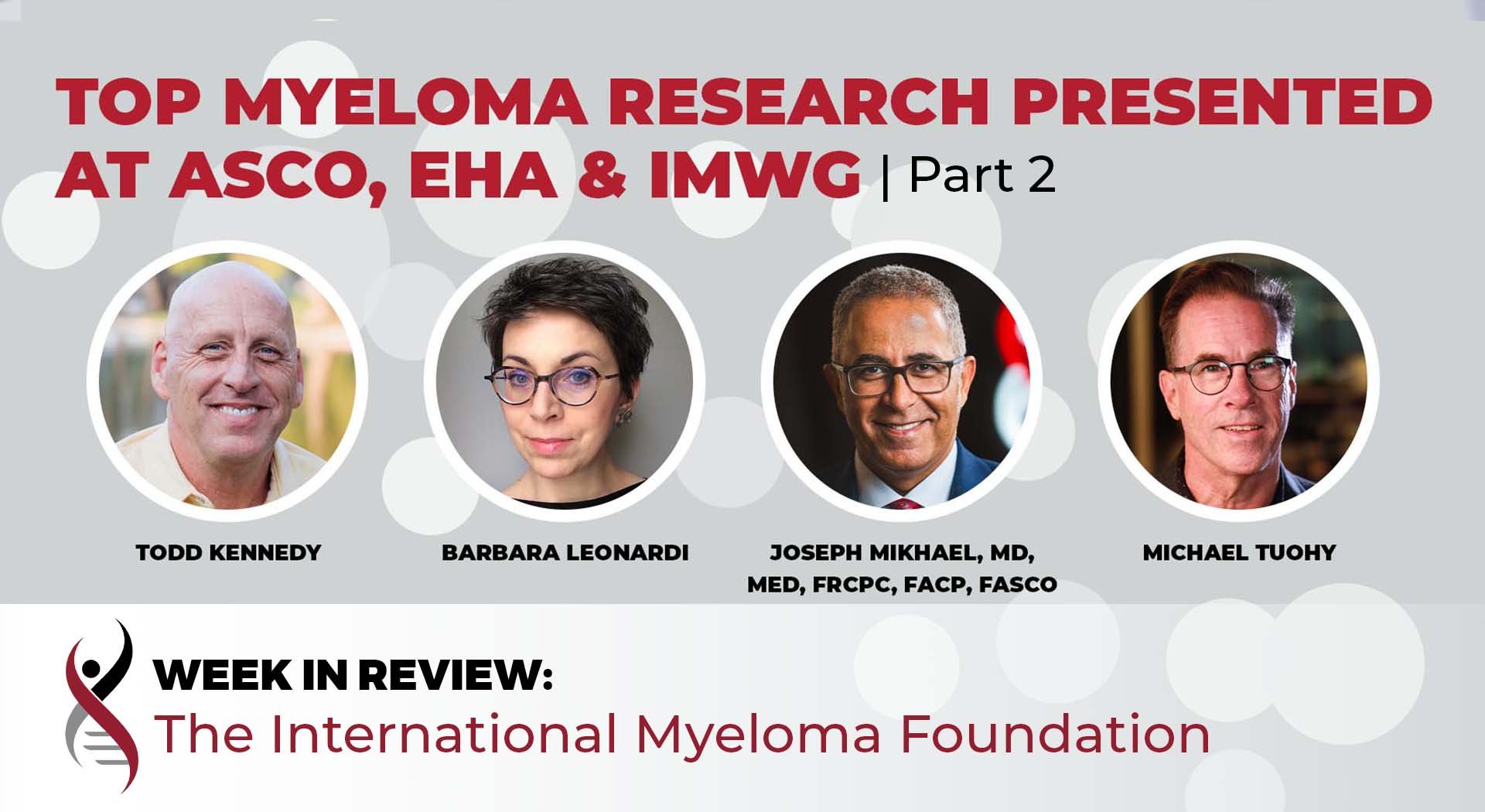
On Tuesday, July 1, the International Myeloma Foundation conducted its annual webinar, “Top Myeloma Research Presented at ASCO, EHA, & IMWG 2025 Webinar: The Patient Perspective (https://www.myeloma.org/videos/top-myeloma-research-presented-asco-eha-imwg-2025-webinar-patient-perspective).”
The webinar was hosted by IMF Chief Medical Officer Joseph Mikhael, MD, MEd, FRCPC, FACP, FASCO (TGen at the City of Hope — Phoenix, AZ), along with patient advocate and support group leader panelists, Todd Kennedy, Barbara Leonardi, and Michael Tuohy.
During the webinar, Dr. Mikhael elaborated on top myeloma research that were presented at the 2025 American Society of Clinical Oncology (ASCO) Annual Conference, the IMF International Myeloma Working Group (IMWG) Summit, and the European Hematology Association (EHA) Annual Conference.
In part two of this two-part series, the speakers discussed Late Relapse (https://www.youtube.com/watch?v=zTe3-3igXqg&t=2758s) and the New Definition of High-Risk Myeloma (https://www.youtube.com/watch?v=zTe3-3igXqg&t=3530s).
Here are some of the top takeaways from the topics mentioned above. We have gathered some of the key insights from this informative and insightful webinar. (EDITOR’S NOTE: Topics of discussion and panelist views have been edited for conciseness and clarity.)
Late Relapse
In this segment, Dr. Mikhael and patient panelists talk about:
- CARTITUDE-1 Trial: (https://www.myeloma.org/videos/long-term-outcomes-cilta-cel-relapsedrefractory-multiple-myeloma) Ciltacabtagene autoleucel (CAR T-cell therapy) showed 33% of patients were progression-free at 5 years, suggesting curative potential.
- JNJ-5322 Trispecific Antibody (https://www.myeloma.org/videos/first-human-jnj-79635322-trispecific-antibody-study-rrmm-patients-initial-phase-1-results): Targets CD3, BCMA, and GPRC5D with strong efficacy and manageable toxicity.
- Talquetamab + Teclistamab: (https://www.nejm.org/doi/full/10.1056/NEJMoa2406536) Combination therapy demonstrated higher response rates in extramedullary disease (EMD).
Dr. Mikhael: Let’s move on to Late Relapse. This was one of the most talked-about abstracts at ASCO and EHA. In fact, it was featured as a plenary at EHA, which highlights the top studies across all of hematology. The abstract reported long-term follow-up from CARTITUDE-1, (https://www.myeloma.org/videos/cartitude-1-final-results-ciltacabtagene-autoleucel-heavily-pretreated-relapsedrefractory) a study of cilta-cel (Carvykti®), a CAR T-cell therapy. These patients had, on average, six prior lines of treatment and were running out of options. At the time, many were expected to survive just one more year. Yet five years after a single cilta-cel infusion, 33% remain disease-free and off therapy. That’s a remarkable result and has sparked conversations about how we define "cure."
The other major highlight was a new trispecific antibody. Unlike bispecifics, which bind to one target on myeloma and one on T-cells, this trispecific targets two antigens on myeloma (BCMA and GPRC5D) and one on T-cells. At the recommended dose, it showed a 100% response rate in early data. Even better, patients experienced fewer side effects—likely due to the drug being given every four weeks instead of every two, as is typical with GPRC5D-targeting therapies like talquetamab (Talvey®).
Another noteworthy abstract was a dual bispecific antibody combination in patients with extramedullary myeloma, a particularly aggressive form where disease spreads outside the bone marrow. In this small study, giving two bispecifics together led to a nearly 80% response rate, compared to around 40% when given individually — highlighting the potential power of combination therapy, a principle we’ve seen work in myeloma before.
Finally, the iMMagine-1 trial (https://www.myeloma.org/videos/updated-results-immagine-1-phase-2-study-anitocabtagene-autoleucel-relapsedrefractory)introduced a new BCMA-targeted CAR T-cell therapy with over 90% response and 80% of patients still in remission at one year. Notably, it also appeared to cause fewer neurological side effects than cilta-cel. While it’s still early, the data are promising and suggest continued progress in refining both safety and efficacy in CAR T-cell treatments. A lot of progress—and a lot to process.
What do you think, Barbara?
Barbara Leonardi: Very briefly, every myeloma patient has two dreams: CAR T and a cure. And I think, I hope, we are getting there. When I started my myeloma journey over five years ago, CAR T was like science fiction, and now it is happening.
Dr. Mikhael: It is. I mean honestly, when I first described it to patients, I was like, okay, we're going to take these T cells out of you, train them to know what your myeloma looks like, multiply them in the lab, and then give them back to you. They're like, Dr. Joe, are you describing a Star Trek movie, or are you describing what’s really going to happen?
Michael, what is your take on these late relapse studies?
Michael Tuohy: I think it's amazing. The way anito-cel is constructed with the D-domain binder seems to be the reason patients are getting less neurotoxicity. The teclistamab-talquetamab combination is impressive with extramedullary disease. But how about the trispecific in that case? Is it because you're hitting the same targets?
Dr. Mikhael: I think that's something we're going to have to look at. I really like the way you mentioned that because I do think that it will be particularly important for that population of extramedullary disease. It can be very challenging at times to treat patients with that big burden of disease. What’s interesting about these drugs is that they could reach the more difficult-to-hit areas.
Todd, what are your thoughts here?
Todd Kennedy: I was in the room with you in Chicago for the CARTITUDE-1 presentation, and honestly, it was hard not to cheer. Everyone tried to stay composed, but that final slide Dr. Voorhees showed really hit—it captured the potential curative power of CAR T. And “potential” is the right word; we’re not there yet, but just having that conversation, especially with the New York Times coverage, is huge. It sparks hope, encourages people to get informed, and keeps momentum going. The trispecific was also incredible. Getting that kind of response with monthly dosing and better tolerability is a major step forward for late relapse.
Dr. Mikhael: Definitely. I want to make sure that’s emphasized. My ideal for treating patients—what I think of as the "nirvana"—is finding a therapy that works better, causes fewer side effects, and can be given less frequently. Essentially, can we have our cake and eat it too?
To put it in context, myeloma exists on a spectrum—from MGUS to smoldering to active disease—but even within active myeloma, there’s wide variation. Some patients, like Michael, are doing well 25 years after diagnosis, which is incredible. But others, heartbreakingly, still die within months. I lost a patient just a year ago who was diagnosed less than a year prior, and that still weighs heavily on me.
Our goal is to match the right treatment to each patient—not overtreat or undertreat. Tools like MRD testing and better risk assessment can help us identify who has more aggressive disease and may need more intensive therapy. And while CAR T offers the hope of treatment-free remission for some, figuring out who needs what—and when—is the key to improving outcomes across the spectrum.
New Definition of High-Risk Myeloma
In this discussion, Dr. Mikhael and patient panelists tackle:
- IMS/IMWG Consensus Recommendations on High-Risk MM (https://www.myeloma.org/news-events/multiple-myeloma-news/IMS-IMWG-consensus-definition-HRMM): Defines high-risk MM based on genetic markers (e.g., del17p, TP53 mutations) and β2M levels.
- Implications: Aims to standardize risk stratification in clinical trials and routine practice.
Dr. Mikhael: I know all the letters and numbers can feel overwhelming, so I won’t go into detail, but here's the big picture: the International Myeloma Working Group and International Myeloma Society came together to define what qualifies as high-risk myeloma. They identified five key criteria, including things like deletion 17p and TP53 mutations, which require advanced testing beyond standard FISH. Patients don’t need to memorize the specifics—but it's important to talk to your doctor about whether you may fall into the high-risk category and ensure the right tests are being done.
Why does this matter? Because we're now designing clinical trials specifically for high-risk patients, like the GMMG-CONCEPT study (https://www.myeloma.org/videos/updated-interim-analysis-isatuximab-carfilzomib-dex-frontline-treatment-high-risk-myeloma) I mentioned earlier. About 20% of patients fall into this high-risk group and recognizing them helps avoid both over- and under-treatment. Even within that 20%, there’s a smaller group with ultra high-risk myeloma, and we urgently need more research and better options for them.
Todd, I know you’ve been a strong advocate for patients understanding their risk—curious to hear your thoughts.
Todd Kennedy: As you said, I think the important part is to have a conversation. Some myeloma patients I’ve spoken with don’t know whether they’re high or standard risk — having this definition certainly makes it more precise. If you have an expert who can really dig into the complexities of this new definition, I think it’s important for patients to initiate the conversation with them. It does factor into shared decision-making. For example, if I’m high risk, then that could influence my decision on having a transplant, dual maintenance, or getting into a clinical trial. All these things we've been talking about up to this point could be impacted, if you knew with precision what your risk status was. And I think it's important.
Dr. Mikhael: You summed it up beautifully. I was just talking with a patient today about this. We recently launched a high-risk myeloma support group. I explained high-risk myeloma like driving a red sports car—it’s built to go faster and is more likely to relapse quickly. But sometimes, as I told the patient, a Prius still passes the Porsche—these risk models aren’t perfect. Still, high-risk disease often needs more aggressive treatment, as we’ve seen in trials like ATLAS, where adding carfilzomib to lenalidomide in maintenance showed particular benefit in high-risk patients. This builds on earlier work like the FORTE study (https://www.myeloma.org/videos/carfilzomib-based-induction-or-without-asct-followed-lenalidomide-or-carfilzomib) and reinforces why understanding your risk status matters.
Summary and Final Thoughts
Dr. Mikhael does a rundown of all topics discussed and gives these final takeaways:
- Quadruplet therapy and MRD-guided strategies are reshaping frontline treatment.
- CAR T-cell therapy is emerging as the most effective option for relapsed MM.
- Novel therapies like antibody-drug conjugates and bispecific antibodies are expanding treatment options.
- High-risk myeloma remains challenging, but new definitions and therapies offer hope.
Dr. Mikhael: To quickly recap: frontline therapy has shifted toward quadruplet regimens for most patients, improving outcomes. MRD testing is becoming a key tool and may help us refine decisions like whether a transplant is needed. CAR T-cell therapy remains one of our most powerful treatments, with a third of patients disease-free five years after just one infusion. And there’s even more on the horizon—from topical drug delivery and next-gen antibodies to off-the-shelf CAR T cells from healthy donors. It’s truly an exciting time in myeloma care.
Let’s hear some final thoughts from our patient panel. Michael, we’ll start with you.
Michael Tuohy: The landscape has certainly changed from when I was diagnosed and it’s really amazing how far we’ve gone, with newer therapies on the way — especially trispecifics. It's just like you said, there's not one treatment that starts out and continues that way. When bispecifics first came out, there were some pretty scary side effects.
But the more that you work with them, with data coming out, the more effective therapies they become, with not as many side effects. Compared to when I was diagnosed, it was basically a transplant and high-dose dexamethasone. Fast forward to how many abstracts did we have at ASH last year? It's just unbelievable, all the research that has gone on in multiple myeloma and we're very fortunate because of it.
Dr. Mikhael: Barbara, your final thoughts?
Barbara Leonardi: Medical research and science are so advanced, it's absolutely amazing. I just hope that our health systems and our authorities will be able to follow and to use them for the benefit of patients.
Dr. Mikhael: Any final thoughts, Todd?
Todd Kennedy: Science is truly awesome. I'm so grateful to you Dr. Joe, and to all your colleagues for driving the research forward. Also, to every single patient who has participated in the clinical trials we discussed, and who will be signing up for future clinical trials until we get to a cure.
I think my hope meter has never been higher than it is right now. I hope others will be just as inspired to educate and empower themselves, to engage with an expert, and to live and celebrate life. We all have a lot to look forward to.