A Conversation with 2026 Brian G.M. Durie Outstanding Achievement Awardee, Dr. Noopur Raje (https://www.myeloma.org/blog/dr-noopur-raje-interview)
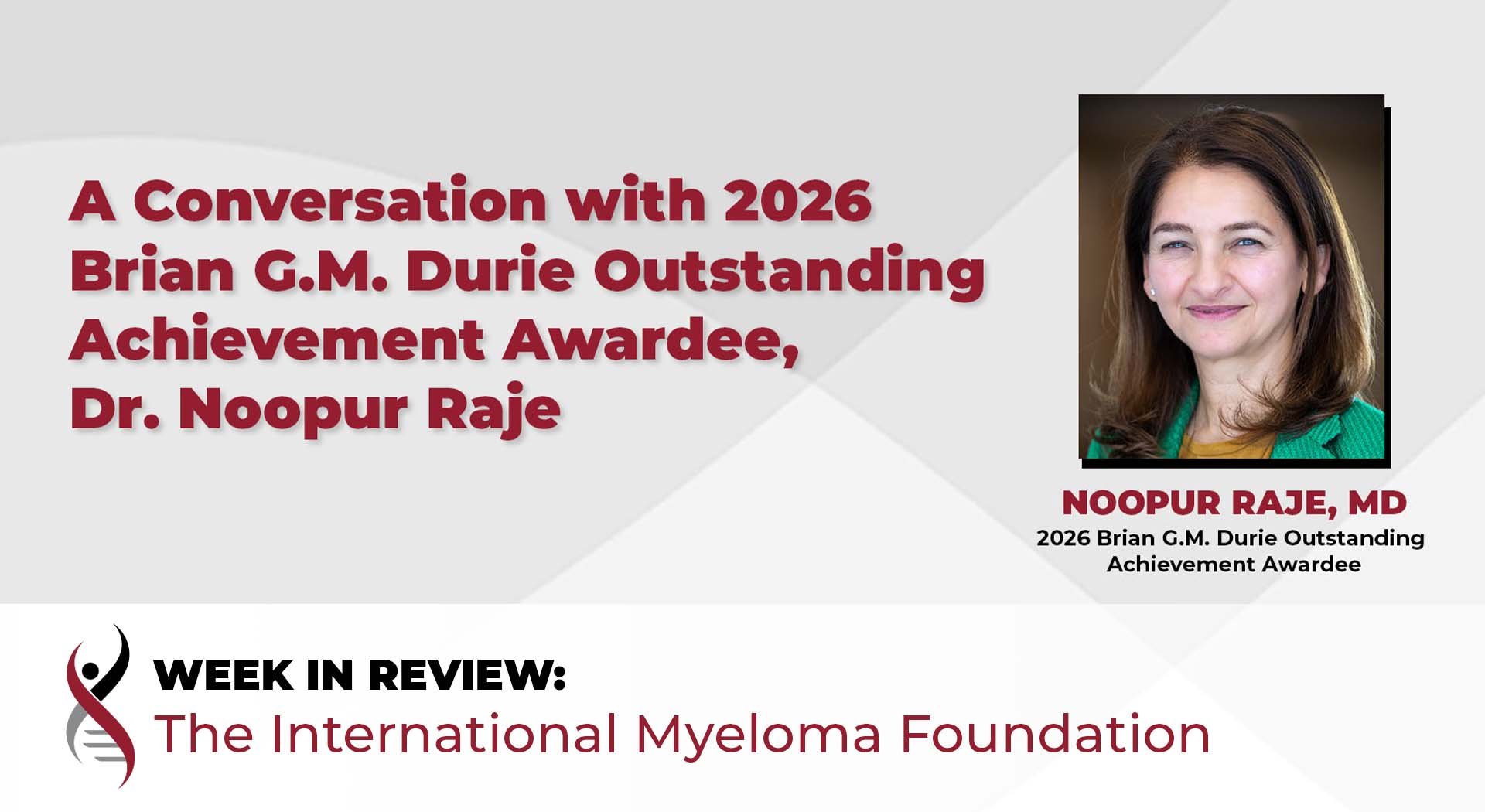
2026 Brian G.M. Outstanding Achievement Awardee Dr. Noopur Raje talks about translational research, myeloma clinical trials, optimal sequencing of therapies, and personalizing treatment approaches for patients.
At this year’s 17th Annual International Myeloma Working Group (IMWG) Summit in Stockholm, Sweden, Noopur Raje, MD — Director of the Center for Multiple Myeloma and the Rita M. Kelley Chair in Oncology at Massachusetts General (Mass General) Hospital Cancer Center; and Professor of Medicine at Harvard Medical School; and a leading expert in multiple myeloma and plasma disorders — was honored with the prestigious Brian G.M. Durie Outstanding Achievement Award, and recognized by her colleagues for her “groundbreaking scientific leadership, extraordinary clinical insight, and unwavering commitment to patients,” as stated by International Myeloma Foundation (IMF) Chairperson of the Board Dr. S. Vincent Rajkumar.
Dr. Raje earned her MD from BJ Medical College, University of Pune, India, and completed her residency at Mass General, followed by a fellowship at Dana-Farber Cancer Institute.
She founded the Center for Multiple Myeloma at Mass General, where she leads a dedicated team of clinical investigators focused on bringing novel cutting-edge treatments to patients. Her translational laboratory efforts include leading pioneering research focused on the biology of myeloma bone disease and immunotherapies.
Dr. Raje's translational research explores the bone marrow microenvironment to identify new therapeutic targets, with the goal of overcoming drug resistance and improving patient outcomes. Her studies also are focused on understanding response and resistance to novel immunotherapies.
Dr. Raje is a member of the International Myeloma Working Group (IMWG) and serves as Secretary and Executive Board Member of the International Myeloma Society (IMS). She chairs educational committees for the American Society of Clinical Oncology (ASCO), the American Society of Hematology (ASH), and the IMS. She is also chair of several steering committees for clinical trials.
Her contributions have been recognized through numerous honors, which include: the Claflin Distinguished Scholar Award (2010); Inaugural Rita M. Kelley Chair in Oncology (2013); Leukemia and Lymphoma Society Clinical Scholar Award (2017); Tom Spitzer Clinical Excellence Award (2020); and Ken Anderson Translational Science Award (2022).
Additionally, Dr. Raje is a recipient of multiple research grants and has published extensively in top-tier journals. She is also on the editorial board of several journals.
What made you decide to pursue translational research focused on myeloma bone disease and immunotherapies?
Dr. Raje: I was working in the laboratory of Dr. Ken Anderson at Dana Farber and was focused on understanding disease biology, identifying novel drug targets and validating these to use as options for our patients. Along the way, I worked on bone disease biology as this is such an important part of myeloma disease burden. I was fortunate to study bone targeted agents in this space, and was able to get the monoclonal antibody, denosumab approved for our patients. This was particularly exciting for me, as this was helpful for our patients who have renal involvement from myeloma. Immunotherapies have been the most recent advance, and I have been fortunate to be a small part of the development of CAR T cells and bispecific antibodies, which have really been transformative in the care of our patients.
As Director of the Center for Multiple Myeloma at Mass General, how would you describe the work dynamic between you and your dedicated team of clinical investigators?
Dr. Raje: I am so fortunate to have an amazing team at the Mass General Brigham Cancer Institute. The passion and dedication to caring for our patients is unsurpassed, and I feel blessed to have them as my colleagues. It is not only my team at Mass Gen Brigham, but all my colleagues and collaborators in the world of myeloma, who have and continue to work relentlessly to make things better for all our patients. The best is yet to come.
As a globally recognized leader and expert in the field of national and international clinical trials, which myeloma clinical trials are you heavily involved with, both in the U.S. and abroad?
Dr. Raje: I am involved in all CAR T-cell, and bispecific and trispecific clinical trials. I am also involved with some of the novel approaches such as mRNA T-cell engagers, allogeneic CARs and In Vivo CARs. I have also been involved with trials pertaining to CELMoDs (cereblon E3 ligase modulatory drugs) and small molecule inhibitors.
Among these clinical trials, which ones do you think are the most promising/notable?
Dr. Raje: I am very excited about the potential of in vivo CARs and trispecific antibodies. But really, I am excited about all these options, as I think we are at the threshold of transformative care in myeloma — where “cure” is a reality, and all these options in combination are going to get us there.
What insights could you share, both with investigators and patients, when it comes to participating in clinical trials?
Dr. Raje: It’s really important for us to continue to participate and do clinical trials. Progress in our field has resulted from us working together and getting all these incredible options approved, so that the broader myeloma community can have access to them. Without the work of clinical trials, we would not be where we are with myeloma. This is truly a result of partnership between academia, industry, and our patients.
What are your thoughts on optimal sequencing of therapies, as well as personalizing treatment approaches for patients?
Dr. Raje: I think we will continue to evolve our thinking on sequencing of these treatments. As we move them earlier in the course of disease, we will get really deep responses and will not need to use them continuously. Therefore, the issue of sequence will be less important. Over time, we will personalize therapy more, based on genomics and other tests which we are now routinely doing.
What do you think are ongoing unmet needs of myeloma patients that should be prioritized and addressed?
Dr. Raje: We are at an incredible time in myeloma research — with diagnostics, monitoring tools, and therapies where we are now focused on curing most, if not all patients. To me, the most important [priority is] to ensure equitable access to all these options for patients, so that all will benefit from these advances.
As this year’s Brian G.M. Durie Outstanding Achievement Awardee, what message can you impart to the younger generation of myeloma researchers and clinicians?
Dr. Raje: Although we have made great progress, there is [still] a lot of work to be done. Remain curious, ask good questions, follow through, and keep your patients at the center of the work you are doing. Collaborate and share your work and build community around you. The greatest progress occurs when individual strengths become a shared purpose.
The International Myeloma Foundation extends its warmest congratulations to Dr. Noopur Raje, for being the recipient of the 2026 Brian G.M. Durie Outstanding Achievement Award. We look forward to her future achievements, and we continue to support her incredible work and unwavering commitment to patients in the field of myeloma.