Living With Myeloma: Joyce’s Story of Hope, Access, and Advocacy (https://www.myeloma.org/blog/multiple-myeloma-patient-story-hope-advocacy)
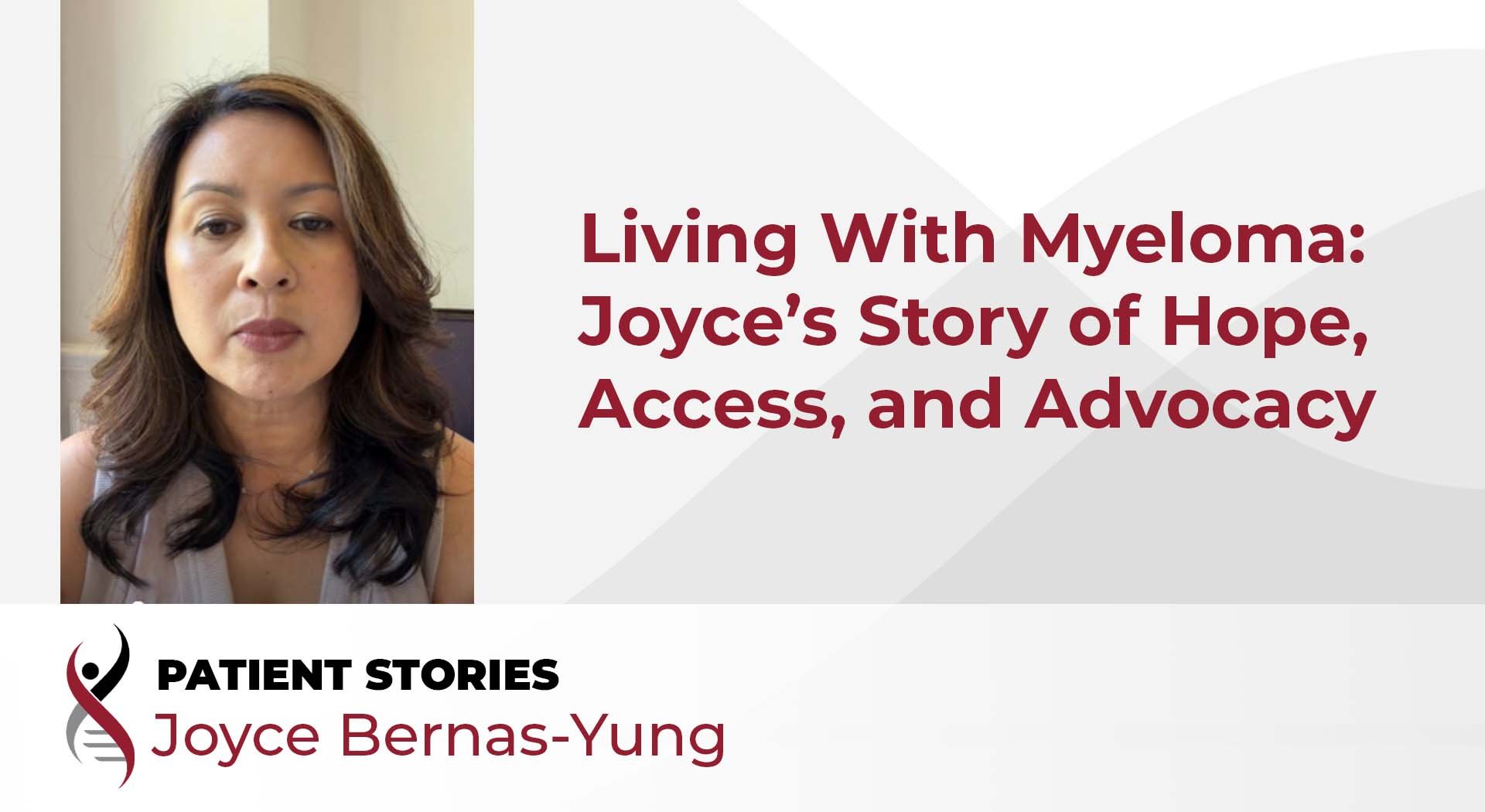
Living With Myeloma: Joyce’s Story of Hope, Access, and Advocacy
The International Myeloma Foundation continues to share this collection of patient and care partner stories from those who have completed the Legislative Advocacy Master Class (LAMC). The IMF hopes that these unique and compelling stories will help raise awareness about the disease, inspire action, and make an impact in changing healthcare laws and policies for the betterment of the myeloma community.
(EDITOR’S NOTE: The Legislative Advocacy Master Class is a 10-week immersive advocacy training course, and a combined collaboration between the International Myeloma Foundation and Patients Rising—"a leading grassroots patient advocacy organization seeking comprehensive policy solutions that puts the patient experience at the forefront of addressing America’s biggest healthcare challenges.” The stories in this blog series were taken from the now-completed first class, where participants submitted their stories as final projects to graduate from the course. The LAMC is an ongoing effort to train advocates for the IMF to tell their stories, write a letter to Congress, and make an impact in changing healthcare laws and policies. If you have questions or inquiries, or would like to sign up for the LAMC, please email Khyre Edwards at [email protected] (mailto:[email protected]))
This week’s blog was written by Joyce Yung-Bernas, a five-year myeloma patient who shares her myeloma journey: from diagnosis, to remission, to relapse, to undergoing a clinical trial.
An Unexpected Diagnosis and Urgent Treatment
My name is Joyce, and I live in the San Francisco Bay Area. I have always lived a physically active and very busy life. In June of 2021, I presented with extreme fatigue and a very painful right shoulder. After lots of blood tests, an X-ray, a kidney ultrasound and ultimately a kidney biopsy, it was determined that I had severe kidney failure. It took the help of my husband, a physician, and a very caring and curious nephrologist to put the information together and to get me admitted into the hospital and start figuring out what was happening to me. Once I was admitted into the hospital, while feeling so very weak and still in my street clothes, I immediately had a bone marrow biopsy done bedside by my amazing general hematology-oncologist.
The next day, I was formally diagnosed with multiple myeloma. I was told that day that there were a couple of treatment options available to me. One chemotherapy treatment option was a tried-and-true regimen and would be “safer” for my impacted kidneys. The other treatment option was a newer form of treatment; however, my hematologist-oncologist was not comfortable administering this three-drug regimen given that one of the medications is known to add further strain to my already failing kidneys. There was no time to get a second opinion. I just needed to have immediate treatment. I was quickly put on the tried-and-true chemotherapy cocktail which, besides the burning bi-weekly injections, required that I take many pills — all of which had awful side effects that were very difficult for me to tolerate.
Seeking Access to a Myeloma Specialist
My health insurance is with an integrated managed care organization, so all my treatment happens within its medical facilities. Once I got in front of the right doctors, I really appreciated the coordinated care that was provided to me. My doctor told me that the treatment administered would need to be working for her to approach the myeloma board about getting an outside referral to a nearby academic research center. The academic research center would be able to provide a life-saving treatment — the gold standard at the time — called an autologous stem cell transplant.
At first, my body was responding to the treatment, which allowed my doctor to get approval for that outside referral. But after a few weeks, unfortunately with each ongoing treatment, the myeloma markers began to plateau and then rise in numbers. I had lost so much weight and energy that it was incredibly difficult to maintain my usual daily activities. Luckily, my health plan approved the second opinion for outside consultation with a multiple myeloma transplant specialist. And with the help of a wonderful friend who was connected to the transplant doctors at that hospital, my wait time for an appointment with a multiple myeloma transplant specialist was decreased from the typical 8 weeks down to 4 weeks.
A New Treatment Plan and Three Years in Remission
Once I met with the multiple myeloma transplant specialist, she was able to review my chart and recommend an even better and newer treatment regimen- the best treatment available at the time, a four-drug treatment regimen. With her expertise, she was confident that providing a lower dose of that particular medication, the one that my general hematologist-oncologist was afraid would strain my kidneys.
She said that once I started on this lower dose, it should start to help control the myeloma and my kidneys might start to heal. I switched over to this new set of treatments, and immediately, we could see the rapid response. The damage to my kidneys began to reverse. After a few cycles of treatment, my doctor felt that I was ready for the next phase of treatment, autologous stem cell transplant. This part of my journey was not easy as I suffered quite a bit of gastrointestinal problems that required an inpatient stay. Over time, I was able to regain my strength and stamina and eventually went on to enjoy a little over 3 years in remission while on maintenance therapy for multiple myeloma.
Facing Relapse and Joining a CAR T-Cell Clinical Trial
Last year, my hematologist-oncologist and I noticed the myeloma markers were starting to increase, and it was time to think about another treatment. She told me that she regularly received communication from our local academic research center about ongoing and upcoming clinical trials. It was from this communication that she found a clinical trial that she hoped would be a good fit for me.
Once again, she was able to procure an outside referral so that I may be evaluated to be considered as a participant in a phase 3 study of a very promising, new cellular therapy. It was a CAR T-cell therapy as opposed to the standard of care for patients who have relapsed, refractory multiple myeloma. I was quickly screened for participation and then randomized into the study arm where I would receive the CAR T-cell therapy.
The study required my admittance to the hospital for a minimum of 10 days. Fortunately, all went smoothly in that I did not suffer any serious side effects from this new experimental treatment and was allowed to complete my recovery at home. Today, I am over 8 months post-CAR T-cell therapy. My specialist told me that CAR T was the best treatment available to me at this time. She also said that this particular CAR T-cell therapy is likely to be approved by the FDA and available for use by the end of this year.
Reflecting on Care, Research, and Hope
I am so grateful to have excellent health insurance and access to really great and caring doctors. While it is a stretch, I am also fortunate to be able to afford the time and the very expensive treatments needed to overcome this disease.
I wish I had access to my multiple myeloma specialist on day one of my diagnosis so that I would not have had to endure such awful side effects from my first line of treatment. Perhaps if I had access to the specialist earlier, my kidneys could have had a chance to be fully healed. I am also very grateful for the work and effort put into cancer research. Without the efforts of great scientists and doctors, these newer and better tolerated treatments for multiple myeloma would not be available to me and others. Furthermore, I feel fortunate to live close to an academic research center that is involved in studying treatments and therapies relevant to multiple myeloma.
My hope is that my story of coming from severe illness to living and thriving with multiple myeloma will inspire others to not ever give up hope whether they are newly diagnosed or undergoing a relapse.
Advocating for Broader Access to Clinical Trials
I think it is important for others suffering from multiple myeloma to advocate for themselves and have access to multiple myeloma specialists from the first day that they are initially diagnosed. It is also important for patients with multiple myeloma to have access to life-saving clinical trials such as the one I had access to. This access should not just be possible for them because they live close to a center. It should be possible because ways have been developed in our healthcare system to reach patients living further away.
And it is imperative that doctors and providers as well as patients and caregivers be informed of these new developments and opportunities. This is why I am advocating for the Clinical Trial Modernization Act (CTMA). This bill will help support patients who might live far from a multiple myeloma clinical trial research center. It also supports education, outreach, and recruitment efforts for underrepresented populations and communities in need.
Reducing the Financial Burden of Trial Participation
Further, in my experience participating in a clinical trial, there is a huge cost to the patient in terms of lost wages and time as we attend much needed appointments and supportive treatments beyond the necessary trial treatment. And in my case, with the way that my health care insurance is structured, I must pay a very high-deductible co-pay before my insurance kicks in.
Participating in a clinical trial requires that a patient take time off work, have the resources to cover their insurance costs, and can transport themselves to and from these various appointments. After the exhaustion and fatigue of treatment, there is no energy left to prepare a healthy meal.
The CTMA exempts from anti-kickback laws so that a patient’s travel and food expenses can be covered, and it also allows for payment for participants’ cost-sharing obligations as it relates to the clinical trial. It also exempts up to $2000 in compensation that is received for participating in a clinical trial from income tax. These key pieces eliminate the additional hurdle and challenge to overcome the hefty finances needed to participate in a clinical trial. Finally, with continued, robust funding for cancer research, we hope that someday, there will be a cure for this awful disease.
About the Advocacy Master Class
At Patients Rising, we believe that patients and caregivers hold the power to move the needle in healthcare and create a better tomorrow for all patients and caregivers by raising their voices! That is why we offer our Advocacy Master Class in collaboration with the International Myeloma Foundation (IMF). The master class is designed to train patients, caregivers, and citizens in the art of healthcare advocacy.
This course is a comprehensive way for participants to raise their voices and create a better tomorrow for all patients and caregivers. The IMF, in collaboration with Patient Rising, is spearheading the Advocacy Master Class. For more information on the Advocacy Master Class, email Khyre Edwards at [email protected] (mailto:[email protected])
About Patients Rising
Patient Rising’s mission is “empowering every patient in America to advocate for reforms placing them, alongside their doctors, in control of their healthcare choices” with a bold vision: “Healthcare is personal. By partnering with patients, we envision a future where every individual has healthcare options that align with their unique needs and circumstances.” To know more about the advocacy organization, visit PatientsRising.org (https://www.patientsrising.org/).