Updated FAQs on Newly Diagnosed Multiple Myeloma for 2026 with Dr. S. Vincent Rajkumar (https://www.myeloma.org/blog/updated-faq-newly-diagnosed-myeloma-2026)
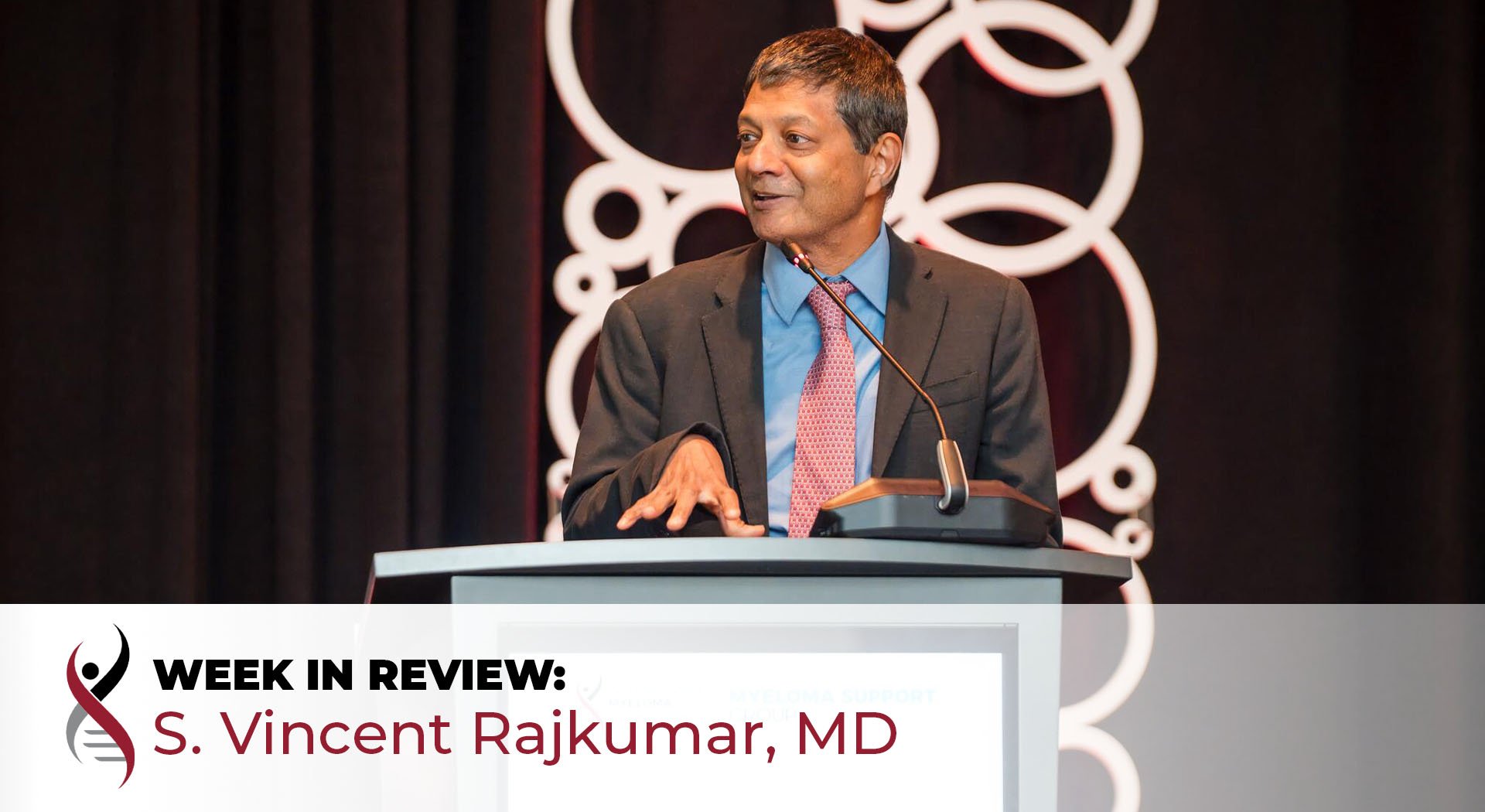
IMF Chairperson of the Board Dr. S. Vincent Rajkumar answers updated FAQs on newly diagnosed myeloma for 2026.
In this week’s blog, International Myeloma Foundation (IMF) Chairperson of the Board S. Vincent Rajkumar, MD (Mayo Clinic — Rochester, MN) provides answers to updated frequently asked questions (FAQs) on newly diagnosed multiple myeloma for 2026 — the new definition of high-risk myeloma, frontline regimens, quadruplets, maintenance therapies, and more.
What is the best frontline regimen for newly diagnosed myeloma?
A quadruplet regimen — either the four-drug combination of daratumumab, bortezomib, lenalidomide, and dexamethasone (Dara-VRd); or isatuximab, bortezomib, and lenalidomide and dexamethasone (Isa-VRd) — is the preferred frontline treatment regimen for newly diagnosed multiple myeloma. This is based on randomized controlled trials showing superiority over triplet regimens. Unless patients are frail and unable to tolerate a quadruplet regimen, I recommend a quadruplet regimen such as Dara-VRd or Isa-VRd regimens for newly diagnosed myeloma.
How long should a quadruplet regimen be given?
In patients proceeding to autologous stem cell transplantation (ASCT), we usually give 4 months of the quadruplet regimen and then proceed to transplant followed by maintenance therapy.
If patients are not proceeding to transplant (either because they are ineligible or have elected to defer transplant), we give 6 months of the quadruplet regimen and then proceed to maintenance therapy.
What maintenance should be given after initial therapy?
In standard-risk patients, we use doublet maintenance with lenalidomide plus either daratumumab or isatuximab.
In high-risk patients, we prefer a doublet regimen: lenalidomide plus daratumumab or isatuximab similar to standard-risk myeloma is one option. Another option is bortezomib plus lenalidomide.
How long should maintenance therapy be given?
Based on the results of the ENDURANCE trial, in standard-risk patients, lenalidomide is given for two years and then stopped. Daratumumab or isatuximab is usually given until progression but can be stopped at 2 years if patients are MRD negative for 12 months.
In high-risk patients, we usually continue maintenance until disease progression.
Is transplant still recommended in eligible patients?
In high-risk multiple myeloma, we do recommend early stem cell transplantation in eligible patients.
In standard-risk myeloma, overall survival is similar between early transplant and delayed transplant (transplant intended at first relapse), so the decision on early versus delayed transplant is based on the patient's age and shared decision making based on patient preference.
What is the new definition of high-risk myeloma?
The definition of high-risk multiple myeloma has changed.
The International Myeloma Society (IMS) and International Myeloma Working Group (IMWG) have redefined high-risk multiple myeloma. Using this new definition, only about 15-20% of myeloma patients will be classified as high risk.
Del 17p or p53 mutation are automatically high risk by themselves. All other abnormalities: namely, t(4;14), t(14;16), or t(14;20),;1q gain; and 1p deletion - need two abnormalities together to call it high-risk; Eg., t(4;14) plus gain 1q. Bi-allelic deletion 1p is also considered high risk.
You can check out myelomarisk.com (https://myelomarisk.com/) to make this assessment easily.
What about CAR T or bispecifics in newly diagnosed myeloma?
These are totally investigational therapies, done only in approved clinical trials. They are highly effective therapies and are recommended for first and second relapse.
In newly diagnosed myeloma, however, ongoing trials will clarify whether the benefits of these treatments outweigh the risks, and therefore they are recommended only as part of clinical trials.
What should be given to frail patients who cannot tolerate quadruplet regimens?
In frail patients, I prefer a triplet regimen, such as Dara-Rd or Isa-Rd. If that's not possible or safe, then a doublet such as lenalidomide-dexamethasone (Rd), or even single agent daratumumab may sometimes be necessary, at least initially, until performance status improves.
What about patients with acute renal failure?
In acute renal failure, I prefer not to give lenalidomide. I prefer a quadruplet regimen such as Dara-VCd (daratumumab, bortezomib, cyclophosphamide, and dexamethasone) rather than Dara-VRd or Isa-VRd. After one to two cycles, once renal function improves, you can always switch to those two regimens.
How long should dexamethasone be given?
Continue dexamethasone only for the initial 4-6 months. Do not give dexamethasone in maintenance. The CEPHEUS trial is a great example where dexamethasone was stopped after the induction period of 6 months.
For the latest on myeloma research and more, follow Dr. Rajkumar on X/Twitter: @VincentRK (https://x.com/VincentRK)
About S. Vincent Rajkumar, MD
Dr. S. Vincent Rajkumar is the Edward W. and Betty Knight Scripps Professor of Medicine at the Mayo Clinic, Rochester, MN. He is recognized internationally as a leading authority in the field of plasma cell disorders and chaired the Mayo Clinic group from 2006-2016. Dr. Rajkumar is Chair of the International Myeloma Working Group (IMWG), and Chair of the Eastern Cooperative Oncology Group (ECOG) myeloma committee. He serves as the Editor-in-Chief of Blood Cancer Journal, and Associate Editor for the following: Mayo Clinic Proceedings, Leukemia, and European Journal of Haematology.
Dr. Rajkumar is the recipient of several awards, including the Robert A. Kyle Lifetime Achievement Award (2016), Giants of Cancer Care Award (2019), and the Jan Waldenstrom Lifetime Achievement Award (2021). He has over 800 publications, including over 500 peer-reviewed original research papers, and over 200 reviews and book chapters.