Jim Omel, MD: When the Doctor Becomes the Patient (https://www.myeloma.org/blog/jim-omel-doctor-becomes-patient)
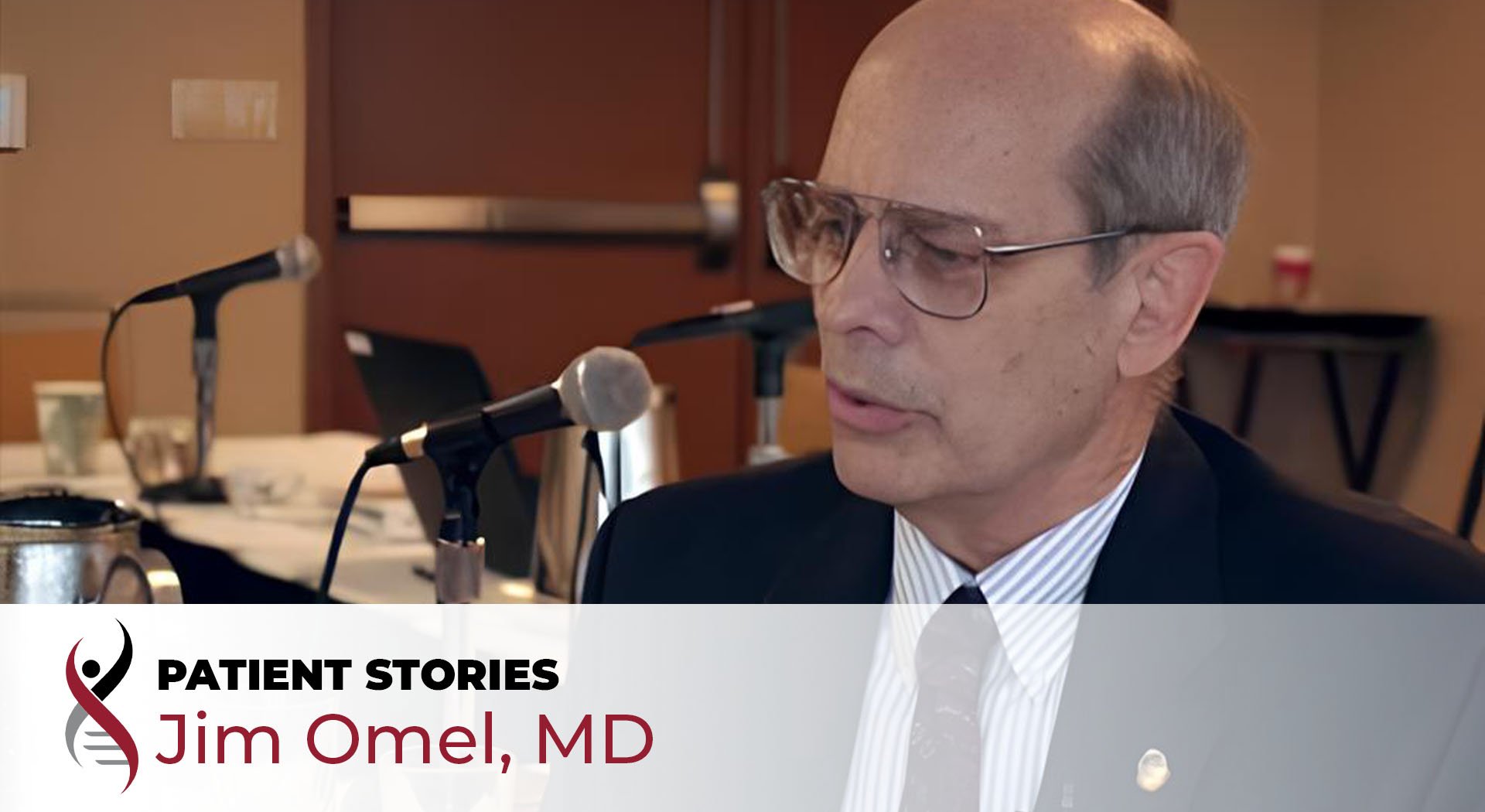
Jim Omel, MD: When the Doctor Becomes the Patient
When the doctor becomes the patient, the meaning of living well with myeloma is amplified. Jim Omel, MD, had been a family physician for 25 years, and his favorite part of his career was having delivered more than 1,000 babies.
Getting His Affairs in Order
Jim was diagnosed with multiple myeloma in 1997. At that time, Jim thought that he had better get his affairs in order. He said, “There were no good treatments [for multiple myeloma], and I planned my life, expecting to die within 3-4 years.”
At age 50, he bought a gravesite and erected a headstone for his wife and himself. He sold his valuable coin collection and an antique bottle collection, too, figuring his wife would not know the value of these collections after his passing.
Jim was especially impacted by the magnitude of his condition because he had lost two of his own patients to the disease. One was a close friend for whom Jim had delivered “one of his wife’s babies.” This friend was young, exceptionally strong, yet passed away from graft-versus-host disease (GVHD) when undergoing an allogeneic stem cell transplant.
Knowledge Is Power
Because of all these factors, Jim’s reaction to his myeloma diagnosis was one of fear. However, he knew who to call. One of his colleagues was a myeloma doctor, and they were on a first-name basis.
As Jim learned more about his disease, he put on his "doctor hat" as a patient. He read studies and discussed protocol development for new myeloma clinical trials.
Through his association with advisory boards, the FDA and the National Cancer Institute (NCI) peer review, he was able to connect with many myeloma experts, including International Myeloma Foundation (IMF) Chairperson of the Board Dr. S. Vincent Rajkumar, Dr. Kenneth Anderson at Dana-Farber Cancer Institute, Dr. Paul Richardson at Dana-Farber Cancer Institute in Boston, and Dr. Robert A. Kyle (retired and formerly with the Mayo Clinic).
After these conversations, Jim met with his myeloma physician in Omaha, Nebraska, about his treatment options. Once, Jim’s myeloma doctor said, “Jim, you have already asked the Dream Team. I’d go along with what they suggested.”
After 29 years of living with myeloma, Jim continues to be guided by the motto, “Knowledge is power.” He has had no myeloma treatment for 16 years, and he has normal lab results today. While he has not opted to undergo testing for it, Jim’s disease may be minimal residual disease negative (MRD-).
Jim Explains Measurable Residual Disease or Minimal Residual Disease
Jim said, “Measurable Residual Disease, or Minimal Residual Disease (MRD-) is a descriptive search for one myeloma cancer cell hiding in a huge sea of normal cells. To even consider the concept of MRD-, we must realize how far we have come with myeloma treatment.
“In 1997, the best we could hope for was a Complete Response (CR), which meant disappearance of all M protein. As we got into the Revlimid and Velcade era, we advanced to check for stringent Complete Response (sCR). This was defined as normalization of serum free light chains (FLCs).
“Now, with outstanding therapies, including immunotherapy, we can search for one myeloma cell in a million normal cells (10-6), or even (10-7) or one in ten million normal cells. That is MRD, and the change in outcome is astounding. We should all be optimistic about the future.”
Jim went on to say that MRD-negativity “is totally meaningful and is predictive of a good, or a bad, outcome. MRD- is so important that we can even make treatment decisions based on the total absence of myeloma cells. It can help us approach one of the greatest unmet needs in multiple myeloma by helping patients:
- to know when it is safe to STOP treatment, and
- to get off continuous treatment.”
From Planning End of Life to Living a Full Life
Today, Jim lives life as if he “had never had myeloma.” He thinks about it, speaks to other patients, writes about it, attends webinars daily, and more. Jim does all of this not because of fear, because he “wants to help others.” With his 29 years of living with myeloma, he reminds others in the myeloma community of these five key messages:
- "Be optimistic.
- Ask your doctor about myeloma, and DO NOT ask Dr. Google!
- Get your immune system involved in your treatment plan as soon as you can.
- See a myeloma specialist.
- Do not be afraid of clinical trials. In fact, you should look for [them], or ask your doctor about what myeloma clinical trials are available for you. With myeloma clinical trials, you get tomorrow’s best treatment today!”
THIS BLOG IS HOSTED BY THE INTERNATIONAL MYELOMA FOUNDATION (“IMF”) FOR PATIENT ADVOCATES TO SHARE THEIR STORIES. THE CONTENT APPEARING ON THIS WEBPAGE IS NOT CONTROLLED OR PROVIDED BY IMF, AND IMF NEITHER WARRANTS NOR GUARANTEES THE ACCURACY OF SUCH CONTENT. THE FOREGOING NOTWITHSTANDING, THE CONTENT IS NOT A SUBSTITUTE FOR ADVICE AND SERVICE PROVIDED BY QUALIFIED AND LICENSED MEDICAL PROFESSIONALS, AND SHOULD NOT BE RELIED ON WITH RESPECT TO ANY HEALTH MATTERS. ANY HEALTH-RELATED INFORMATION FOUND HEREIN IS ONLY MADE AVAILABLE AS PART OF A GENERAL EDUCATIONAL SERVICE.
Published on July 23, 2026.