One Lyric at a Time: How Oya Gilbert Turned a Delayed Myeloma Diagnosis into Advocacy (https://www.myeloma.org/blog/one-lyric-time-oya-gilbert-myeloma-story)
One Lyric at a Time: How Oya Gilbert Turned a Delayed Myeloma Diagnosis into Advocacy
The Mountain Before the Diagnosis
Fifty-five-year-old Oya Gilbert climbed his own mountain before being diagnosed with multiple myeloma. From 2015–2017, Oya experienced such symptoms as extreme fatigue, shortness of breath, and bone pain. Despite numerous trips to physicians’ offices and hospitals, the cause of Oya’s symptoms was never determined. Often, he was dismissed as having run-of-the-mill back pain, tiredness, or anxiety issues.
It was until he attempted to enroll in a life insurance policy, and the insurance company tested him to see if he had any pre-existing conditions. At that time, the life insurance company did bloodwork and learned that Oya had elevated protein in his urine and blood.
Finally Being Heard
Once learning this, Oya had to visit another primary care physician, the fifth one since the start of his symptoms. Finally, he was listened to, and he received orders for a biopsy. A month later, Oya was diagnosed with multiple myeloma.
In 2017, as a single father of two sons, Oya’s first thoughts upon diagnosis were, “Who is going to raise my boys? I wasn’t ready to go. I didn’t know anything about the disease except that it was cancer and it was incurable. I knew how sick I was because my diagnosis was delayed for two years, and I’m thinking, ‘This is it.’”
A Purpose Revealed
Oya took a deep dive into learning about the illness and receiving the care he desperately needed. Having undergone a stem cell transplant and various drug therapies, Oya is now able to maintain a good quality of life.
By 2018, he spoke at an event about his disease. A woman at the event came up to him after his talk and said, “I’m struggling with having multiple myeloma. Your outlook has helped me.”
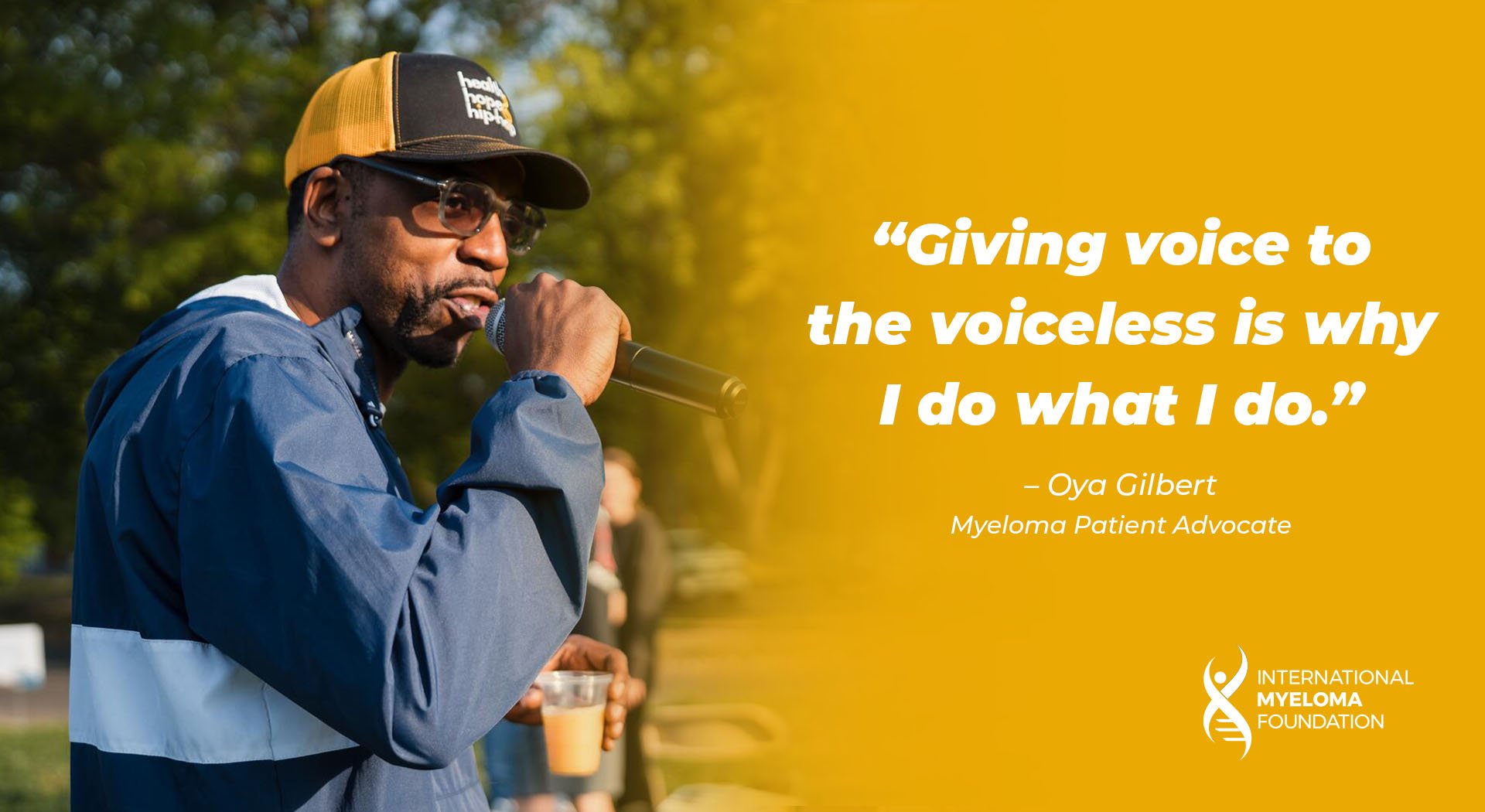
From just that one person’s voice, Oya was catapulted into action. He realized his core purpose was “to inspire others.” Having been part of hip hop culture since he was a teenager, Oya bridged his passion with his purpose and formed the non-profit The Health, Hope, & Hip Hop Foundation (https://healthhopehiphop.org/), which promotes health literacy through the language of hip hop.
Oya chose hip hop as a tool to reach others because as he sees it, “Hip hop really saved my life. The other portion is hip hop was born from an underserved community. It’s storytelling. It gave and gives voice to the voiceless.”
The Soundtrack of Social Change
Some of Oya’s earliest influences include socially resonant hip hop songs such “9-1-1 Is a Joke,” by Public Enemy, “Let’s Talk About Sex,” by Salt N’ Pepa, and “Self-Destruction” by KRS-One.
Perhaps Oya even borrowed a page from KRS-One’s book, who, in the nineties, “formed the Stop the Violence Movement in hopes of encouraging the hip hop community to end violence being committed among themselves,” according to Wikipedia (https://en.wikipedia.org/wiki/Self_Destruction_(song)).
Turning His Diagnosis into Advocacy
Oya’s catalyst though, was multiple myeloma, his own delayed diagnosis, and the facts about the disease that played out in his case: the disease is 2X more common in people of African descent than all other races, and 1.5X more common in men than in women. Also, many Black patients face issues of delayed diagnoses, as Oya did.
For these reasons, Oya “was very intentional in saying we’re going to use hip hop to teach health literacy. We’re going to use it in its purest format from when I was growing up, back in the day. We’re going to use it as a tool for social justice and all those different avenues to bring awareness to create some kind of call to action.”
Oya continued, “In today’s times, hip hop has touched every facet of this planet . . . Everybody! It’s not just an underserved communities’ thing. It is a means of communication to the world as a whole.”
Looking Ahead
Oya hopes in the next decade his organization will reach communities that “might not necessarily fit the landscape and normal trends [in educating about health literacy].”
Though it was deeply unfortunate that Oya’s myeloma diagnosis was delayed for two years, it was also the impetus for his advocacy today. As someone who gives back to others daily, Oya shares his wisdom about the role of advocacy, especially for myeloma patients.
Through the Health, Hope & Hip-Hop Foundation, he is on a mission to inspire healthier living nationwide. While multiple myeloma remains central to his advocacy, his message now reaches people facing all types of health challenges and wellness journeys.
Alongside his team, he has built a movement that amplifies real stories, empowers everyday people, and engages Hip Hop artists who have faced their own health battles. Together, they launched International Hip Hop Health Day, a global call to action that encourages patients, caregivers, healthcare professionals, and communities everywhere to pause, prioritize their well-being, and put their health first.
On that day, the Foundation joined forces with The Hip Hop Museum and CBS News New York as a co-sponsor of The Beat of Democracy: Revolution 250, a groundbreaking public forum created to amplify community voices during the nation’s semi-quincentennial celebration.
The program explored how Hip Hop culture interprets America’s 250-year journey, bringing together artists, activists, educators, elected officials, and community leaders for meaningful conversations about civic engagement, social responsibility, public health, and the future of democracy. By centering both civics and health, the event highlighted the vital connection between informed citizenship and community well-being, encouraging participants to examine how culture can inspire positive change, increase health literacy, and strengthen democratic participation for future generations.
Even One Person Matters
At the International Myeloma Foundation’s Support Group Leaders Summit, Oya overheard another support group leader express disappointment about having a small number of attendees to their group. Oya reminded this leader, “Even if you can help just one person, or three people, what you’re doing is important work.”
Yet, Oya reminds other advocates that this work “is not for the faint of heart.” To sustain himself, Oya turns to his spirituality, and his “relationship with God.” He also makes sure to make even the smallest moments count greatly.
The Moments That Fill Him Up
For example, Oya recounts, “My son was a three-year old when I was diagnosed. Today, he’s almost 12. Recently, we were throwing a football around, and I just realized with how deadly this disease can be, in that moment, I was tossing a football on a nice sunny day. I was just saying to myself how grateful I was to still be here and have this quality of life. It's moments like these that fill me up and keep me going. This is why I do what I do.”
You can learn more about Oya’s advocacy at The Health, Hope, & Hip Hop Foundation website (https://healthhopehiphop.org/), and tune into the Hip, Hooray, Podcast (https://healthhopehiphop.org/hip-hope-hooray-podcast/).
Learn about all their events and efforts to improve health literacy, one lyric at a time.
THIS BLOG IS HOSTED BY THE INTERNATIONAL MYELOMA FOUNDATION (“IMF”) FOR PATIENT ADVOCATES TO SHARE THEIR STORIES. THE CONTENT APPEARING ON THIS WEBPAGE IS NOT CONTROLLED OR PROVIDED BY IMF, AND IMF NEITHER WARRANTS NOR GUARANTEES THE ACCURACY OF SUCH CONTENT. THE FOREGOING NOTWITHSTANDING, THE CONTENT IS NOT A SUBSTITUTE FOR ADVICE AND SERVICE PROVIDED BY QUALIFIED AND LICENSED MEDICAL PROFESSIONALS, AND SHOULD NOT BE RELIED ON WITH RESPECT TO ANY HEALTH MATTERS. ANY HEALTH-RELATED INFORMATION FOUND HEREIN IS ONLY MADE AVAILABLE AS PART OF A GENERAL EDUCATIONAL SERVICE.
Published on June 18, 2026.