Key Takeaways from the Facebook Live Q&A: Drs. Joseph Mikhael and Melissa Alsina Answer Myeloma Questions This Myeloma Action Month (https://www.myeloma.org/blog/key-takeaways-facebook-live-qa-drs-joseph-mikhael-melissa-alsina-answer-myeloma-questions)
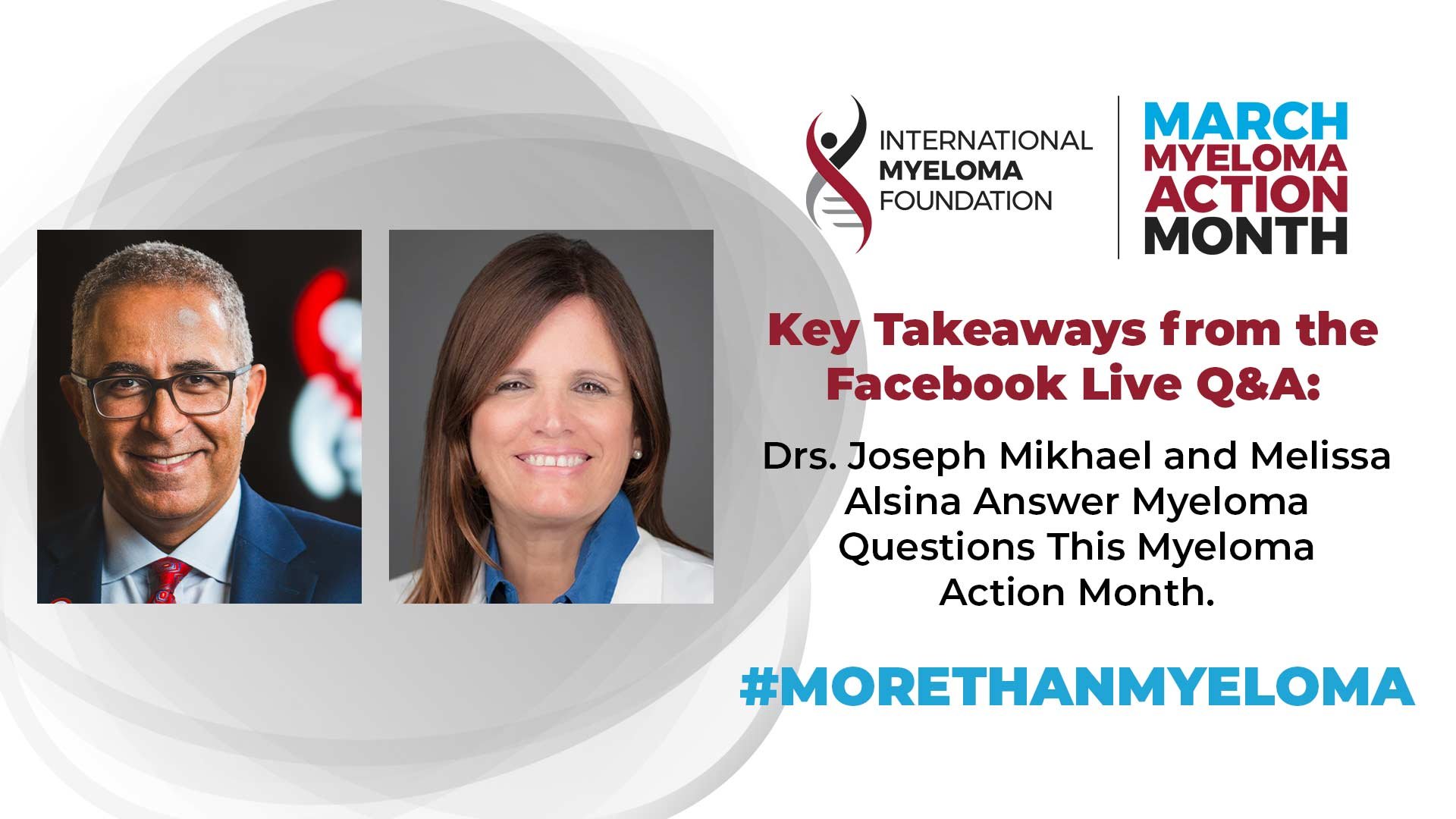
Drs. Joseph Mikhael and Melissa Alsina Answer Myeloma Questions — a Summary of the March 14, 2026, Facebook Live
On Saturday, March 14, IMF Medical Advisor Joseph Mikhael, MD, MEd, FRCPC, FACP, FASCO, along with associate professor of medicine in the Blood and Marrow Transplant Program at Moffitt Cancer Center, Melissa Alsina, MD, hosted a Facebook Live Q&A session to answer the most pressing questions about multiple myeloma as part of Myeloma Action Month — from the latest treatments to managing side effects.
IMF Director of Public Policy and Advocacy Danielle Doheny also joined the session, sharing that her dad is a longtime myeloma patient, and that this cause is more important to her than anything.
The three hosts dived into details about Myeloma Action Month (MAM). Dr. Mikhael directed listeners to myelomaactionmonth.org (https://myelomaactionmonth.org) so they can learn all the ways to get involved with the campaign. He also emphasized that the IMF led the charge to light the world red — landmarks, cultural centers, and medical campuses across the globe illuminated in red to raise myeloma awareness. Danielle also encouraged listeners to continue their advocacy beyond MAM by reaching out to [email protected] (mailto:[email protected]).
Here are some of the top questions and answers we gathered from their Facebook LIVE session (EDITOR’S NOTE: Viewers’ questions and Drs. Mikhael and Alsina’s responses have been edited for conciseness and clarity):
How does CAR T-cell therapy work? Do patients have to be hospitalized for months? How must they undergo CAR T-cell therapy?
Dr. Alsina: Patients frequently ask if CAR T-cell therapy is like an autologous stem cell transplant (ASCT). It’s actually simpler, easier, and has less side effects. We do it in an outpatient setting. Patients do not go into the hospital, except if they develop any side effects of toxicity that requires admission. The most patients might be in the hospital is about five days, during the middle of the month. They do have to be close to a CAR-T center for within an hour, for a month. However, CAR T-cell therapy is typically well-tolerated.
The main side effect or most common side effect occurs when we give those cells back. Then, those cells go and find the myeloma. They begin to start a fight to heal the myeloma, and that creates an immune reaction. Usually, patients would have a fever, or maybe a little bit more than a fever; low blood pressure; or shortness of breath, and so forth.
Most patients experience fever, which we can treat to mitigate or calm down. Patients could also have some neurologic toxicity. Usually, it could be some confusion or headache, which is reversible and mild in most patients. In general, CAR T is well tolerated.
With the recent approval of teclistamab (a bispecific antibody) in combination with daratumumab (a monoclonal antibody) for the treatment of relapsed/refractory myeloma, how are clinicians reacting?
Dr. Alsina: We are super excited because [bispecific antibodies] as we know, are very, very effective. Before, we had to wait until the patient relapsed four times before treating them. Now, we can intervene earlier.
And there's a lot of, I think, there's more access to that combination, for example, than to CAR T. It's something that patients can get from their community oncologist. Whereas with CAR T, you really have to go to a big center that does CAR-T frequently, which might not be close to home. Having more options is definitely a good thing.
What are some other myeloma therapies and/or drug classes that may be approved soon?
Dr. Alsina: There are so many other things in the pipeline in clinical trials, newer CAR Ts that seem to be maybe, I mean, at least as effective as cilta-cel [Carvykti], but maybe with less toxicity. We have anito-cel, which is a CAR T that has a unique binding site. It seems to be less toxic. That's probably going to be approved later this year.
Dr. Mikhael: Yes, and the CELMoDS are coming through as well.
Should a person living alone consider CAR T-cell therapy?
Dr. Alsina: For CAR T, you will need a caregiver [care partner] because the treatment is quite involved — we need to put a central line. We have to drop blood every day. You could have some side effects. You could have a fever at some point, and someone needs to take you to the hospital and so forth. You do need to secure a caregiver to get that. But the good news is, CAR T is not the only option.
We just talked about the recently approved combination of the bispecific, teclistamab with daratumumab. The efficacy looks very similar to CAR T-cell therapy. And this is something that you can get from your community oncologist. You do not need a caregiver to be with you 24/7.
With CAR T, we're excited because of the results and the fact that you get that treatment-free interval. Yet, these drug combinations are very effective and might be more accessible.
Dr. Mikhael: I would also add that the IMF is partnering with other organizations to really think of ways to provide care partners for individuals going through the CAR T process. Perhaps there is a family member or a friend who may be able to help you through it. As Dr. Osina said, it's not a prolonged commitment that lasts for months. It's really a few weeks and there are options. And if you reach out to the IMF through the InfoLine, we can talk to you about some of those options.
I developed severe sepsis during treatment with pomalidomide. Can I take a lower dose?
Dr. Mikhael: I'm sorry that you developed an infection that may or may not obviously have been directly related to the dose of pomalidomide. Of course, we can't give specific answers for your exact care, but I think in general, it's worth commenting that patients may have differing responses to a particular drug. Pomalidomide is one of them.
Pomalidomide is a drug that we typically start at the four-milligram dose. That being said, I actually often use it at half that dose of two milligrams, and I do that for various reasons. First, back in the day when I was at Mayo Clinic, I had the privilege of leading a clinical trial with Dr. Lacey, where we compared four and two milligrams. It seemed that the efficacy/benefit of the drug was the same, but we saw less of the low white blood cell count or neutrophil count that this patient with sepsis experienced. Second, it was better tolerated in general.
I would speak to your healthcare provider about that, of course, but that is a very accepted phenomenon of using a lower dose of pomalidomide.
Dr. Alsina: Yes, I frequently start lower like you do, depending on the patient counts and how many treatments they have had in the past. Yet, low counts are a very common side effect of pomalidomide. Sometimes patients feel that if I adjust the dose, maybe it's not going to be as effective. I always tell my patients that the drug is very rough on their cells, other cells in the bone marrow. It's also very rough on the myeloma.
Dr. Mikhael: I had a conversation with a patient the other day. He was asking about moving from 4 milligrams to 2 milligrams of pomalidomide — if cutting the dose in half would make it less effective.
These drugs are a little less dose-dependent, meaning that it doesn't mean that 2 milligrams will only be half as effective than 4 milligrams. The way these drugs work and the way they interact with the immune system, with even lower doses.
The other drug in that family, lenalidomide, sometimes we use five milligrams, sometimes we use 10, 15, or even 25. So, look at that huge range of dosing, and yet it can be very effective at all those doses.
Is dexamethasone really necessary? Does it increase the efficacy of carfilzomib (Kyprolis)? Or can you just go without it, given its potential side effects?
Dr. Mikhael: Dexamethasone, in many respects, is a wonderful drug. It does boost the effect of other drugs. It reduces the risk of certain reactions to drugs which should include carfilzomib (Kyprolis®), as you've mentioned. It also can reduce nausea and pain.
On the other hand, it causes a lot of side effects. It can make people very jittery, grumpy, and have difficulty sleeping. It can also increase blood sugar levels and blood pressure, affect skin, make one prone to bruising, and cause thinning bones. And the longer we use dexamethasone (dex), the greater those side effects may manifest.
Recently, we published a large review paper in the Journal of Clinical Oncology on this very topic. We brought down dex to so-called low dose dex at 40 milligrams a week, which is still a high dose. Based on evidence and experience that we have, this article said that most patients get the greatest benefit of their dexamethasone for the first two cycles. And then we can really turn it down, as I call it, “Down with Dex.”
I encourage you to have a conversation with your healthcare provider about this to look at ways that you can turn down dex, because the benefit it's giving you is minimal after that first cycle or two. Also, patients can live with a lower dose of dex.
Dr. Alsina: I cannot agree more. It's definitely dex. Historically, when we did not have all these good therapies, it was a super important drug, right? It was the drug that probably was doing most of the work, but that has totally changed.
When we use quadruplet, where one of the four drugs is dex — it’s not really a fair partner. With these newer treatments, we feel confident that we can drop dex very quickly, because it’s probably not the most important drug.
In many cases, we use it more to prevent side effects from the treatment than to actually treat the myeloma.
Can a myeloma patient still undergo CAR T-cell therapy after getting treated with a bispecific antibody?
Dr. Alsina: The quick answer is yes. Now, it depends on the interval between when you receive the bispecific to when you're getting the CAR T.
I'm assuming that the bispecific is targeting the same protein as the CAR T, or BCMA. We have bispecifics that target BCMA, just like available CAR Ts. We also have one that targets a different protein. If it's the same, then the issue is you're taking a drug that is targeting the same protein.
I’m assuming that your disease is becoming more active. More than likely, the CAR-T is not going to work as well. That has been shown in clinical trials because you're targeting the same protein. Your disease is still growing because you’re doing that same target. It's finding ways of escaping that.
But if you have a treatment-free interval, and you're not targeting that same protein, yes, you could easily get a CAR T.
The challenge with having teclistamab approved as a second line is if patients are going to be able to receive CAR-T later.
The answer is yes, because I think even though the study continues these patients on treatment until progression, I am pretty sure that in practice that is not what we're going to do. We usually treat patients with bispecific antibodies until we see that good response, and then we back off. And in many cases, we stop the treatment altogether.
Dr. Mikhael: I think that stopping the treatment — although it sometimes sounds counterproductive, and patients are probably asking if we really want to stop — actually has a dual benefit. Patients not only get the convenience of not being treated with dara in the meantime; it also gives their cells and immune system a rest. In that sense, a rest that could be then engaged again for a CAR T.
Do you lose your hair with CAR T-cell therapy?
Dr. Alsina: The answer is no.
Dr. Mikhael: Next question.
Can a myeloma patient get a tattoo?
Dr. Alsina: I think it's okay in general, but you need to make sure that your blood counts are good. You shouldn’t get a tattoo when your white blood cell count is low, because you would be at risk of infections. If your platelets are low, then you would be at risk of bleeding. But if your counts are good, your immune system is okay, and you didn't get a CAR T last week, I think it should be okay. However, I would always ask that question directly to your doctor, who would know exactly at what stage of your treatment you are in.
If you have had an autologous stem cell transplant (ASCT), can you get CAR T-cell therapy?
Dr. Mikhael: An initial study that came out of Boston questioned whether having an ASCT can lessen the benefit of CAR T. I think maybe it’s not what we're actually seeing in practice. Especially because in the early days, the vast majority of our patients who received CAR T had also undergone ASCT.
I don't typically tell patients that by getting an ASCT they’re burning a bridge per se and that they’re not going to be able to get CAR T. I really think we want to always, of course, keep options open, but we want to give the best therapy that we have at the time.
Dr. Alsina: Eighty percent of patients in clinical trials and in the real world who get CAR T have had an ASCT before. Not only that, but also in terms of safety, there are several studies that have looked at CAR T just following transplant. A patient gets a transplant three months later when they're not either in complete remission or their disease is starting to go up, and they were able to get CAR T.
In terms of safety, we know that you can do an ASCT three months later, after having CAR T-cell therapy.
In case you missed it, you can still watch a replay of the Facebook Live Q&A in its entirety. (https://www.facebook.com/watch/?v=1249474407325148)