Diane Phipps and the Power of Myeloma Community (https://www.myeloma.org/blog/diane-phipps-power-myeloma-community)
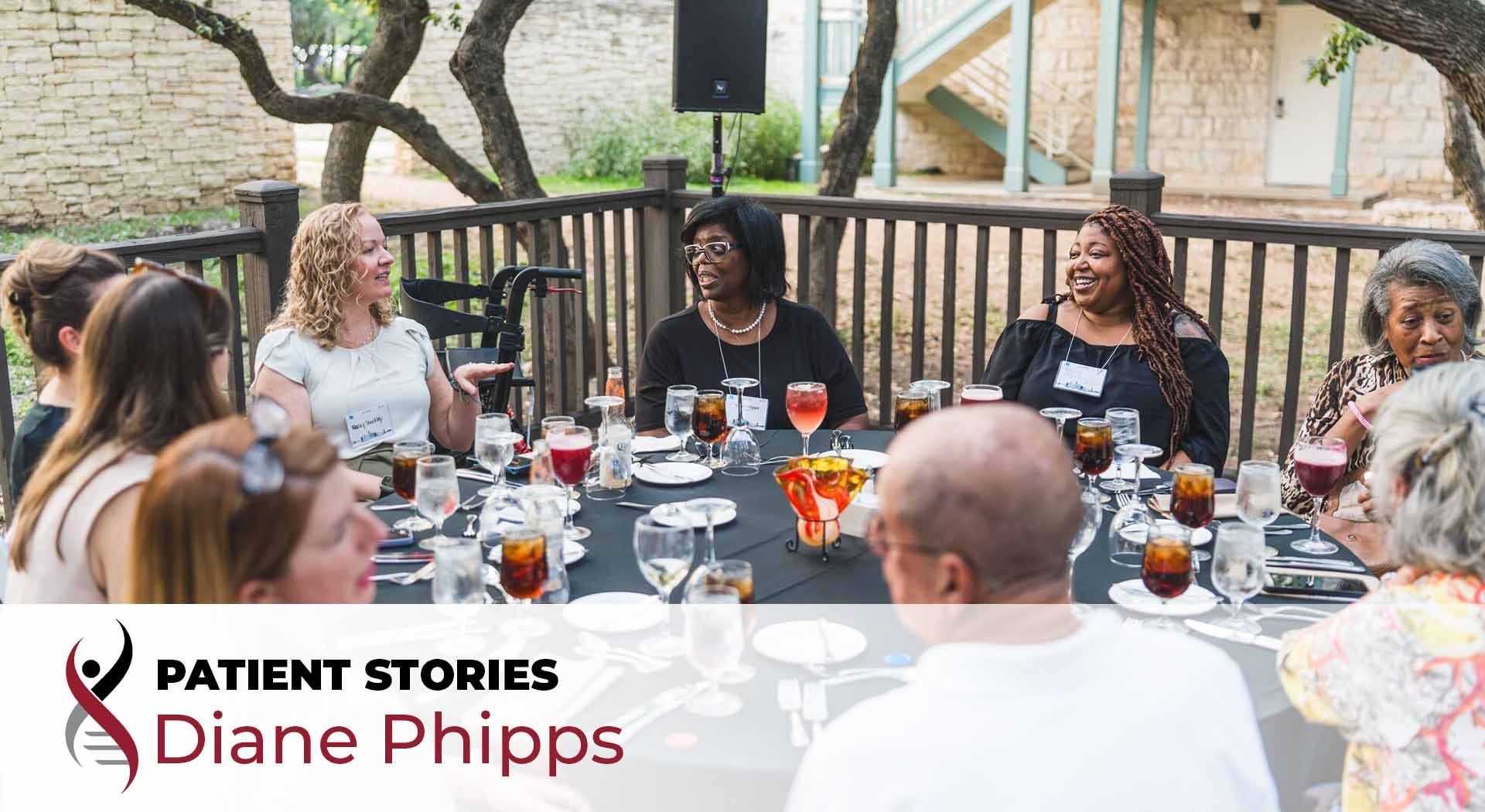
Multiple Myeloma Patient and Support Group Co-Leader Diane Phipps Shares Her Perspective on the Myeloma Community
A Diagnosis and a Turning Point
In an interview with the International Myeloma Foundation (IMF), Diane Phipps shared something she has come to believe deeply about living with multiple myeloma:
“It is so much better than trying to tell someone who doesn’t know what you’re going through. And I believe that you can’t go through this alone. You’ve got to have people who are in your corner.”
Diane’s experience with myeloma began in 2017, after months of seeking answers for persistent back pain. A nephrologist (kidney specialist) discovered elevated protein levels, and she was immediately referred to an oncologist. Treatment began almost at once.
But soon after she began chemotherapy, Diane’s husband was diagnosed with a brain tumor, from which he passed away. She suddenly found herself alone—grieving and still fighting for her own health.
Discovering a Community
Walking out of her oncologist’s office one day, Diane noticed a flyer for the Greater St. Louis Multiple Myeloma Support Group. She emailed the leader, Carla, asking, “Do you have space for another person at the table?”
That simple email would change everything.
Soon after, she met Carla—a nurse—as well as Carla’s husband Dennis, a pharmacologist. Diane instantly felt she was in good hands, surrounded by people who understood both the medical and emotional terrain of myeloma. But she also noticed how much of the work fell on the couple. She remembers asking, “Why are you and Dennis doing everything?”
Within weeks, Diane was also delegating tasks and organizing meetings—a natural next step for someone who had already begun to rebuild her life by leaning into community.
More Than a Meeting: A True Support System
For Diane, a support group isn’t just a gathering; it’s a place where people show up for one another in tangible ways. Members decorate for holidays, send encouragement cards to those too sick to attend, and trade hard-earned insights about living with the disease.
It was at one of these meetings that Diane learned a certain therapy could cause nosebleeds. Months later, when she experienced one herself, she felt informed—not frightened.
This is what community gives you, she says: preparation, reassurance, and the kind of knowledge only lived experience can provide.
Speaking Up and Reaching Out
Diane’s advocacy has grown from the very challenges she faced. As a Black woman with myeloma, she knows firsthand how vital awareness is. She remembers feeling dismissed when she first sought help for her back pain, noting that her doctor focused more on her White husband’s questions. Diane said, “During appointments we both attended, my pain was routinely ignored, and I was only prescribed another pain medication. "
Whatever the reason for being disregarded, she says, the stakes are too high to ignore. African Americans are twice as likely to develop myeloma as people of other racial and ethnic groups. Knowing the symptoms—and the risk—could lead to earlier diagnoses and better outcomes.
Diane also believes in supporting those who can’t always show up in person. One close friend who had a busy work schedule as a bus driver, relies on Diane to share what she learns at myeloma support group meetings.
And as a U.S. Armed Forces veteran, Diane makes a point to reach out to fellow veterans. When she discovered that a former colleague was being treated for myeloma in the same bone marrow transplant unit, she immediately encouraged him to join the support group. His care partner later learned at a meeting that dexamethasone could cause mood changes—an insight that finally explained what he’d been experiencing.
A Place for Difficult Questions
The Greater St. Louis Multiple Myeloma Support Group has also become a forum for addressing broader community concerns. When a scientific journal reported on possible links between radioactive waste exposure from nearby Coldwater Creek and increased cancer risk, group members appreciated having a space to discuss and process the news—even if the findings weren’t directly tied to myeloma.
Information is power, Diane believes. Shared information is something even stronger; it is connection.
Hope in a Ballroom
One of the most powerful reminders of that connection came at the 28th BMT and Cellular Therapy Patient Celebration in St. Louis. Diane remembers being told the history of BMT Celebrations started years ago, in the basement of a hospital building. This year, about 800 attendees filled the ballroom—blood cancer patients, care partners, and other loved ones.
Diane said, “I saw people, ladies with tiaras on, and ball gowns, and men in tuxedos. Everyday people just saying, ‘Hey, we’re here, and the treatment is helping us live longer’... I cried for the first time. I boohooed the whole time!”
Looking Ahead
Diane lets herself cry when she needs to—but not for long. There’s too much work to do. Today, as a co-leader of the Greater St. Louis Multiple Myeloma Support Group, she continues to build the kind of community that sustained her: one grounded in hope, knowledge, and everyday acts of care.
Her goal is simple but profound: to make life a little easier, one day at a time, for everyone touched by myeloma.