The Fast Pace of Progress in Myeloma Treatment Practice (https://www.myeloma.org/blog/fast-pace-progress-myeloma-treatment-practice)

Faster Myeloma Progress: ASH 2025 Takeaways on CAR-T and New Drugs
By Jill Zitzewitz, PhD
The day before the American Society of Hematology (ASH) meeting kicks off each year is Satellite Symposia Day, where community oncologists can attend and receive continuing education credit by learning about the latest clinical trial data informing clinical practice. The sessions always have pre- and post-tests, and as an educator, I enjoy seeing how much I’ve learned as a patient advocate over the years. On Friday, I attended three of these sessions virtually from the comfort of my cozy chair with a kitty on my lap.
I’m currently recovering from recent chimeric antigen receptor T-cell therapy (CAR-T) after experiencing a second relapse of my multiple myeloma earlier this year. I am extremely grateful to be able to attend ASH25 virtually while my immune system gets back up to speed as part of the Myeloma Voices team of the International Myeloma Foundation (https://www.myeloma.org/resources-support/imf-support-network/patient-blogs-ash) (https://www.myeloma.org/resources-support/imf-support-network/patient-blogs-ash (https://www.myeloma.org/resources-support/imf-support-network/patient-blogs-ash) #IMFASH25). Throughout the day, I was continually reminded how much has changed in myeloma treatment practice in the five years that I have been attending ASH as a patient advocate and multiple myeloma support group leader.
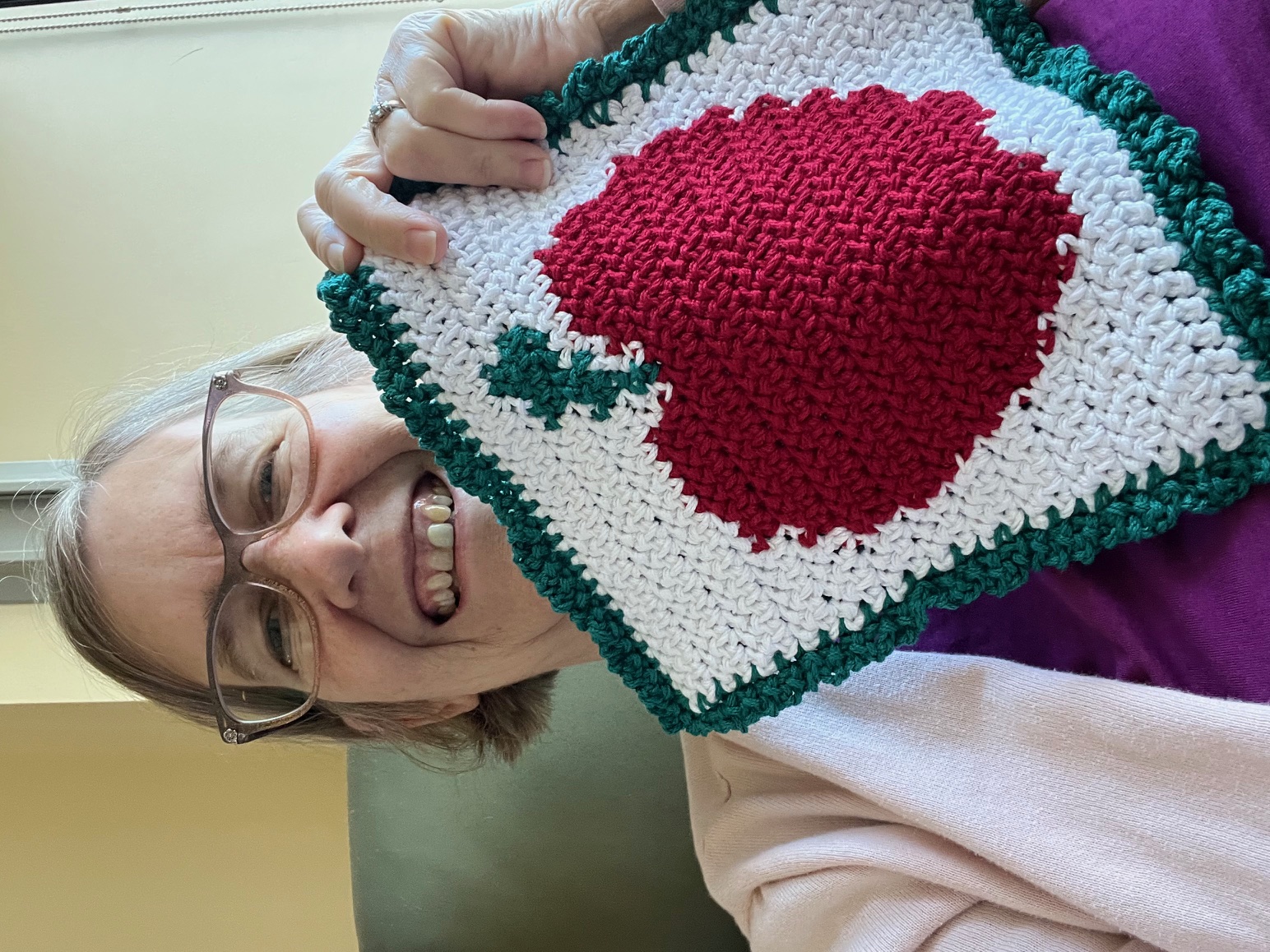
The morning session, entitled "Many Roads to Myeloma Remission: Making Sequential Choices with BCMA and non-BCMA Immunotherapies," focused on how CAR-T and bispecific antibodies provide long remissions, have manageable side effect profiles, and are moving forward in the treatment paradigm. Notably, CAR-T is now available after the first relapse, although only about 10% of patients who are eligible currently access CAR-T, indicating the need to bring these life-changing therapies to more community practices. Additionally, discussion focused on how the risk of severe neurotoxicities from CAR-T is limited when myeloma is under control with effective bridging therapy, consistent with my own experience. I was in the hospital for 13 days, writing the sentence “I like to eat apples!!” multiple times a day as a test to see if any concerning side effects were occurring. I crocheted an apple potholder while in the hospital as a memento of this experience, a sign to my family and care team that my brain was working just fine. The panelists discussed how managing infection from BCMA-targeted therapies is also now well controlled with prophylactic medication and IVIG infusions (other people’s antibodies). The biggest risk to infection remains patient behavior, and they emphasized how patients should avoid crowds and travel at least three, and preferably six, months after CAR-T. I can’t wait for my treatment-free, post-CAR-T life of adventure to begin in the new year!
The second session that I attended, entitled "‘Four’ Every Patient: Maximizing Outcomes in Newly Diagnosed Multiple Myeloma Care with Anti-CD38 Monoclonal Antibody-Based Quadruplet Therapies," was another reminder of how much standard of care for myeloma treatment has changed in recent years. I had a triplet therapy at diagnosis in 2018 and then an anti-CD38 antibody, Darzalex® (daratunumab) as part of my second line of therapy after relapsing in 2021. Today, most newly diagnosed patients in our support group are on a four-drug treatment at diagnosis, providing a deeper, and potentially longer, remission.
The third session that I attended, entitled "Myeloma Myth Busters: Investigating the Now, Soon, and Future Clinical Implications of CELMoDs," was one that I thoroughly enjoyed as a scientist who studies protein misfolding pathways. The session focused on the mechanism of action and clinical trial data for some new therapies that target the cell’s garbage can for misfolded proteins. These therapies also enhance the immune system and may become available to patients outside of clinical trials in the future. The session reminded me of the way I teach graduate students and medical students about how we can target normal cellular processes to treat cancer. The session was also a good reminder that even with all the incredible progress in myeloma therapeutic development, there is still more hope on the horizon for patients who relapse.
Each of Friday’s sessions showed that the progress we’ve seen in how myeloma is treated has been advancing at lightning speed, and the potential for a cure may be within reach.
Jill Zitzewitz, PhD, Central MA Multiple Myeloma Support Group (https://www.myeloma.org/central-ma)
Follow me on BlueSky @jillzzz.bsky.social
THIS BLOG IS HOSTED BY THE INTERNATIONAL MYELOMA FOUNDATION (“IMF”) FOR MULTIPLE MYELOMA SUPPORT GROUPS. THE CONTENT APPEARING ON THIS WEBPAGE IS NOT CONTROLLED OR PROVIDED BY IMF, AND IMF NEITHER WARRANTS NOR GUARANTEES THE ACCURACY OF SUCH CONTENT. THE FOREGOING NOTWITHSTANDING, THE CONTENT IS NOT A SUBSTITUTE FOR ADVICE AND SERVICE PROVIDED BY QUALIFIED AND LICENSED MEDICAL PROFESSIONALS, AND SHOULD NOT BE RELIED ON WITH RESPECT TO ANY HEALTH MATTERS. ANY HEALTH-RELATED INFORMATION FOUND HEREIN IS ONLY MADE AVAILABLE AS PART OF A GENERAL EDUCATIONAL SERVICE.
Published on December 6, 2025.