2025 Patient and Family Seminar Los Angeles: Highlights of the Fireside Chat on the Future of Myeloma (https://www.myeloma.org/blog/PFS-LA-fireside-chat-highlights)
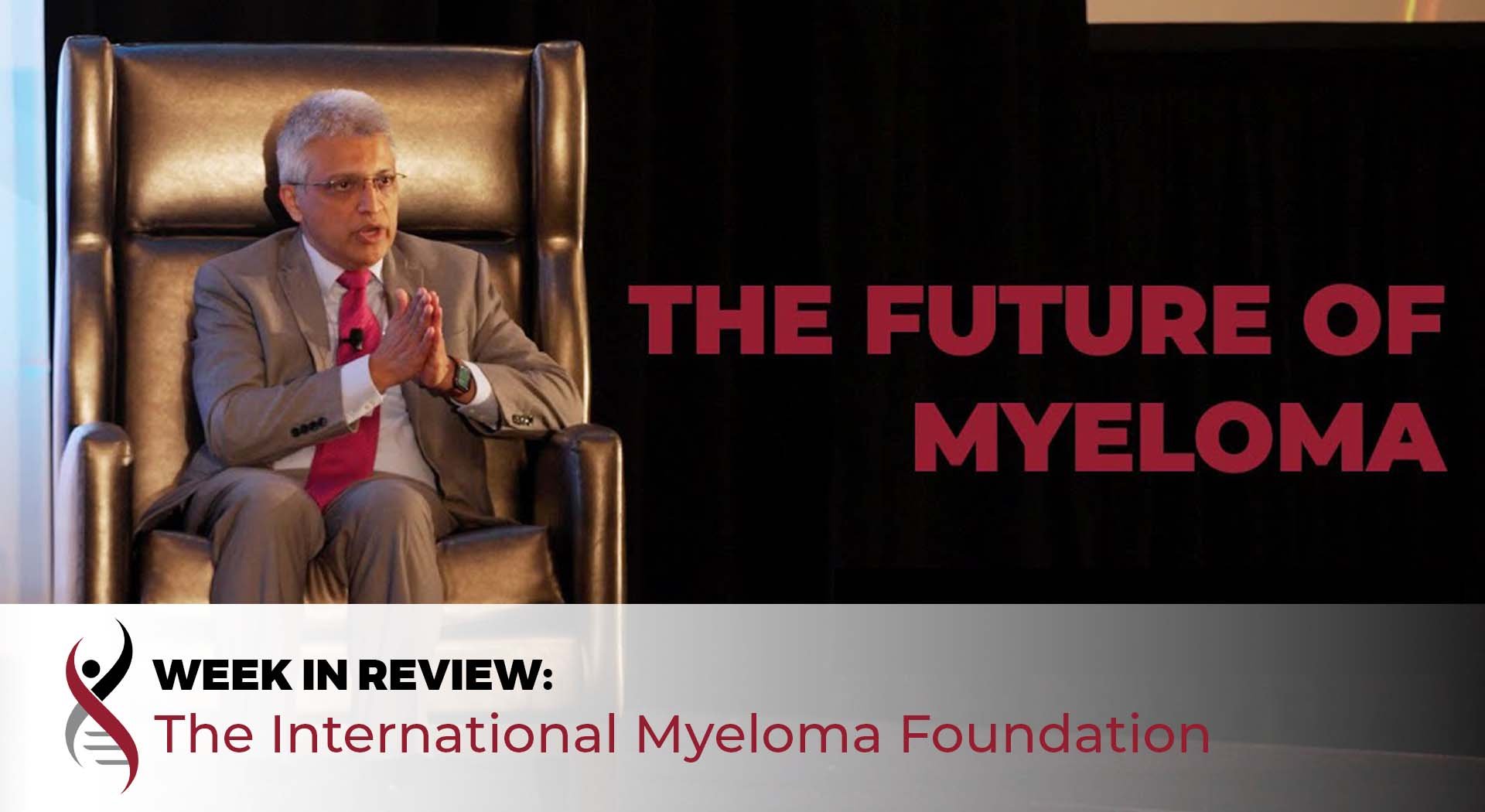
An informative conversation between IMF Chief Medical Officer Dr. Joseph Mikhael and IMF Scientific Advisory Board Member Dr. Shaji Kumar on what myeloma patients and their families should expect next in terms of early screening and diagnosis, treatments, and care.
On the second day of the Patient & Family Seminar (Saturday, August 16), IMF Chief Medical Officer Joseph Mikhael, MD, MEd, FRCPC, FACP, FASCO (TGen, City of Hope Cancer Center — Phoenix, AZ) and IMF Scientific Advisory Board Member Shaji Kumar, MD (Mayo Clinic — Rochester, MN) engaged in a fireside chat to talk about what’s next in multiple myeloma: targeted MGUS screening, strategies for treating high-risk smoldering myeloma, CAR T-cell therapy vs stem cell transplant, as well as minimal residual disease (MRD)-guided care.
They also discussed how AI tools and partnerships are helping accelerate research and bring patients to the best clinical trials.
Here are some of the takeaways we gathered from this informative and insightful fireside chat, along with some questions that were addressed during the Q&A session. (EDITOR’S NOTE: Topics of discussion, panelist views, as well as questions and responses have been edited for conciseness and clarity.)
Dr. Mikhael: I’ve asked Dr. Shaji to share his thoughts on the future of myeloma—what's coming next and what patients might expect.
On the first day of the PFS, we covered the basics of myeloma and current treatment options. Today, you’ll hear more about the standard treatments used when someone is first diagnosed and what happens when the disease comes back. But in this session, we want to look ahead.
There are two main goals:
- To give hope – This is an incredibly exciting time in myeloma care. In over 25 years, I’ve never seen so many new treatments, clinical trials, and real progress.
- To help you think about the future – We want to talk about things that could affect your care in the months and years ahead.
We'll explore where myeloma treatment is heading.
Shaji, let’s start by looking at early detection. Right now, most people are diagnosed after having symptoms like back pain, fatigue, or weakness—often after several visits to their primary care doctor.
Are we getting closer to being able to catch myeloma earlier, maybe even through screening?
Dr. Kumar: This is a really important question. Myeloma doesn’t just appear overnight. It usually develops slowly over time, starting with earlier conditions like MGUS (monoclonal gammopathy of undetermined significance) and then smoldering myeloma, which can eventually progress to full myeloma.
The good news is that this slow development gives us a long window where we might be able to catch it early and even treat it before it becomes more serious. The challenge is that most people don’t know they have these early conditions—we usually find them by accident during routine blood tests.
Now that treatments have improved and early intervention is starting to show real benefits, there's growing interest in screening people earlier. But here’s the problem: myeloma is not a common cancer. If we screened everyone, we’d find many people with low-risk conditions who may never develop myeloma—and we don’t want to cause unnecessary worry.
The future is likely in targeted screening—focusing on people at higher risk, like those with a family history or African American individuals, who are more likely to develop myeloma.
We’re not quite there yet, but we’re getting close. We also need to figure out what tests to use and when to use them. For example, a highly sensitive test called mass spectrometry has shown promising results. In one study, doing that test just once at age 50 showed that people had almost no risk of developing myeloma for the next 20 years.
In the future, screening might look like a one-time test at age 50 for people at higher risk, and that could give peace of mind for many years.
Dr. Mikhael: Absolutely—this is something the entire cancer community is working toward: catching cancer earlier. It just makes sense. But it’s important to remember that figuring out how to screen properly takes time. It took years to get it right for breast cancer (with mammograms) and colon cancer (with colonoscopies), and we’re still working through that process for myeloma.
Myeloma is especially tricky because it’s rare, and the symptoms—like fatigue or back pain—aren’t specific. So, we need to be careful. We want to catch it early, but we also don’t want to cause unnecessary worry in people who may never develop the disease.
About five years ago, the iStopMM study in Iceland screened over half the country’s population over age 40 to find out if screening for early myeloma or MGUS could save lives. The study is massive and important, but the results aren't final yet. We still need a couple more years before we know whether screening should become standard practice.
In the meantime, whether through large trials or better education—especially for primary care providers and the public—the goal is the same: diagnose myeloma before it causes serious damage, like broken bones or kidney failure.
Now, shifting to the next big question: what do we do when we catch myeloma in the early stages—specifically high-risk smoldering myeloma?
Dr. Kumar: It’s likely that the future of treating smoldering myeloma will be a mix of both approaches—treating some people early and carefully monitoring others.
Right now, one of the biggest goals is to make our tests more accurate and specific, so we can better predict who is truly at risk of developing active myeloma. Some people may already have crossed that line—even if they’re still technically labeled as “smoldering”—and those people may need to be treated like they already have myeloma.
For others, especially those at very low risk, we may continue to just monitor them without treatment, knowing their chance of progression is small.
Then there’s a middle group, where the risk is real but not immediate. For them, we may try to delay the development of active myeloma—turn 5 years into 10, or 10 into 20. And in some cases, if we catch it early enough, we might even be able to cure it before it fully develops.
The idea is to use what we’ve learned from treating active myeloma, but apply it in smarter, more targeted ways earlier in the disease—possibly stopping it before it ever becomes a serious problem.
Dr. Mikhael: Beautifully said. I just want to highlight something we heard yesterday about the importance of shared decision-making—and this applies not just to smoldering myeloma, but to all stages of treatment.
Today, we have more treatment options than we did 20 years ago. That means your preferences—what matters most to you—should help guide your care.
For example, if you have smoldering myeloma and a 20% chance of it becoming active in the next two years, most people might choose not to start treatment. But if the risk rises to 40%, 60%, or 80%, some of you might still want to wait, while others might want to take action right away. Both decisions are valid. There is no one-size-fits-all answer.
Some people may say, “I’m feeling great right now, I want to keep living life as I am.” Others might say, “That risk worries me—let’s treat it now.” Neither approach is wrong. The best treatment is the one that fits your personal values, goals, and lifestyle.
Think of it like choosing a meal at a restaurant. If the menu has lots of options, the best choice depends on your taste. Myeloma treatment is the same—you’re not weakening your care by choosing what fits you best. You’re actually strengthening it by making sure it aligns with your life.
Now, looking ahead: we’ve heard a lot about CAR T-cell therapy, which has shown great success even for people with heavily treated myeloma, and now earlier in the disease too—like at first relapse.
Here’s the big question: Will we one day use CAR T therapy as the very first treatment, even replacing stem cell transplants?
That’s something experts like Dr. Shaji and others are actively exploring. The field is moving fast, and in the next few years, we may see CAR T move earlier in treatment, possibly even replace transplants in some cases.
It’s an exciting time, and the future could look very different from what we've known for the past two decades.
Dr. Kumar: Yes, CAR T-cell therapy has proven itself—we’ve seen some amazing results. In one study, about one-third of patients who received CAR T had no signs of myeloma for five years, without needing any further treatment. That’s a big deal.
Because of results like that, it's natural to ask: Why aren’t we using CAR T right away, as a first treatment? The answer is: not yet, but we’re getting there.
Right now, CAR T therapy can come with serious side effects, including rare but concerning neurological problems like Parkinson’s-like symptoms. Since many people with myeloma today can live 10 to 15 years or longer on current treatments before the disease even comes back, it may not make sense to take that kind of risk right at the start.
However, researchers are already working on improving CAR T—making it safer and more precise. New technology allows scientists to design CAR T cells without using viruses, which helps lower the risk of side effects. In the next 2 to 5 years, we expect CAR T to become safer, more effective, and possibly ready to use earlier in treatment.
That said, even if CAR T becomes a first-line option, it won’t be right for everyone. Factors like a patient’s health, ability to handle side effects, and access to specialized centers all play a role.
Still, the future is promising—and we’re moving closer to using CAR T earlier in myeloma care.
Dr. Mikhael: Absolutely—I completely agree. Even though CAR T-cell therapy already helps about 90% of patients respond, we still want to make it even more effective and safer. The goal is to keep raising the bar and aiming for the best possible outcomes.
I guess my next question is: What about transplants? Do you think that we’re going to abandon doing transplants?
Dr. Kumar: I think we'll eventually stop using stem cell transplant as part of the first treatment for myeloma, but we won’t stop using it altogether.
As you said, we're curing some, but not everyone—and until we can cure all patients, we need to keep every treatment option on the table.
Dr. Mikhael: That’s a really important point. With a disease we still can’t fully cure, we shouldn’t take any treatment off the table. Myeloma is different in every person, and sometimes it surprises us.
For example, I recently saw a patient who didn’t respond well to our best four-drug combination but did respond really well to a stem cell transplant. It reminds us that for some patients, the biology of their myeloma still responds best to older treatments like transplants.
That said, I do believe the role of stem cell transplant is going to shrink over time. We're seeing newer, gentler, and more effective options that may eventually replace it for many patients. But for now, transplant still has a place—especially when other treatments don’t work as well.
Now, looking ahead to the future: we talked yesterday about MRD—Minimal Residual Disease— which is a test that looks for tiny amounts of myeloma cells left after treatment.
Do you think we’ll start using MRD more often to guide treatment decisions? For example, could MRD results help us decide whether to keep treating, change treatment, or even stop treatment altogether if no disease is found?
That’s the direction the field seems to be heading.
Dr. Kumar: Absolutely. Minimal Residual Disease, or MRD, is here to stay and will play a big role in myeloma treatment. We’ll use it in a few ways:
- To help decide early treatment choices, like whether or not to do a stem cell transplant.
- To measure how well treatment is working and decide when it’s safe to stop therapy.
- To guide when to restart treatment, maybe even before symptoms or protein levels rise.
Right now, many new clinical trials use MRD to compare treatments, helping bring better options to patients faster. MRD is becoming a key tool in both treatment and research.
Dr. Mikhael: Ideally, one day MRD testing will be as simple as a regular blood test—no more bone marrow needle needed every time. While bone marrow gives the best info since myeloma starts there, sometimes tiny bits of myeloma show up in the blood, and researchers are working on detecting those.
Also, the IMF has worked with the FDA to use MRD as an early sign in clinical trials. Instead of waiting years to know if a new treatment works, MRD helps predict results much faster—like knowing the game’s outcome early on. This speeds up drug development, getting better treatments to patients sooner.
Q&A Session
I’m excited about better testing for early, symptom-free diagnosis, but what about people who are diagnosed late because doctors don’t test enough? Could doing an SPEP test earlier help catch myeloma sooner? What can we do to fix this delay in diagnosis for people with symptoms?
Dr. Kumar: Myeloma isn’t common, so doctors don’t always think about it when someone has symptoms like back pain. The biggest step is better education for primary care doctors, so they know when to test for myeloma. If they check for other causes and don’t find anything, myeloma testing should be part of the next steps. That way, diagnosis can happen earlier.
Dr. Mikhael: We’re working to educate both the public—especially those at higher risk like older adults and people of African descent—and primary care doctors, so they don’t overlook symptoms like pain that could be myeloma. It’s important to remember myeloma can affect anyone, not just certain groups.
Also, doctors are starting to use newer, faster tests like mass spectrometry, which could make screening easier and quicker in the future.
I was diagnosed in October of 2023, standard triplet, Dara, Revlimid and dexamethasone. I was told I'm in remission. I don't really know what that means and my doctor has never mentioned MRD. My question is: what should I be asking going forward and what does remission really mean?
Dr. Kumar: When doctors talk about remission in myeloma, they mean the disease is quiet or very low—sometimes even undetectable. To understand this better, ask how your myeloma is being measured. Are they checking the M-spike, free light chains, or looking for myeloma cells in your bone marrow? You can also ask if MRD testing was done, which looks for tiny amounts of myeloma that might still be there.
MRD testing is becoming more common and important, but not every patient gets it yet. Sometimes, if your treatment plan is clear and you don’t have high-risk features, MRD results might not change what doctors do. Still, a negative MRD test can give extra confidence that the myeloma is less likely to come back soon.
So, it’s good to ask what tests are being used—blood tests, urine tests, bone X-rays—to keep an eye on your myeloma and understand your remission status.
Dr. Mikhael: That’s a great point! But I want to be careful about how we talk about MRD testing. It’s a useful tool, but it hasn’t changed everything about treatment yet, and we’re still learning the best way to use it. So, if your doctor hasn’t done MRD testing, that’s okay—it doesn’t mean they’re missing something.
What’s important is that your doctor has told you you’re in remission. Sometimes doctors assume patients understand what that means, but it’s okay to ask questions. We’re here to help you understand things like M-spike and light chains, so you know what tests are being used to watch your myeloma.
If you want, you can also reach out for help with understanding your test results.
I’m on a unique three-drug treatment for myeloma and have amyloidosis in the background. My doctors found I have the t(11;14) chromosomal change, and I'm currently being treated with daratumumab, dexamethasone, and venetoclax, which have worked really well and put me in remission. What do you think about this type of treatment for someone with t(11;14)? And is there any research on the long-term effects of this combination?
Dr. Kumar: Having both multiple myeloma and amyloidosis at the same time happens in about 5–10% of patients, so it’s not that rare. Both are caused by abnormal plasma cells making a harmful protein, but in amyloidosis, the body reacts to that protein differently.
As for your treatment with daratumumab and venetoclax, you’re on a very effective combination for someone with the t(11;14) translocation. It’s a strong option that we use often in those cases. It’s not usually used as a first treatment because venetoclax isn’t FDA-approved yet for myeloma or amyloidosis—but we do know it works well.
Some trials with venetoclax didn’t show positive results, but that was mostly due to how the studies were designed—not because the drug doesn’t work, especially in patients with the t(11;14) translocation.
Venetoclax has been used for a long time in other cancers, like chronic lymphocytic leukemia, where people often take it for extended periods. So far, there’s no evidence of any serious long-term or irreversible side effects. Like any drug, it can cause some side effects while you’re on it—such as low blood counts—but overall, it’s considered safe.
It sounds like your treatment is working really well, which is great to hear!
You mentioned the time it takes to analyze clinical trial data — sometimes up to eight months. As a caregiver, I’m wondering: Is the IMF involved in any efforts with AI or machine learning companies to speed up that process and help reach conclusions faster? Maybe even using predictive tools?
Dr. Mikhael: That’s a great question about how we can speed up clinical trial results and make a real difference. One big step has been using MRD as a clinical trial endpoint. Instead of waiting years to see if patients stay in remission, MRD lets us assess treatment impact much sooner. It’s not perfect—some patients still have tiny amounts of disease that aren’t harmful—but it’s a major improvement.
Also, the field of myeloma research is very active right now, with many new drugs and studies. That momentum is helping us break through old barriers that slowed down trials.
We're also moving trials beyond large academic centers. For example, City of Hope is opening more community-based locations, so patients don’t have to travel far. This makes it easier for people to participate, speeds up enrollment, and improves representation in trials.
Lastly, we’re pushing for more diversity in trials. The FDA needs to see that studies include a broad range of participants to make meaningful decisions. So, we're designing smarter, faster, and more inclusive trials right from the start.
Dr. Kumar: You're right—two key things really matter. First, the faster we enroll patients in clinical trials, the faster we get results. Second, once a new treatment is approved, we need to get it into the community quickly.
Future trials often build on previous ones, so if the new standard treatment isn’t being used yet in real-world settings, it slows things down. That’s why education and awareness in the community are so important.
Could AI technology play a role in Research and Development or be involved in the process?
Dr. Mikhael: AI is already playing a big role in education and awareness. It can pull together huge amounts of information from many sources, which no single person could do alone. In that sense, AI helps us learn and share more effectively.
The IMF is working hard to gather and organize this knowledge, almost like a “human chatbot.” And there are exciting efforts—especially at places like Mayo Clinic—to explore how AI can also advance research in myeloma.
Shaji, could you answer this question from a research standpoint?
Dr. Kumar: AI is starting to play a big role in many parts of myeloma research and care. For example, in drug development, AI can help identify the most promising treatment candidates early on, so we don’t waste time testing dozens or hundreds of options. That helps speed up clinical trials from the very beginning.
AI is also helping with matching patients to the right clinical trials, like what you see with SparkCures. It can look through electronic medical records and spot patients who might qualify or even identify those at higher risk of developing myeloma.
Because AI can analyze huge amounts of data—lab results, genetics, patient characteristics—it can help us predict which treatments might work best for each person, and who might need closer monitoring.
Overall, AI is becoming an important tool in diagnosing, treating, and developing new therapies for myeloma.
Dr. Mikhael: Let me give one last example—the iStopMM trial in Iceland, where researchers screened over 80,000 people for MGUS. That created a massive amount of data, and they used AI to build a tool that helps doctors decide whether a bone marrow test is really necessary.
Since the difference between MGUS and smoldering myeloma often comes down to what's found in the bone marrow, the AI tool looks at a patient’s individual features and estimates whether the test would actually give us useful new information.
Thanks to this, we're now able to spare some patients from getting unnecessary bone marrow biopsies, especially if the chance of smoldering myeloma is very low. It’s a great example of how AI can make care more precise—and a bit more comfortable—for patients.
(You can watch the PFS-LA fireside chat (https://www.myeloma.org/videos/future-multiple-myeloma-screening-smoldering-strategies-car-t-vs-transplant-mrd-guided-care) in its entirety.)