Key Takeaways from the Top Myeloma Research Presented at ASCO, EHA, & IMWG 2025 Webinar: The Patient Perspective (Part 1 of 2) (https://www.myeloma.org/blog/key-takeaways-2025-top-myeloma-research-part-1)
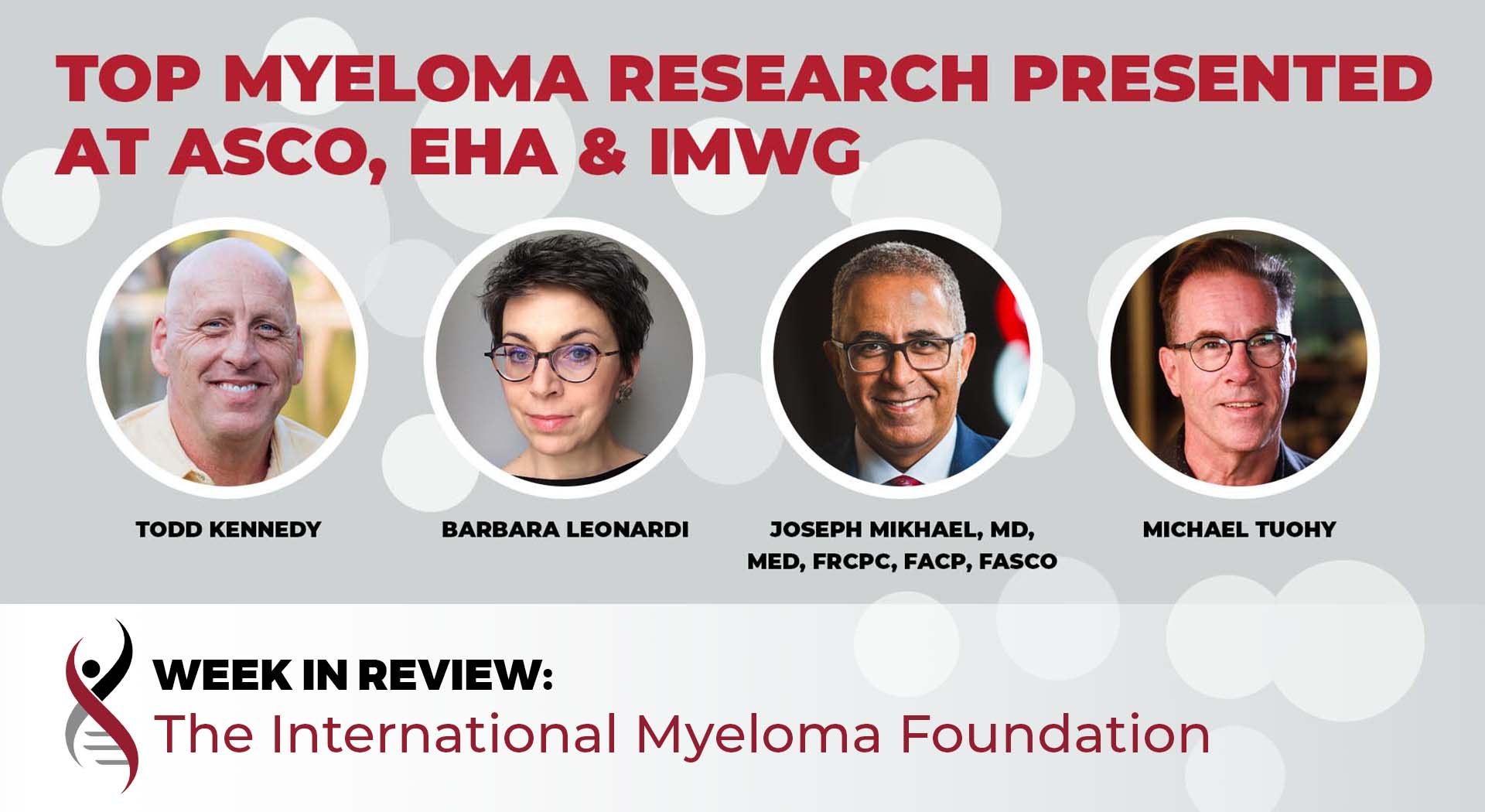
On Tuesday, July 1, the International Myeloma Foundation conducted its annual webinar on “Top Myeloma Research Presented at ASCO, EHA, & IMWG 2025 Webinar: The Patient Perspective.” (https://www.myeloma.org/videos/top-myeloma-research-presented-asco-eha-imwg-2025-webinar-patient-perspective)
The webinar was hosted by IMF Chief Medical Officer Joseph Mikhael, MD, MEd, FRCPC, FACP, FASCO (TGen at the City of Hope — Phoenix, AZ), along with patient advocate and support group leader panelists, Todd Kennedy, Barbara Leonardi, and Michael Tuohy.
During the webinar, Dr. Mikhael elaborated on top myeloma research that were presented at the 2025 American Society of Clinical Oncology (ASCO) Annual Conference, the IMF International Myeloma Working Group (IMWG) Summit, and the European Hematology Association (EHA) Annual Conference.
In part one of this two-part series, the speakers discussed Smoldering Myeloma (https://www.youtube.com/watch?v=zTe3-3igXqg&t=517s), Frontline Therapy, (https://www.youtube.com/watch?v=zTe3-3igXqg&t=1184s) and Early Relapse. (https://www.youtube.com/watch?v=zTe3-3igXqg&t=2028s)
Here are some of the top takeaways from the topics mentioned above. We have gathered some of the key insights from this informative and insightful webinar. (EDITOR’S NOTE: Topics of discussion and panelist views have been edited for conciseness and clarity.)
Smoldering Myeloma
In this segment, Dr. Mikhael and patient panelists talk about:
- The 20-2-20 Model: Risk categories (low, intermediate, high) with progression rates and time-to-progression (TTP) data.
- The AQUILA Trial: Daratumumab reduced progression risk by 51% compared to active monitoring, especially in high-risk smoldering myeloma.
- Future Directions: More trials with intense therapies like CAR T-cell therapy.
Dr. Mikhael: Within smoldering myeloma, there is a huge spectrum. On one end, there are people who probably don’t need treatment and then at the other, those who are about to develop active myeloma. This has been a hot area of study, because we want to catch cancer as early as possible.
We all realize that myeloma is not really one disease. There’s not one piece of evidence that tells you the whole story. We’re trying to collect all the evidence to know if someone has high-risk, standard-risk, or low-risk smoldering myeloma. Do they have the likelihood of getting active myeloma in two years? If so, the patient might want treatment. This is what brought on the development of the 20-2-20 model (https://www.myeloma.org/videos/high-risk-smoldering-multiple-myeloma).
Smoldering multiple myeloma is an early form of the disease that hasn’t caused symptoms yet, but in some people, it can progress to active myeloma. Doctors now recognize that if certain test results are high—like having over 20% plasma cells in the bone marrow, an M-protein over 2, or a free light chain ratio (involved over uninvolved) over 20—if patients have 2 or more of these factors, they are considered high-risk.
The AQUILA trial (https://www.nejm.org/doi/abs/10.1056/NEJMoa2409029) looked at whether treating these high-risk patients early with daratumumab (Darzalex) could help. The results showed that more people who got the drug avoided progressing to full myeloma after five years, compared to those who were only monitored.
This doesn’t mean everyone needs treatment right away, but it does mean there’s now a choice. Some patients may prefer early treatment to delay the disease, while others may still want to wait. The most important step is having a thoughtful discussion with your doctor to decide what’s right for you.
That said, I'm going to turn to my friends here on the panel. Todd, as a patient with active multiple myeloma, who has been treated already, what's your take on this? How does it resonate with you?
Todd Kennedy: When this new data was presented at ASCO, it was really powerful—both inspiring and eye-opening. One thing I’ve noticed, when talking to people with smoldering multiple myeloma: many don’t know whether they’re considered as high risk or standard risk. That’s why the earlier discussion about the 20-2-20 criteria is so important. It’s worth having that conversation with your doctor.
The AQUILA trial results are compelling—it shows that early treatment could delay progression but choosing to treat or wait is a personal decision. There’s no right or wrong answer. What really resonates with me is the idea of “kicking the can down the road.” If you can delay progression by a few years, you might benefit from newer, more effective treatments that are just around the corner. The field is moving fast, so waiting a little longer could mean having better options in the future. Still, the most important thing is to understand your own risk and make the choice that feels right for you.
Dr. Mikhael: Thanks, Todd. Barbara, you and your team at Myeloma Patients Europe have done incredible work gathering insights from patients, including publishing important data on their experiences and preferences. Your take highlights how crucial it is to have open, honest conversations between doctors and patients—especially when deciding whether to start treatment or continue with active monitoring. It’s all about making sure patients are informed and involved in decisions that align with their values and comfort level.
What is your take on this? Why is it important to have a conversation with the patient about whether or not they want to be treated or want to continue to be actively monitored?
Barbara Leonardi: It’s great to have options, because every patient is different. Some feel comfortable with watch-and-wait, while others find it stressful and would rather start treatment. That’s why it’s so encouraging to see a new treatment option becoming available, especially with a recent positive opinion from the EMA. The key is having a choice—and making that choice through open, shared decision-making based on what works best for each person’s life, mindset, and situation. One more important point is early diagnosis. Many patients are still being diagnosed too late, often because primary care doctors aren’t familiar with the early signs. By then, they’ve already progressed to active myeloma and missed the chance to consider early intervention.
Dr. Mikhael: I think you made an excellent point, Barbara. A big part of the IMF’s work has been focused on early detection, and we’ve been doing this in our M-Power program — helping educate both primary care providers and the public about the signs and symptoms of myeloma so the disease can be diagnosed earlier.
It was encouraging to see the recent positive opinion from the EMA, and here in the U.S., we're still waiting on FDA approval—but the discussion at the ODAC meeting was very promising.
Before wrapping up, let’s shift our conversation to Michael—a long-time myeloma survivor —to hear his thoughts, especially since he's followed these developments closely for years.
Michael Tuohy: I think Todd and Barbara summed it up well, but I’ll just add this: the idea of “kicking the can down the road” with a treatment like daratumumab, which seems to have relatively few side effects, makes a lot of sense to me. If someone isn't right on the edge of developing full-blown myeloma, this could be a good option to delay progression. But as always, it’s a very personal decision—what’s right for one person may not be right for another. I personally like the Dara study and see it as a promising, low-impact approach for some patients.
Dr. Mikhael: Exactly. That was the key takeaway from the AQUILA trial: finding that sweet spot of doing enough without doing too much. There are different approaches being studied now, including doublet and triplet therapies, and even a trial looking at CAR T-cell therapy for high-risk smoldering myeloma. The idea isn’t just to delay the disease but maybe even eliminate it entirely. It’s an exciting, fast-moving area of research, and as Barbara pointed out earlier, catching cancer early remains a major priority.
Frontline Therapy
For frontline setting, Dr. Mikhael and patient panelists discuss:
- Quadruplets as Standard: Incorporating daratumumab, lenalidomide, and other agents for sustained minimal residual disease (MRD) negativity.
- The PERSEUS Trial: DVRd (daratumumab, bortezomib, lenalidomide, dexamethasone) doubled sustained MRD negativity rates compared to VRd.
- How MRD will guide therapy, potentially reducing reliance on transplants.
- Why high-risk MM requires intense approaches with sustained MRD as the goal.
Dr. Mikhael: One of the most talked-about studies in frontline myeloma treatment this year was the MIDAS study. It explored whether we could fine-tune treatment based on how patients respond early on.
Most patients today get quadruplets up front, whether or not they're having a transplant. The MIDAS study (https://www.myeloma.org/videos/top-10-myeloma-breakthroughs-asco-eha-frontline-therapy-early-late-relapse-car-t-cell) used a powerful combo—isatuximab, carfilzomib, lenalidomide, and dexamethasone—for six cycles. Then, based on how deeply the cancer responded (specifically, if the patient became MRD negative), they were treated differently. If MRD-negative, they were randomized to more Isa KRd or Isa KRd plus transplant. If MRD-positive, they were randomized to Isa KRd plus transplant or to two transplants.
Interestingly, patients who were MRD-negative did just as well whether they had a transplant or not. This doesn’t mean we’re done with transplants—far from it—but it suggests that in the future, some patients might safely avoid one. For those who were MRD positive, two transplants did not seem to be any better than a single transplant.
This is exciting because MRD testing—looking for even tiny traces of myeloma—might help guide treatment decisions more precisely. We're not ready to change practice just yet, but it’s a big step toward more personalized care.
The (https://www.myeloma.org/videos/improved-depth-response-mrd-negativity-dara-vrd-transplant-eligible-ndmm-perseus-trial)PERSEUS trial (https://www.myeloma.org/videos/sc-daratumumab-vrd-dr-maintenance-te-ndmm-sustained-mrd-negativity-perseus-trial)was also updated and supports using four drugs up front and then adding daratumumab to maintenance therapy along with Revlimid. After two years, daratumumab was stopped, but many patients (55%) remained MRD-negative, showing strong, lasting responses. Both studies point toward smarter, more targeted ways to treat myeloma, while potentially reducing the need for some of the more intense therapies in the future.
More than half the patients in the PERSEUS trial stayed MRD negative for two years—something we've never seen before. Early estimates suggest this could mean people might live with myeloma for over 14 years on average. That’s a big step forward.
Another study, GMMG-CONCEPT (https://www.myeloma.org/videos/updated-interim-analysis-isatuximab-carfilzomib-dex-frontline-treatment-high-risk-myeloma), focused on high-risk myeloma, which affects about 20–25% of patients and tends to come back faster. This trial used an aggressive approach: four drugs (Isa-KRd), a transplant, and continued treatment—with promising early results. Historically, high-risk patients didn’t live beyond five years, but now, more than two-thirds are living six years or longer. The key seems to be achieving MRD negativity, especially in high-risk patients—it’s a strong sign the disease is under control.
Overall, quadruplet therapy is becoming the new standard, and it's worth discussing with your doctor, especially if you’re newly diagnosed. While MRD testing isn’t yet used to make major treatment decisions, these studies show it may help guide care in the future—possibly even helping some patients avoid transplants. We're also seeing more use of carfilzomib in early treatment and emerging interest in other drugs like belantamab and CAR T-cell therapy, which may soon play a bigger role in frontline care.
Maybe I’ll start with you, Barbara. What do you see in these studies around frontline therapy?
Barbara Leonardi: Yes, it’s a lot to take in, but what really stands out is that we’re finally moving away from a one-size-fits-all approach. Treatments are becoming more personalized, and MRD testing, while not standard yet, looks like it’s on its way. These studies suggest MRD can help doctors decide when a patient has had enough treatment—avoiding both undertreatment and overtreatment. It may even help determine whether someone truly needs a stem cell transplant, which can be tough on the body. It’s all about giving each patient the right amount of care—not more, not less.
Dr. Mikhael: Beautifully said—and I love the emphasis on options, because that’s really where we are now. Compared to the past, patients today have many more choices. We have two monoclonal antibodies (daratumumab and isatuximab-irfc), two proteasome inhibitors (carfilzomib and bortezomib), plus drugs like lenalidomide and dexamethasone. While availability may vary by country or insurance, the big takeaway is that treatment can now be more personalized, and that’s a major step forward from where we were 25 years ago.
Michael, what's your take on this? This is a little different than what you were treated with 25 years ago.
Michael Tuohy: For sure. High dose dex before transplant wasn’t easy, but the shift to quadruplet therapy has been really impressive. Just a couple of years ago, I was asking experts why we were moving from three to four drugs, and everyone agreed—it works better. One smart approach is using daratumumab until a patient reaches MRD negativity, then stopping it to avoid becoming resistant to it later. The data really back this up—it’s a strong and effective plan.
Dr. Mikhael: Exactly. Myeloma is a complex disease, and treating it is like getting rid of different types of weeds in a lawn—you need a mix of treatments to target them all. That’s why using multiple drugs with different mechanisms of action has proven so effective, especially in frontline therapy. We’re also learning that lower doses of several drug types may work better—and be easier on patients—than high doses of just one or two.
Todd, what’s your take on this?
Todd Kennedy: I think the first point on the slide is so important. Quadruplet therapy is now the clear standard of care for most patients, not just those who are transplant-eligible or high-risk. But it's not just about the four drugs up front—ongoing maintenance is key.
The PERSEUS and MIDAS trials show that continued treatment, such as dual or triplet maintenance, is likely a big reason for the long remissions we're seeing—possibly over a decade.
PERSEUS, for example, combines quad therapy with transplant and dual maintenance, and that full approach is what’s producing such strong, lasting results. So even though MIDAS raises exciting possibilities about tailoring treatment based on MRD results, having transplant still has a solid role for many patients today. Overall, it’s clear we’re seeing smarter, more strategic treatment planning than ever before.
Dr. Mikhael: You are right. An important takeaway is that more upfront treatment doesn’t always mean more long-term treatment. In fact, by using strong combinations early, we may be able to de-escalate later—down to just one drug like lenalidomide, or even no treatment at all. The ultimate goal is to control the disease so well that patients can eventually take less or nothing, which is always the best-case scenario.
Early Relapse
In the discussion on early relapse, Dr. Mikhael and patient panelists tackle:
- Isatuximab On-Body Injector (OBI): A novel subcutaneous delivery system offering ease of use and potential at-home administration.
- Belantamab: Effective in triplet combinations for frail patients not eligible for CAR T-cell therapy.
- Emerging Therapies: Linvoseltamab and bispecific antibodies.
Dr. Mikhael: In early relapse, a few exciting updates are worth highlighting. First, researchers are testing a new way to give isatuximab through a small, on-body injector—about the size of a button—that sticks to the skin and delivers the drug over 12–15 minutes. It doesn’t need a nurse or IV, and patients in the study found it just as effective and more convenient. This could even open the door to at-home treatment in the future.
Next, belantamab mafodotin —a drug that was previously pulled from the market—is showing strong results in new studies and may soon be reapproved. In the DREAMM-7 trial, belantamab combined with bortezomib and dexamethasone led to an average remission of nearly three years in relapsed patients, even those with high-risk features. It’s given infrequently—sometimes every 8 to 12 weeks—which helps preserve quality of life, especially for those who may not qualify for CAR T-cell therapy.
Finally, we’re awaiting approval of linvoseltamab, a new bispecific antibody that’s shown promising results in early relapse and could be approved very soon. All of this points to more treatment options and more flexibility for patients facing relapse. [UPDATE: On Wednesday, July 2, the FDA granted accelerated approval to LYNOZYFIC™ (linvoseltamab-gcpt) for the treatment of adults with relapsed or refractory multiple myeloma who have already received at least four prior treatments. Find out more from Regeneron’s press release (https://www.myeloma.org/news-events/multiple-myeloma-news/fda-approval-lynozfic-linvoseltamab-rrmm).]
Michael, let me start with you. What do you think about this on-body injector device?
Michael Tuohy: I was impressed. A tiny 30-gauge needle is much less invasive than regular injections at the doctor’s office. We’ve seen daratumumab given at home in Australia, and while it might be an uphill battle in the U.S., the on-body injector (OBI) for isatuximab could make at-home treatment possible. It seems simple enough to use and doesn’t require a nurse, kind of like a subcutaneous shot. I think it has real potential for the future.
Dr. Mikhael: Yes, the 30-gauge needle is really tiny—about the size of a pencil tip. It’s much less intimidating than a typical injection. In parts of Europe, patients already have more access to at-home treatments, and this on-body injector could be a great way to cut down on time in the clinic. It’s not just about convenience—it’s also about improving quality of life by making treatment quicker and easier.
Barbara, what are your thoughts about this?
Barbara Leonardi: Myeloma Patients Europe looked into quality of life, especially for working patients, and found that a device like the on-body injector could be a game changer. It would let people keep up with daily life—going to work, caring for family—without needing to spend a full day at the hospital. It could really improve quality of life.
Dr. Mikhael: Wonderful. Todd, maybe I can ask you about belantamab since I know you're so well-informed. What do you think about these DREAMM-7 (https://www.myeloma.org/videos/dreamm-7-bvd-vs-dvd-relapsed-refractory-multiple-myeloma-phase-3-survival-efficacy-update)and DREAMM-8 (https://www.myeloma.org/videos/dreamm-8-study-belantamab-mafodotin-plus-pomalidomide-dexamethasone-shows-improved-outcomes) studies and the potential of bringing belantamab back?
Todd Kennedy: Like you, I'm keeping an eye out for approval news, and I think it's just a matter of time. Belantamab is especially important for frail patients who may not be eligible for CAR T, and it pairs well with other treatments. We're seeing a shift in research toward using these drugs in smart combinations, not just as single agents. Belantamab looks like it will be a valuable addition to those options.
Dr. Mikhael: It’s definitely not one-size-fits-all. I always say, I don’t treat myeloma, I treat people, and everyone’s situation is unique. For example, some patients live hours away, so a treatment like belantamab that reduces clinic visits could be a real game-changer.
To answer a couple of questions: Belantamab was withdrawn because its first big study didn’t show it was significantly better than the comparison drug, though it wasn’t worse either. But with the new positive DREAMM-7 and DREAMM-8 results, we expect it’ll be back soon.
About side effects — yes, eye issues like blurry vision can happen, especially when given every 3–4 weeks. But now we space doses out more, like every 8–12 weeks, which lowers those problems.
And just to clarify, when we say, “early relapse” we mean patients who have had only one to three prior treatments, so there are still many options available.
Todd Kennedy: Can I add one more point to that, Dr. Joe? The belantamab data is really important—especially for high-risk patients who did quite well. And CAR T therapy, like in CARTITUDE-4, also showed strong results in high-risk patients. So, for anyone worried about a high-risk diagnosis, these studies offer hope that good responses are definitely possible.
Dr. Mikhael: I absolutely agree. Our thinking has evolved—we now aim to reduce the number of truly high-risk patients by hitting the disease hard early. We used to save our best treatments for later, but that doesn’t work well for myeloma. “Saving the best for last” might work in movies, but not here. What we do in frontline and early relapse—the one-two punch—can be more important than any risk score. So, the focus now is on using our most effective therapies early, before the disease becomes more resistant.
(To be continued next week)